
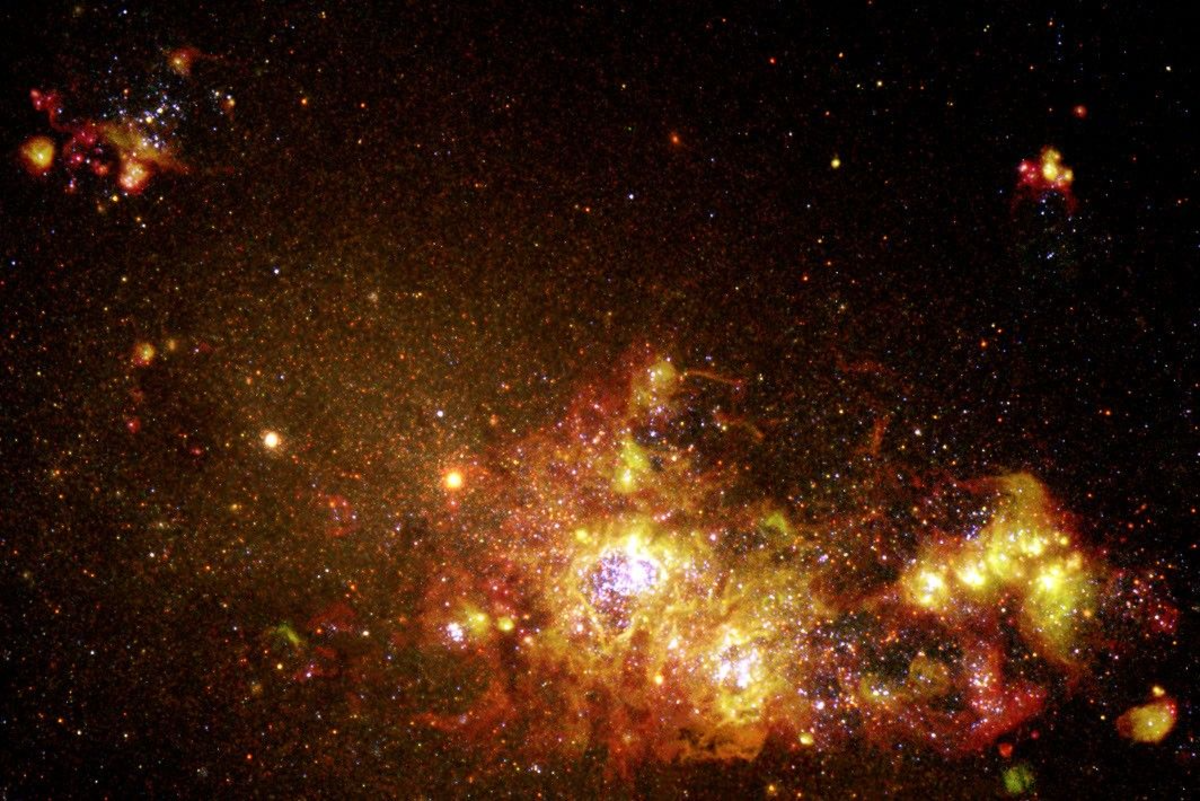
A small, ferociously star-forming galaxy observed by NASA’s Hubble Space Telescope has given astronomers their closest look yet at how the early universe burned away its primordial hydrogen fog — and the finding arrives just four days after its June 23 publication in The Astrophysical Journal, confirming what many researchers had considered physically impossible.
The galaxy, designated MXDFz4.4, existed just 1.4 billion years after the Big Bang. Hubble detected ionizing ultraviolet light escaping from it in a direct measurement that no previous telescope had achieved this close to the Era of Reionization. Before this finding, the earliest galaxy from which escaping ionizing radiation had been measured existed when the universe was 1.6 billion years old. MXDFz4.4 pushes that frontier 200 million years deeper, landing just 250 million years after reionization itself concluded.
“Observing a galaxy like this was thought to be impossible,” said lead author Ilias Goovaerts, a postdoctoral fellow at the Space Telescope Science Institute (STScI) in Baltimore. “Researchers expected the fog of neutral hydrogen that filled the early universe would be too thick and obscure our view of its ionizing light.”
Why Measuring This Light Requires Hubble to Stand at a Cosmic Sweet Spot
The reason no earlier detection was possible — and why this one required Hubble specifically — comes down to a fundamental physical barrier. During the actual Era of Reionization (approximately 400 million to 1.1 billion years after the Big Bang), the intergalactic medium was itself still thick with neutral hydrogen. Any ionizing photon produced by a galaxy during that period would be absorbed almost immediately by the surrounding gas before it could travel the billions of light-years needed to reach a telescope on Earth. Direct measurement of how much ionizing light escapes from reionization-era galaxies is, in effect, physically impossible: the fog that the galaxies were trying to clear would swallow the evidence of the clearing.
By the time the universe was 1.4 billion years old — the epoch when MXDFz4.4 existed — reionization had recently ended. The intergalactic medium had grown thin enough to let ionizing photons through. That places MXDFz4.4 in a narrow observational window: recent enough that the gas had cleared, but early enough that the galaxy’s properties still faithfully reflect the physics of the reionization era it had just exited. It is the closest proxy measurement to reionization that the laws of physics permit.
A second engineering constraint made Hubble uniquely suited to this detection. MXDFz4.4’s intrinsic ultraviolet light — photons with wavelengths shorter than 91.2 nanometers — was stretched by more than 12 billion years of cosmic expansion by the time it reached Hubble’s mirror. The expansion factor at redshift z = 4.442 is approximately 5.4, which shifts that UV light into visible wavelengths around 490–500 nanometers — precisely the range where Hubble’s Advanced Camera for Surveys excels. What began as ultraviolet radiation arrived as blue-green visible light, and Hubble’s optical sensitivity caught it.
How a Galaxy a Hundredth the Size of the Milky Way Lit Up Its Neighborhood
MXDFz4.4 covers an area roughly 100 times smaller than the Milky Way. Despite that, it was generating new stars at a rate approximately 10 times faster. The explanation lies in density: the young, massive, hot stars it produced were crammed into an extraordinarily compact region, creating a furnace of ultraviolet radiation concentrated in a small volume.
Goovaerts and co-author Marc Rafelski — Hubble’s deputy mission head at STScI — found that the galaxy’s stars formed not continuously but in a series of discrete bursts. Each burst wave created a fresh surge of ionizing photons. Crucially, the team used data from NASA’s James Webb Space Telescope to analyze older stellar populations and confirm the bursty star-formation pattern; Hubble alone could not have established that history.
Those same massive stars that produced the ionizing light also ended their short lives violently. A star many times the mass of the Sun burns through its fuel in a few million years and then detonates as a supernova, each explosion releasing an enormous amount of energy and blasting a cavity through the surrounding gas. Those cavities opened low-density channels — pathways of least resistance through which ionizing photons could stream out into intergalactic space without being absorbed. The researchers estimate that between 50 and 100 percent of MXDFz4.4’s ionizing light escaped into the surrounding medium during the period they studied.
That escape fraction — the share of ionizing photons that actually reach the intergalactic medium rather than being swallowed by the galaxy’s own gas — is the quantity cosmologists most urgently need to nail down. It is the last key unknown in understanding how reionization actually worked.
Three Telescopes, Three Layers of Evidence
No single telescope could have produced this result alone. The researchers assembled a three-instrument picture of MXDFz4.4, with each contributing what only its design could provide.
Hubble’s optical detectors captured the redshifted ultraviolet light — the escaped ionizing radiation itself — after sifting through deep archival exposures from multiple long-term surveys of the same patch of sky. Those stacked exposures, accumulated over years of Hubble operations, provided the sensitivity required to pick out the faint signal from a galaxy 12.37 billion light-years away.
The James Webb Space Telescope supplied the infrared data needed to characterize the galaxy’s older stellar populations — cooler, less massive stars invisible to Hubble’s optical instruments. Comparing Webb’s picture of MXDFz4.4’s old stars against Hubble’s picture of its young, hot stars let the team reconstruct the full star-formation history, including the bursty pattern that produced successive waves of ionizing radiation.
The third instrument was MUSE — the Multi Unit Spectroscopic Explorer mounted on the European Southern Observatory’s Very Large Telescope in Chile, the survey whose name gives MXDFz4.4 its catalog designation (MUSE eXtremely Deep Field). MUSE provided the precise spectroscopic measurement that pinned the galaxy’s redshift to z = 4.442, placing it definitively at 1.4 billion years after the Big Bang.
“Without Webb to clarify what we saw in Hubble’s images, we couldn’t make these conclusions,” said Rafelski.
What the Escape Fraction Measurement Means for Cosmic Reionization
The broader scientific question MXDFz4.4 advances is one of the oldest in modern astrophysics: where did the light come from that ended the universe’s dark ages?
Reionization took place over hundreds of millions of years. Ionizing photons gradually stripped electrons from neutral hydrogen atoms in the intergalactic medium, turning an opaque fog into the transparent cosmos observable today. The process was not driven by a single source; it required an enormous, sustained supply of ionizing photons spread across the observable universe.
Two broad candidates have long competed for the dominant role: rare, luminous objects such as quasars and active galactic nuclei, which are individually powerful but comparatively few in number; and the vast population of small, faint, intensely star-forming galaxies, which individually produce less ionizing radiation but are far more numerous and distributed throughout the early cosmos.
MXDFz4.4 is not a quasar. It is exactly the kind of small, bursty, compact galaxy that the latter hypothesis requires. And its escape fraction — 50 to 100 percent — is strikingly high. If the broader population of small, bursty galaxies that existed at the edge of the reionization era produced and released ionizing photons at comparable rates, the collective output would be sufficient to drive the phase transition the universe underwent.
“Hubble’s observations of MXDFz4.4 let us test our hypotheses much closer to the Era of Reionization than ever before,” Rafelski said. “Finding more galaxies, especially at slightly later cosmic times where larger samples are within reach, would let us refine these measurements and figure out what cleared our view as that era was ending.”
The study, published June 23, 2026 in The Astrophysical Journal, also introduces a methodological contribution beyond the single galaxy detection: it is the first test at high redshift of whether the spatial spread of Lyman-alpha emission — a type of UV light from hydrogen atoms — can serve as an indirect indicator of ionizing photon escape. At redshifts where the intergalactic medium is still too opaque for direct detection, such a proxy could become the primary tool for mapping escape fractions during the reionization era itself.
What Comes Next: Bigger Samples, Sharper Answers
Future campaigns with both Hubble and JWST are expected to search for more galaxies of the MXDFz4.4 type — compact, bursty, high-escape-fraction sources at similar and slightly later cosmic times. A statistical sample large enough to draw firm conclusions about the escape fraction distribution across the faint galaxy population would finally resolve whether small galaxies alone drove reionization, or whether larger, rarer sources contributed significantly.
After more than three decades in orbit, Hubble remains the only observatory capable of directly detecting redshifted Lyman continuum photons from this epoch — and MXDFz4.4 suggests the population of galaxies that used that light to clear the early universe is still waiting to be found.
Frequently Asked Questions
What is the Era of Reionization, and why does it matter?
The Era of Reionization was the period in cosmic history — roughly 400 million to 1.1 billion years after the Big Bang — during which neutral hydrogen gas in the intergalactic medium was ionized by light from the first stars and galaxies, transforming an opaque universe into the transparent one we observe today. It is considered one of the most important phase transitions in cosmic history because it set the conditions under which all subsequent galaxy formation occurred, including the galaxies that eventually formed the Milky Way.
What cleared the hydrogen fog in the early universe?
Astronomers have long debated whether the primary drivers of reionization were rare but powerful quasars or the vast population of small, intensely star-forming galaxies. MXDFz4.4 provides the most direct evidence yet that compact galaxies with bursty star formation — which generate repeated waves of ionizing radiation and use supernova explosions to open escape channels through surrounding gas — were capable of reionizing their local neighborhoods. If they were representative of a broader population, small galaxies may have been responsible for most of the reionization of the universe.
Why can’t astronomers simply look further back and measure escape fractions during reionization itself?
During the actual Era of Reionization, the intergalactic medium was still filled with neutral hydrogen, which absorbs ionizing photons. Any ionizing light produced by a galaxy during that era would be swallowed before it could reach us — making direct escape fraction measurement physically impossible at those distances and redshifts. MXDFz4.4 at z = 4.442, observed 1.4 billion years after the Big Bang, sits in the nearest usable window: just after reionization ended, when the gas had cleared enough to let ionizing photons through, but early enough that the galaxy’s properties still reflect conditions at the reionization boundary.
How does Hubble detect ultraviolet light from 12 billion years ago?
MXDFz4.4’s intrinsic ultraviolet radiation has been stretched to longer wavelengths by the expansion of the universe over the 12.37 billion years it has traveled. At redshift z = 4.442, the expansion factor is approximately 5.4, which shifts the galaxy’s ionizing UV light (wavelengths below 91.2 nanometers) into blue-green visible light (around 490–500 nanometers) — precisely the range where Hubble’s Advanced Camera for Surveys is most sensitive. The UV became visible, and Hubble caught it.