
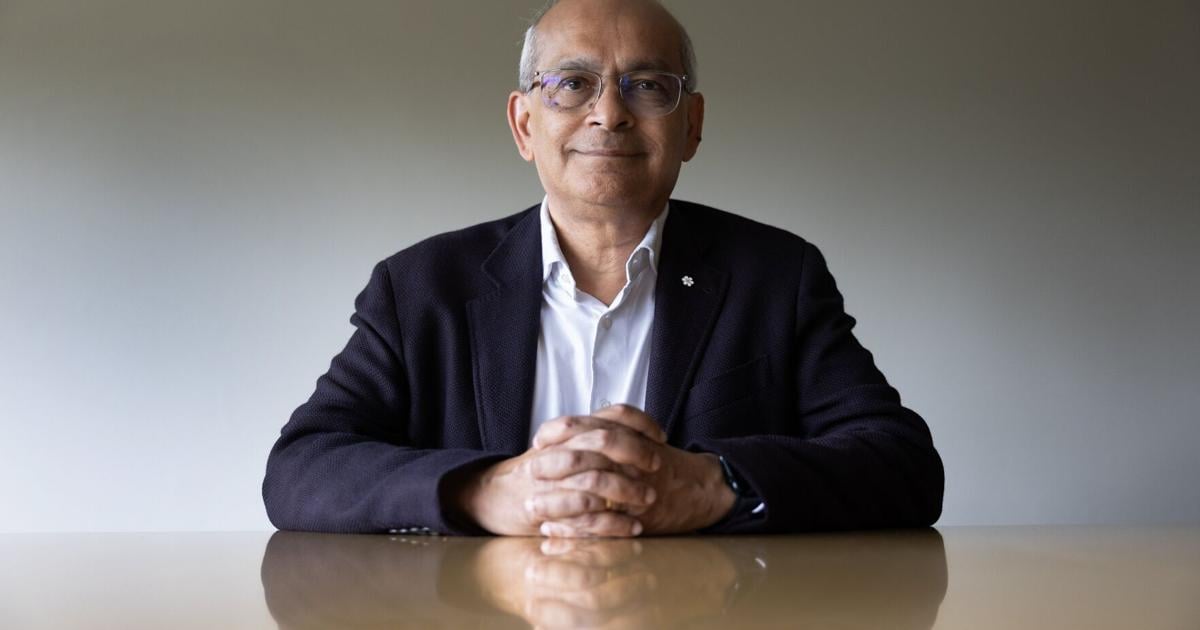
The paintings are off the wall. The desk is cleared. The cabinets are empty, ready for his successor.
Vivek Goel — no tie, top button undone, a flashy pair of custom University of Waterloo sneakers on his feet — is ready to step down on June 30, after five years as president. His tenure began amid a global pandemic and ends in a world transformed by artificial intelligence, geopolitical upheaval and a fundamental rethinking of universities’ place in society.
“It was a very strange time,” Goel said of his arrival on campus. “I remember coming to campus, doing tours of the buildings, and they were all empty. The first year was a challenging year because we were continuing to deal with vaccine issues, people being allowed to come to campus — but it was also challenging because there wasn’t a sense of community, and everything existed in these little boxes on a screen.”

University of Waterloo president Dr. Vivek Goel wears Warrior-branded shoes as he spoke about his time in the post, Wednesday, June 24, 2026.
Mathew McCarthy/Waterloo Region Record
Drawing on his background in public health — he was the founding president and CEO of Public Health Ontario from 2008 until 2014 — Goel said he tried to use that expertise to help guide Waterloo through the crisis. They were challenging times, and mandates and policies were questioned as faculty and students yearned to return to the classroom.
Now, he sees the pandemic differently than he did while living through it.
“When we were in the pandemic, we thought this was such a disruption to society, but it was time-limited. When we were in it, we couldn’t necessarily see the end, but we did get through it,” he said.
“The pace of change thereafter has really been unlike anything we have seen before in history.”
AI has become one of the defining issues of Goel’s presidency. He chaired the Council of Ontario Universities’ AI Task Force, and the question driving that work was a simple one, he said: “What have we done to prepare students for the world they are facing?”
His answer focuses on what he calls human skills.
“I see human skills as the essential skills. Call them soft skills — critical thinking, collaboration, problem solving, curiosity — those are the skills that are essential,” he said. “AI can answer questions, but they can’t tell you what questions to ask.”
He draws a sharp line between what machines can do and what people still must.
“Memorizing and solving equations, that’s what AI can do. But building things, working in teams across disciplines to find new problems and then solve them — those are the things that humans can do.”
Goel is not convinced every institution will adapt quickly enough to survive what’s coming.
“I don’t know that all universities will persevere. It will require significant change because the nature of work, the nature of society, is going to change in the coming years,” he said. “We’ve had changes throughout history; the difference is the time interval of when technology is introduced to when it is adapted into society has changed from a few centuries to a few decades to a few years and now on a monthly basis.”
Still, he believes the core purpose of a university will endure, even if the way that happens continues to move away from the traditional classroom.
“Where I feel confident is that what universities do for young adults — developing those human skills — is still going to be needed,” he said.
University of Waterloo president Dr. Vivek Goel spoke about his time in the post, Wednesday, June 24, 2026.
Mathew McCarthy/Waterloo Region Record
Beyond AI, Goel said, the financial pressures facing Canadian universities were building long before the recent international enrolment cuts.
At Waterloo, a three-year plan to return to a balanced budget is underway after years of growing deficits and cost-cutting efforts.
“This was a challenge that had been coming to our institutions for a number of years, and it was masked because we were able to identify new revenue streams like international students, but the underlying challenge of declining public supports has been there,” he said.
He said this isn’t a partisan issue, or even a uniquely Canadian one — it’s playing out across provinces, and across American states as well. In Ontario, the problem has been compounded by enrolment caps and a tuition freeze introduced in 2019 — one that has been removed starting in 2026-27, allowing for modest increases.
“Every institution was going to have to deal with this at some point,” he said.
At its core, he said, it’s a revenue problem — “if you’re constrained in how many students you can admit, if you’re constrained in the price you can charge, and you live in an environment where there is inflation, you’re going to reach a point of unsustainability.”
Recent provincial investment has eased some of that pressure, Goel said, but new solutions are still needed and are already being considered at the university — international degree partnerships, online programs and other forms of transnational education that extend Waterloo’s reach beyond its physical borders.
These decisions will now lie with incoming president Bill Rosehart, who starts his term on July 1.
Though he is stepping down as president, Goel isn’t leaving the university. He will remain on the faculty, working on health innovation and technology, and he has been appointed to the board of the Waterloo Regional Health Network, where he’ll help build connections as a new hospital is constructed on campus.
Becoming a university president was never part of the plan, he said — the idea only took shape once he moved further into senior administration roles.
“In terms of the administrative part of my career, it’s a great way to cap my career,” he said. “One of the things I’ve really felt here is that the community values having the universities — (Wilfrid Laurier University) and Waterloo. That’s not always the case when I talk with my peers across Ontario and across Canada.”
University of Waterloo School of Optometry and Vision Science director Stan Woo, left, poses with University of Waterloo president Vivek Goel, right, during a groundbreaking ceremony for the Waterloo Eye Institute on Friday afternoon.
University of Waterloo
Times on campus weren’t always easy.
“We’ve had the impacts of various conflicts — we had the encampment and the challenges around that, and we had the knife attack, which really reflected a broader set of societal issues — and then this past year and a half with Donald Trump and the world order ultimately being turned upside down.”
Goel took a hard stance in his dealings with the pro-Palestinian “Occupy UWaterloo” encampment at the University of Waterloo in 2024. After failed negotiations, the university issued a trespass notice, and filed a lawsuit in late June seeking an injunction to clear the camp and $1.5 million in damages for trespass and property damage.
After nearly two months occupying the campus location, protesters agreed to voluntarily decamp in exchange for the university dropping its legal injunction and civil lawsuit.
In 2023, an assailant entered a gender studies classroom in Hagey Hall and stabbed associate professor Katherine Fulfer and two students. Geovanny Villalba-Aleman, 25, was sentenced to 11 years in prison, but calls on campus were strong to increase safety.
The attack sent shock waves through the university community and led to a large security review about what it shares publicly about instructors and course locations, as well as its emergency notification system.
Of everything he’s done in the role, Goel says he’s most proud of his work on truth and reconciliation, and on equity, diversity and inclusion — work that became more fraught as political winds shifted.
Under his leadership, Waterloo created the Indigenous Strategic Plan 2023-2028 and secured full tuition waivers for local First Nations students.
Goel also led Waterloo to become a signatory to the Scarborough Charter on Anti-Black Racism and Black Inclusion in Canadian Higher Education in 2021, while also backing institutional restructuring that created the associate vice-president of equity, diversity, inclusion and anti-racism role and embedding EDI principles into the university’s long-term “Waterloo at 100” vision and core values.
“When I started, it was a period of time where there was a lot of concern and attention,” he said. “Regardless of how the political winds blow, we as an institution remain committed to those principles.”
Goel said Canadian university presidents were preparing for an upheaval leading up to the last federal election.
“There were a lot of conversations happening across institutions in Canada about what they would do if the Conservatives won — Pierre Poilievre was clear he would scrap EDI,” he said.
Liberal Prime Minister Mark Carney was ultimately elected, but Goel said there is no guarantee future leaders won’t one day cut funding for EDI initiatives.
“I think what’s important is laying down the values and the principles,” he said.
The University of Waterloo’s associate vice-president, Indigenous relations, Jean Becker, alongside president and vice-chancellor Vivek Goel at the Truth & Reconciliation event on Friday, Sept. 30, 2022.
Bill Jackson
Some of his clearest moments of optimism, he said, have come while sitting on the convocation stage, watching students graduate.
He thinks often, too, about his two grandsons — one almost three years old, the other almost three months.
“People ask me, ‘Don’t you have despair about their future?’ And I don’t. I look ahead and they’re going to have so many opportunities in their future, and I see this as an exciting time to be alive.”
For all presidents who come after him, his advice is to look backward before moving forward.
When Waterloo was created in 1957, it was the height of the Cold War, the Space Race was on, computers had just been invented and local community members built Waterloo with a clear purpose in mind to help the world navigate these changes, he said.
“We’re at a very similar moment in time today,” he said. “So, understand our history, because that got us to where we are, and that will help us get through to the next period.”