

Listen to this article
Estimated 2 minutes
The audio version of this article is generated by AI-based technology. Mispronunciations can occur. We are working with our partners to continually review and improve the results.
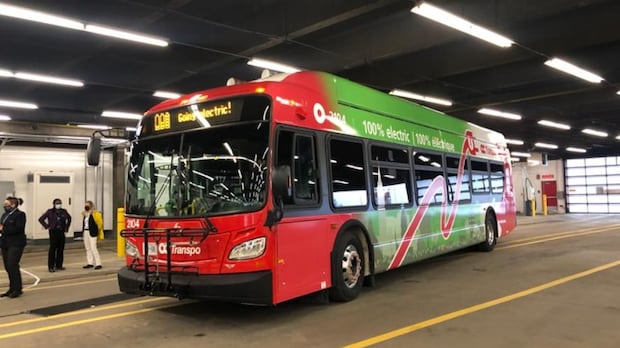
A software problem prevented dozens of OC Transpo’s electric buses from hitting the roads Saturday morning.
The issue kept 133 buses at the St. Laurent garage from charging properly overnight, leaving them unready for the start of service, the city told CBC in an email.
As a result, drivers and maintenance staff were forced to relocate Saturday morning to other garages not normally open on weekends, said Noah Vineberg, president of Amalgamated Transit Union Local 279.
“[It was] a scramble just for operators to be able to get to buses as quickly as possible and on time in order to serve the public,” he said.
The software issue “caused some electric buses to charge at a slower rate than normal,” wrote Troy Charter, the city’s associate general manager of transit services, in an email.
OC Transpo used shuttles to take operators to different garages, Charter said, and also deployed a number of buses not typically used on weekends.
That “quick action” minimized disruptions for riders, he said.
The affected electric buses still had enough power to move about the garage, the city said.
 Noah Vineberg is president of Amalgamated Transit Union Local 279, which represents OC Transpo’s operators. (Nathan Fung/CBC)City will review problem
Vineberg said it took extra time to get buses on the roads Saturday, partly due to how they’re parked in the garages.
“You can imagine a lot of these are are stationed in a garage bumper-to-bumper in all their charging portals,” he said.
“So even if even if it’s only a certain amount of them that [didn’t charge properly], the way they line up inside of [the garage] would affect whether or not they can go out.”
The software problem has been addressed, Charter wrote, and buses are charging normally now.
Monitoring is in place and no further service impacts are expected, he said, adding the city will review what happened.
While the issues appeared to have been resolved by the afternoon, Vineberg said the problem serves as a lesson that there needs to be better contingency plan in place.
He also said he’s surprised a warning system doesn’t exist if there’s a failure with the charging system.