
It started before the 2025 season, in a meaningless preseason game, the first indication the NFL was about to literally experience a kicking boom.
Jacksonville Jaguars kicker Cam Little hit the longest field goal in league history – a 70-yarder – in an Aug. 9 game against the Steelers. Because it was preseason, the kick didn’t count as an official record.
Little would get that soon.
Meanwhile, in Week 4, Tampa Bay’s Chase McLaughlin kicked two field goals against Philadelphia that were longer than his previous career high of 57 yards. The second was from 65 yards, the longest outdoor field goal in NFL history.
And it’s not just the NFL.
Tanner Brown booted two field goals of at least 60 yards on June 7 for the Louisville Kings of the United Football League. Not even Dallas kicker Brandon Aubrey, the king of long-distance field goals, has done that in the same game.
“Guys across the league are just smashing footballs right now,” said Steelers kicker Chris Boswell, who has a career long of 60 yards. “And it’s really cool to see.”
From 1960-2014, NFL kickers converted just 14 of 118 attempts from 60 yards or longer, a meager 11.9% success rate. In the past three seasons alone, they have connected on 14 of 37 attempts from 60-plus – that’s 37.8%.
Trying field goals from that distance is no longer a literal long shot at the end of a half. They are now starting to feel like mere formalities for kickers and their coaches, who don’t even bat an eye when their team reaches midfield.
“I like watching long balls,” said former Steelers kicker Shaun Suisham, who played for three teams in 10 NFL seasons. “It’s been incredible to see the impact it has had on the game.”
Boswell among the best
Eagles defensive coordinator Vic Fangio suggested the NFL should start putting an asterisk next to some of those long-range kicks after McLaughlin drilled his 65-yarder. He compared it to MLB’s live-ball era, when Barry Bonds, Sammy Sosa and Mark McGwire were breaking down fences with prodigious home runs.
Five weeks later, Fangio had more evidence.
In Week 9, Little officially claimed the NFL record for the longest field goal when he connected from 68 yards against the Las Vegas Raiders. That broke Justin Tucker’s record of 66 yards.
Unlike Little and McLaughlin, Boswell does not get to kick in warmer climates – where the ball compresses easier and flies farther. But Pittsburgh’s kicker has converted 52 of 63 attempts from at least 50 yards in his 12-year career.
At 82.5%, that is the highest percentage among kickers with at least 50 attempts since the AFL-NFL merger in 1970.
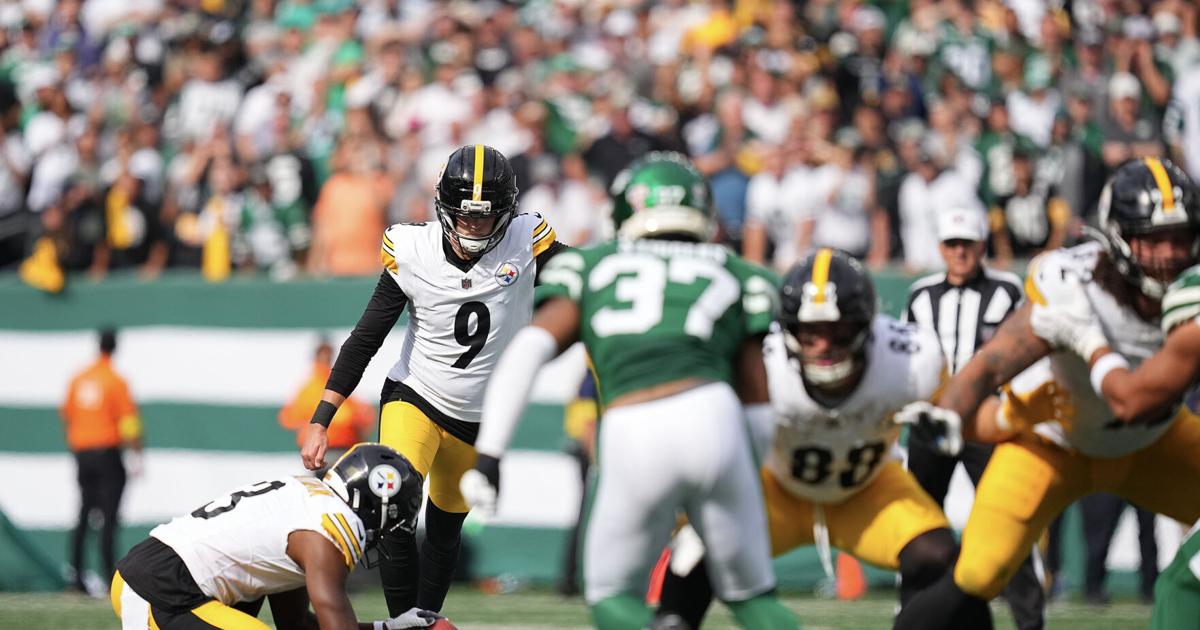
Boswell’s range has expanded as he has gotten older. At age 34, Boswell opened the 2025 season with a 60-yard field goal against the New York Jets, the longest of his career. His five longest kicks have all come during his 30s.
Two years ago, Boswell enjoyed the climate-controlled conditions of Mercedes-Benz Stadium in Atlanta while kicking field goals of 51, 56 and 57 yards among the team-record six he converted in a victory against the Falcons.
Afterward, offensive coordinator Arthur Smith said, “I’ve been around a lot of great kickers, and this isn’t a slight to anybody, but Boz is different than anybody I’ve been around.”
‘They can pound it’
Just two years ago, the league was buzzing about the number of field goals converted from beyond 50 yards – 35 of 39 – in the first two weeks alone.
Now, the boundaries are being pushed even further.
From 1970 through 2006, a period of 36 years, there were only six total field goals of 60 yards or more. Just last season, there were 12 of them.
There have only been six field goals of 64 yards or longer in NFL history. Three came in 2025.
Attempts in general are way up, too. In 2015, teams attempted 160 field goals from 50 yards and beyond. Last season, that number was 265 attempts.
“It’s really cool to see the position evolve the way it has,” former NFL kicker Michael Husted said.
Husted, who kicked in the league for nine seasons, founded the Husted Kicking school, where he has trained a handful of NFL kickers along with aspiring pros.
“The word ‘specialist’ is living up to its name nowadays,” he said. “I work with a lot of kids in middle school who give up every other sport to focus on kicking. It goes to show how specialized and evolved the position has become.”
Why is this happening now?
There are several reasons.
Kickers are bigger and more athletic than the days of Garo Yepremian and Pete Gogolak. Boswell is 6 feet 2 and 185 pounds. And Aubrey – whom Tom Brady has compared to Shohei Ohtani and Stephen Curry – is 6-3, 215. Aubrey has a record six field goals of 60-plus yards. He’s only been in the league since 2023.
And many, if not all, work with kicking coaches in the offseason.
“I think it’s a combination of players getting better, how they’re training. They’re getting bigger and stronger,” Steelers special teams coach Danny Crossman said. “I mean, you look at the size of the kickers now in comparison to what it was 10 years ago. They were all 5-8, 5-9.”
Today?
“They’re 6-1 to 6-3, long-levered and they can pound it.”
NFL’s own live-ball era
But maybe the biggest reason is a new NFL rule that was implemented last year regarding footballs used specifically for kickers, known as K-Balls.
Each team is given 60 K-Balls at the beginning of the season, a drastic change from the old rule in which teams were given three brand-new balls on game day.
Now, each team can break in the balls like a used catcher’s mitt. The balls can be kicked in practice and are subject to any number of devices – heat guns, buffing wheels – to soften the leather and rub down the bumps. The result is a wider sweet spot that allows for greater distance and increased accuracy.
“Being able to beat them in a couple weeks early – or a couple months early, however early we get them – helps a little bit,” Boswell said.
Each team has to give three K-Balls to the officiating crew before each game for approval. Once approved, the ball gets a special mark from the referee. Each K-Ball can be used for only three games before being retired.
Under the old rule, which existed from 1999-2024, teams had approximately 60 to 90 minutes before each game to work over the new kicking balls.
Crossman joked teams used to throw them in a dryer before the game to try to soften them. Now, they have plenty of time to beat them like a rug.
How far can they push it?
Thanks to the simple rule change, long field goals that were once considered improbable – if not impossible – are becoming commonplace in the NFL.
Cincinnati kicker Evan McPherson recently said a “really good, broken-in” kicking ball can add between 5 to 10 yards to an NFL kicker’s range.
“If you can compress the ball, it will go a lot further, and so I feel like that’s what we’re seeing,” McPherson told CBS Sports. “The balls are softer, more springy, and people are being able to compress it really well and not really have to try to hit these long field goals.
Maybe the league should consider a rollback in the ball similar to what is being proposed for the PGA Tour? After all, the NFL can’t build new tees.
Nine years ago, then-Green Bay coach Mike McCarthy sent kicker Mason Crosby in to attempt a 57-yard field goal against the Steelers at Acrisure Stadium. The Packers were leading 21-14 late in the third quarter.
McCarthy’s decision was questioned when Crosby, whose career long was 58, missed badly and set up the tying touchdown for the Steelers.
Seven years later, when he was coaching in Dallas, McCarthy sent Aubrey on the field to attempt a 71-yard field goal, then changed his mind.
It might not be long before 70-yarders become a regular occurrence.
“The range of kickers in the NFL has fundamentally changed the game,” said Suisham, who ranks 31st all time in field goal accuracy at 84.1%. “I find it incredible what the guys are doing at such a high level and a high rate of accuracy – with what appears to be done with ease.”