
As the Dominion of Canada approaches its 159th birthday on Wednesday, the country is having a moment on the world stage.
Canada is one of the hosts of the FIFA World Cup, along with Mexico and the United States. And our young, exciting, diverse men’s national team is soaring to new heights, showing we can compete with the best.
Of course, it would be un-Canadian to brag about it, but everyone is enjoying the ride. For once, we’re cheering for the sum of our parts, even if allegiances to our countries of origin die hard on the soccer pitch.
Prime Minister Mark Carney has also been turning heads internationally for speaking truth at a challenging moment in history.
His speech at the World Economic Forum in Davos in January earned him praise among the global elite (and earned Canada new allies) for his clear-eyed diagnosis of the “rupture” in the world order and his call for middle powers to “act together, because if we’re not at the table, we’re on the menu.”
Since then, Carney has been criss-crossing the planet to forge new trade, economic and defence partnerships.
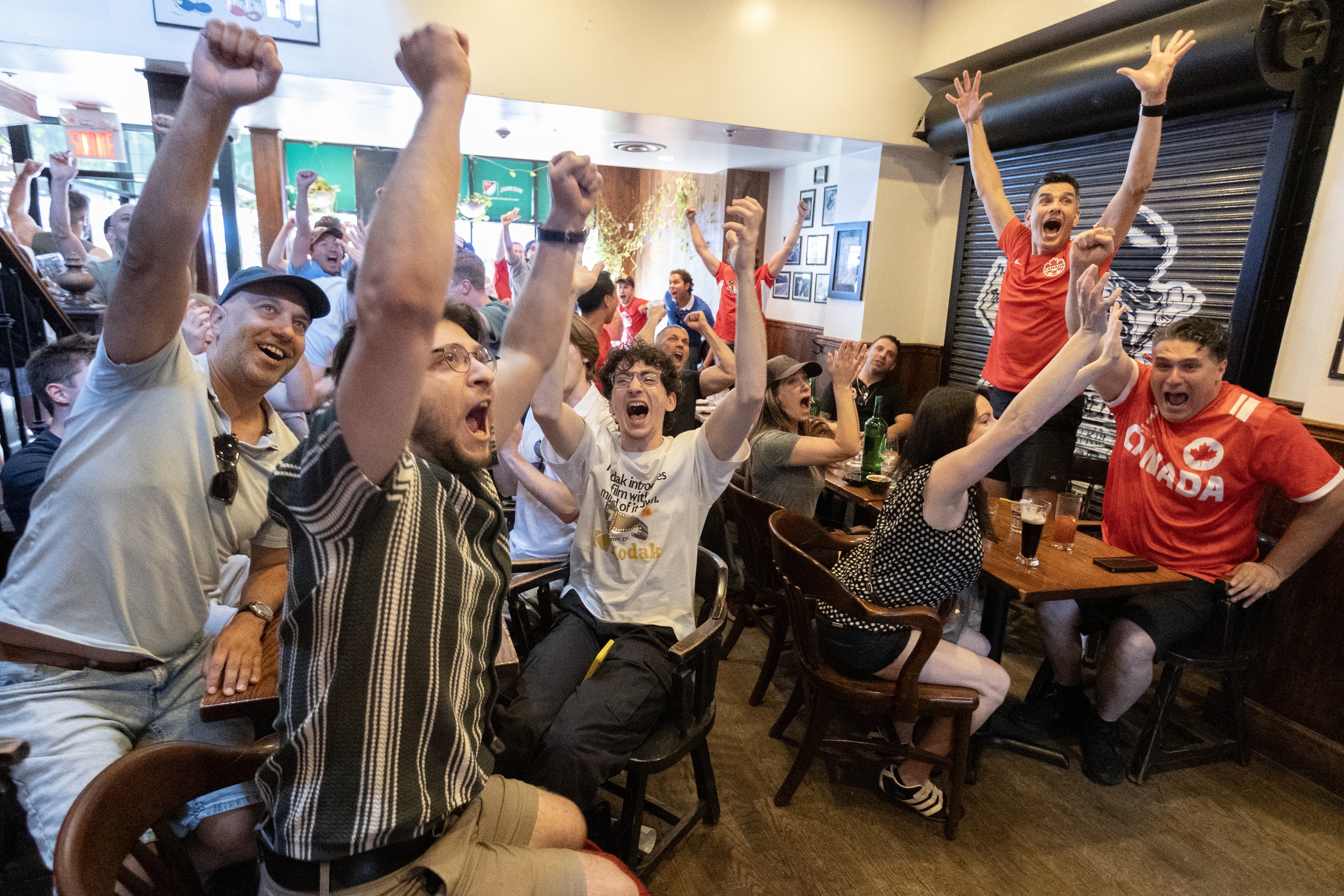 Fans react at the Burgundy Lion pub in Montreal as Canada scores the winning goal during a World Cup match against South Africa on Sunday, June 28, 2026. Canadians don’t tend to get loudly patriotic unless there’s a sports trophy on the line, but maybe it’s time to change that and counter those who want to tear the country apart, Allison Hanes suggests. Tim Snow / Montreal Gazette
The reasons for all this globe-trotting are dark clouds on the horizon. Since the re-election of Donald Trump as U.S. president, Canada can no longer depend on its next-door neighbour, ally and friend for our mutual prosperity and protection.
The deadline to review our most important trade relationship, the Canada–United States–Mexico Agreement, is Wednesday and Trump has said he’s not sure he wants to renew the deal. He’s slapped punitive tariffs on Canadian steel and aluminum and said America doesn’t need anything we make, from cars to furniture.
Most alarming, he keeps musing about making Canada the 51st state.
Yet the greatest peril to the True North strong and free may be from within.
National unity is again hanging in the balance after three decades of relative stability. But this time, there’s not one, but two separatist movements rallying to break up Canada.
Alberta Premier Danielle Smith kowtowed to secessionists by adding a question to a planned referendum on Oct. 19 on whether the province should remain in Canada — or hold another vote on leaving.
Although Smith claims to support a “sovereign Alberta within a united Canada,” it’s a dangerous gamble that could backfire. Just ask former U.K. prime minister David Cameron, who called the Brexit referendum even though he didn’t support leaving the European Union.
But first, Quebecers will hold a general election on Oct. 5.
Parti Québécois Leader Paul St-Pierre Plamondon has been topping the polls for months and vowing to hold a referendum on sovereignty within a first mandate.
In the meantime, St-Pierre Plamondon has been disparaging Canada at every turn. On a visit to France in June, he told a somewhat incredulous TV interviewer that the federal “regime” abuses its power and “there’s no democracy” under the Canadian Constitution.
He accused Ottawa of conducting “espionage” against sovereignists and characterized $10 billion in federal funding for infrastructure in Quebec as an attempt to buy votes. The PQ leader also slammed the planned high-speed rail link between Quebec City and Toronto as an effort to more tightly bind Quebec to the rest of Canada.
Although most Quebecers aren’t falling for his cynicism — and a majority don’t want another referendum — most of his negativity tends to go unanswered.
Even his grand vision for an independent Quebec has failed to draw the scrutiny it deserves. When he unveiled the PQ’s Livre bleu, there was little pushback on promises he would have no control over, like Quebecers maintaining their Canadian passports. And there was plenty of wishful thinking, like NATO or NORAD allowing Quebec to join or Ottawa negotiating away the Citadelle and military bases in Valcartier or Bagotville.
Hopefully the other parties are mustering their counter-arguments so Quebec doesn’t sleepwalk its way to sovereignty. Ottawa is likely to keep its nose out of the election campaign.
But the federal government has also been slow to respond to the brewing independence movements. Carney recently vowed to “make the case for Canada” ahead of Alberta’s referendum. Better late than never.
It’s about time for Canadians to speak up.
We don’t tend to beat our chests (unless there’s hockey hardware or a World Cup on the line). That doesn’t mean we don’t love our home and native land. We just don’t feel compelled to boast that we live in the best country in the world, despite its imperfections.
But perhaps we’re selling ourselves short with this subdued humility. Those of us who cherish Canada the most are often the quietest about it. But this cedes the floor to those with an axe to grind — and those who want to tear the country apart.
Editor’s Picks
In Alberta, the narrative of grievance has been noisy.
In this province, Canadian pride tends to take a backseat to the Québécois identity. Last fall, St-Pierre Plamondon chastised Quebec artists for daring to welcome Marc Miller as the new federal minister of Canadian identity and culture, accusing them of sucking up. The insult caused umbrage, but it still has a dissuasive effect.
Quebecers, however, are perfectly able to reconcile their dual identities, even if we’re not necessarily vocal about it.
Attachment to Canada is especially strong in response to Trump’s threats.
Maybe we also need to stand up to separatists who tell us Canada is broken.
Maybe we should avoid the trap of complacency that causes us to take this country for granted.
Maybe it’s time to talk about why this country works.
If there was ever a time to stand on guard for Canada, it’s now.
I started at The Montreal Gazette in 2000 as an intern. Since then I have covered the National Assembly and courts, worked on the assignment desk and written editorials, before debuting as city columnist in 2017.
ahanes@postmedia.com