
Kavanaugh voted to strike the birthright order – but also said it was constitutionalpublished at 16:48 BST
16:48 BST
Lisa Lambert
BBC News
Conservative Justice Brett Kavanaugh joined five other in voting against Trump’s executive order, but his reasoning was all his own.
“In my
view, the Executive Order does not violate the Fourteenth
Amendment,” he wrote in an opinion explaining his divergence. “The constitutional issue
is not straightforward, much as we might want it to be.”
Basically, Kavanaugh’s problem with the executive order stems from immigration legislation passed early in the 20th century – the Nationality Act of 1940 and Immigration and Nationality Act of 1952. Lawmakers used language from the 14th amendment and also parts of the Court’s Wong Kirk Ark decision in 1898 that created four exceptions to the amendment (such as someone born to a foreign sovereign is not a citizen) in their legislation.
For Kavanaugh, that means creating further exceptions for the children of illegal immigrants or people in the US temporarily should be an act of Congress – not a presidential order.
Then Kavanaugh lays a possible case at to why Congress should pass a law on those two exceptions.
The Constitution is applied “to modern situations
that were unknown or unanticipated by the Constitution’s
Framers”, and the crafters of the 14th amendment after the Civil War could not have foreseen current issues with immigration, he argues.
They could not have anticipated – or even intended – the US would grant citizenship to children whose parents break the law in coming to the country, but deny citizenship to people “who follow US immigration law and have children in their home countries
while seeking to lawfully immigrate to the United States”.
It also would have been hard to imagine people traveling to the US temporarily to give birth to babies, and thereby make them citizens, given how different travel and immigration laws were when the amendment was ratified in 1868, he says.
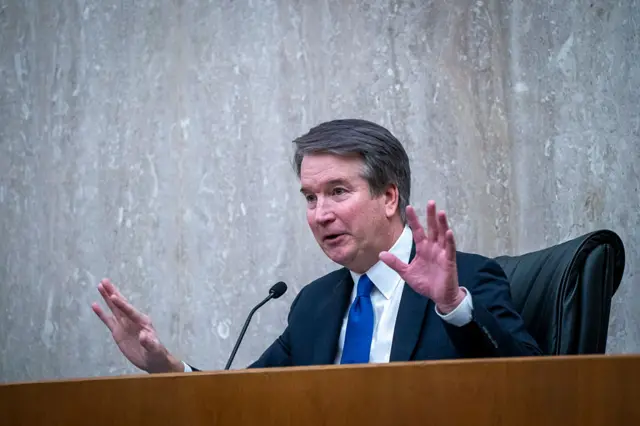 Image source, Getty Images