There are very few places in the world of tennis where you can press your fingerprints on a Grand Slam trophy. Above us loomed New York City’s Arthur Ashe Stadium — the largest stage the sport has ever built, a 23,000-seat coliseum where matches thunder like theater or war. And yet, in the quiet corridors beneath it, where the players and the media converge, after his US Open triumphs, Novak Djoković would ritually pass his championship crown into the hands of a small circle of Serbian tennis writers, myself among them. He offered the silver prize around like it was a family relic; we circled it with cameras, smudging its surface with our awe. That was Djoković’s gift—not just the wins, but the luminous intimacy of letting us hold those wins, as though greatness were something that could be shared.
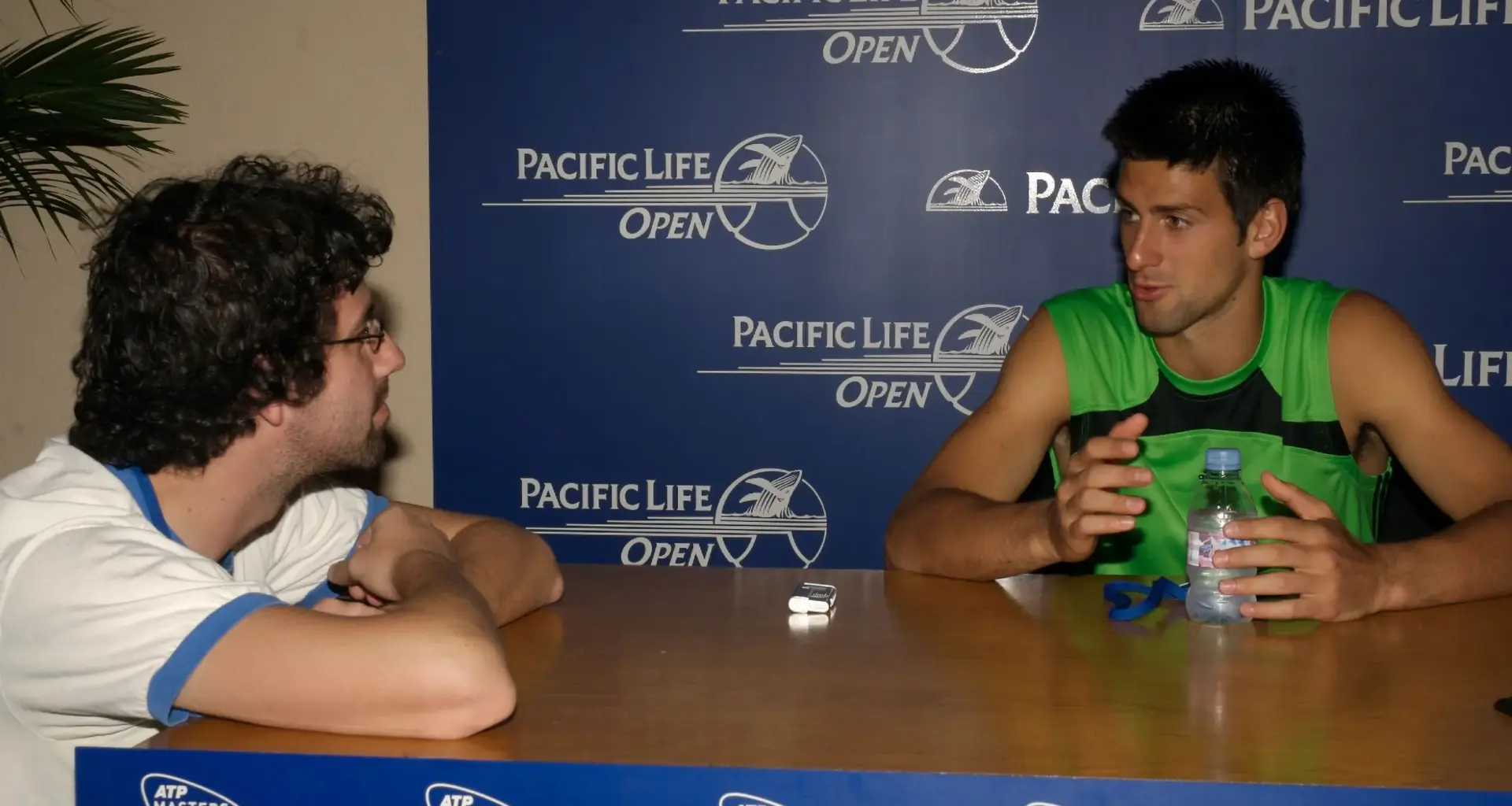
The first time I met Novak Djoković, it felt more like a play than a story. This was 2003, his first US Open as a junior, my first as a writer—long before he became the sport’s winningest player. By the time I walked up after his quick loss, his tennis bag was unmoored, his emotions unready, lamenting in half-whispers that his backhand wasn’t working. As dusk was settling over the court, boundaries between personal and professional dimmed as quickly as the light. “You’ll get it back,” I said, pirouetting a backhand for him — advice as earnest as it was misplaced: “You have to follow through more with your body.” When we spoke at his next US Open, it was no longer just him and me, but a press room lit with reporters, bright lights, and microphones.
I would frequently help the stenographers correct their transcripts after Djoković had been interviewed. It’s not so much his language—Djoković can, quite remarkably, converse well in English, Italian, German, French and Spanish—but the unfamiliar Serbian cultural footprints. The very challenge they had is what makes the interviews with Djoković looser, stranger, mercurial in my notes: when the interview shifts to Serbian. With the score, strategy and statistics having been spent in English, talking in Serbian would offer a shortcut, a code for the shadows and margins of tennis life, questions of rhythm and ritual, the unseen machinery that keeps a player’s mind intact.
Somewhere in my garage in East Dallas, I still have the boxes from the chocolates Novak handed the Serbian press after winning the trophy in 2018. The media room, usually a space of formal theater, loosened that evening into something closer to a shared table. I remembered his last title celebration when this same media room briefly shed its armor, so this time I came prepared. I snuck in a bottle of Serbian plum brandy—our national drink, the taste of history and survival—a quiet offering for the winner, his team, all of us. I later wondered what the watchful stenographers in the corner made of it.
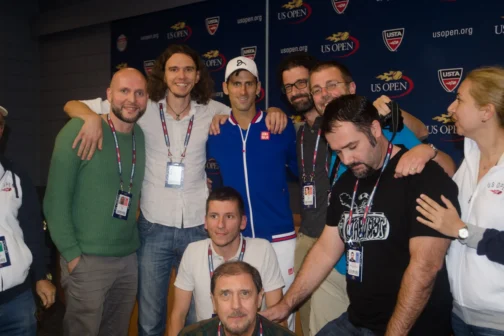
Djokovic with tennis reporters in 2015.
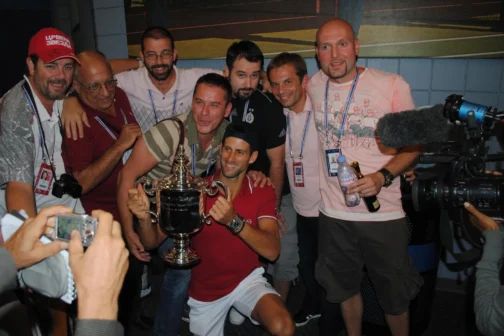
After Djokovic’s first US Open win in 2011.
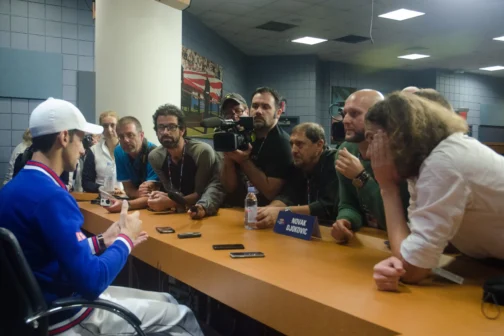
Djokovic and reporters in 2015.
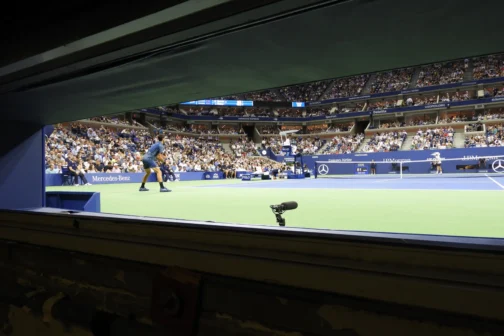
A view from the 2018 US Open press box.
When Djoković practices back home in Serbia’s capital, Belgrade, it is sometimes at the clay courts right across the street from my apartment, the very place where I had fallen in love with tennis as a kid. It was a somewhat subconscious enchantment, lulled to sleep by the metronomic pulse of bouncing balls, my childhood bedtime tethered to the court’s towering nightlights. I thought of those sounds again here at the US Open, when I watched a blind spectator carefully make her way down to a seat in the lower tier of Arthur Ashe Stadium — stepping directly into my story for that day. I shared this with Djoković and asked him about experiencing tennis by sound alone. We talked about hidden frequencies in our game, the distinct sounds tennis gifts us — how the one-handed backhand can sound like a champagne cork popping, especially when played here, in the sport’s largest amphitheater.
It is Djoković’s rare ability to make space for themes like these, to invite us into a dialogue not just about shattering tennis records but about the textures of the game. His words on those subtler topics — carried in my notes, my recordings, my memory — felt like proof that they belonged in our sport. As if Djoković were waving me through a hidden gate, I followed tennis toward the places where quieter stories lived: the off-limits seats just behind the umpire’s chair, the photographer’s pit cut into the baseline, the players’ lounge where Djoković played chess, or the small, unadorned office where millions in prize money were dispensed without fanfare.
World-class athletes alter everything around them. His matches bend my behavior, changing not only how I write about tennis but how I watch and feel it. For decades I’ve held to a secret pact with Djoković: no bathroom breaks, no distractions, no food runs — rooted to my stadium seat until his match was finished. The one selfie I have with Novak was after he beat Juan Martin Del Potro for the 2018 championship. The picture is hurried and blurry, our enthusiasm crowding the frame from all sides, shaking the camera. The trophy didn’t make it into this shot, but it remained the quiet reason it existed at all. After two decades of conversations, Djoković leaves me with the same trace — stories and rituals set in motion by his gravity, whether or not he is in the room.
Author