

Listen to this article
Estimated 4 minutes
The audio version of this article is generated by AI-based technology. Mispronunciations can occur. We are working with our partners to continually review and improve the results.
Winnipeg’s chief of police says he directed officers to move away from areas offering services to people struggling with addictions and homelessness amid concerns from outreach workers.
Gene Bowers said the change came before a meeting with front-line groups Monday, midway through a 10-day, “zero-tolerance” enforcement initiative targeting areas where there’s open drug use and trafficking.
“There was some frustration in the room, for sure,” he said Tuesday.
“I really wanted to listen — and I heard them, and I want to ensure that … we’re working together, not against one another.”
Bowers made the comments during a media event with Assembly of Manitoba Chiefs leadership in which police unveiled a cruiser that will be used in community events such as powwows and parades.
He told reporters police are “going to reassess” their approach to the crackdown after the initiative wraps up Friday.
“Definitely, now we’re at the table,” Bowers said. “We’re going to be able to speak together on …what we do next and how does that look for the community.”
The initiative was announced as community members and businesses called on officials to address open drug use and vandalism in the downtown area.
A group of several outreach organizations raised concerns, saying it appeared front-line services were not consulted and that arresting people near where they access supports forces them elsewhere and puts them at risk.
WATCH | Patrols to avoid areas offering services to vulnerable Winnipeggers: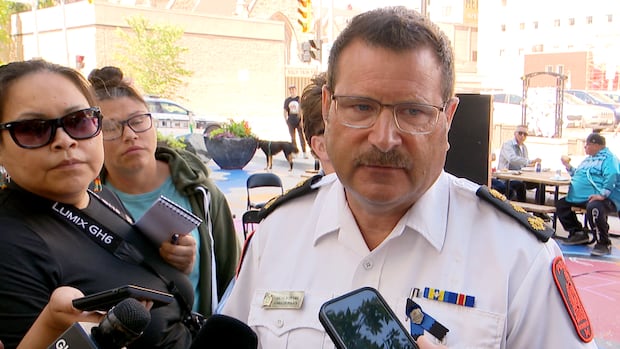
Patrolling police to avoid areas offering services to vulnerable Winnipeggers
It’s been nearly a week since police began increasing patrols in areas of Winnipeg affected by open drug use and trafficking. Community groups critical of the approach met with police Monday to discuss solutions going forward.
Dr. Marcia Anderson, vice-dean of Indigenous health at the University of Manitoba’s Rady Faculty of Health Sciences, said it’s unlikely people will stop using drugs because of enforcement-based measures like the 10-day crackdown.
“So, we have to ask ourselves, where are they going to be using drugs instead?” she said Tuesday. “Are people going to be overdosing somewhere else where these safety mechanisms are not as available?”
Anderson said she is pleased police are open to feedback as communities face significant challenges from a toxic drug supply and rising homelessness.
“What we’re really called to do, and what’s really challenging to do is, to hold public safety and public health together at the same [time], especially when it seems like they might be in conflict,” she said.
“I think it’s really important that we be data-driven and evidence-based. And so, we have to think about who is being most impacted by threats to [public] safety and what kind of harms or threats to safety are there.”
Advocates call for more training
Jackie Anderson with Ka Ni Kanichihk — one of the organizations that raised concerns about the initiative — was among the outreach workers who met with Bowers on Monday.
She said the workers suggested training patrols on trauma-informed practices and the importance of harm reduction, as well as building relationships with the community.
“I know that the police get a lot of phone calls,” she said in an interview with Up to Speed.
LISTEN | Outreach organizations meet with Winnipeg police to discuss crackdown:
Up To Speed14:09Winnipeg police meet with organizations critical of their crackdown on open drug use
Jackie Anderson, the Executive Director of Ka Ni Kanichihk, speaks with host Faith Fundal about their concerns with the Winnipeg Police Service’s 10-day enforcement crackdown on open drug use, and how a meeting between police and several community organizations on the frontlines of the drug crisis went.
“I felt that it’s really important that … police start coming to our different resources, no uniforms … so that when they are educating or responding to calls in the community that they’re coming with that first-hand knowledge.”
Bowers said Winnipeg police will be looking into more training and that he is committed to collaborating with the front-line workers in the future.
He said the issue is complex.
“We admit … we can’t police our way out of it,” Bowers said. “But there has to be a [balance]…. There has to be social services, there has to be some enforcement.”