
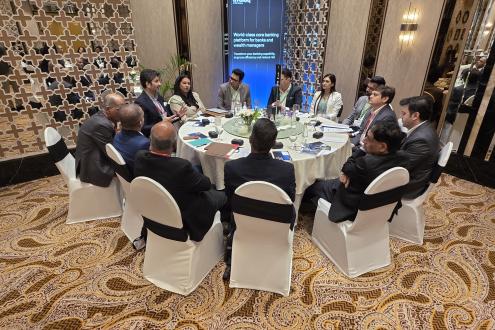
Hosted by Akash Anand, Managing Director – Region Middle East, Africa and India at Avaloq, the table explored “AI-Driven Wealth – From Concept to Execution”. The discussion brought together senior participants from private banking, domestic wealth management, broking-led wealth platforms, investment advisory, structuring, estate planning, product, operations and technology.
The conversation reflected an industry that has moved beyond asking whether AI will affect wealth management. The more immediate question is how firms can apply it safely, commercially and at scale. Participants discussed AI as a tool for RM productivity, client preparation, portfolio analysis, operational automation, workflow execution and business model efficiency. Yet the table also returned repeatedly to the constraints that will determine whether AI becomes genuinely useful: data governance, fragmented systems, platform architecture, internal adoption and the enduring role of human judgement.
The central issue was not whether AI can improve Indian private wealth management, but whether firms have the operating foundations to use it properly. Participants suggested that the next phase will require more than experimentation. It will demand a shift from isolated use cases towards governed, integrated platforms that can support the adviser, protect the client and reduce the structural inefficiencies that sit beneath today’s growth.
Key Takeaways
AI has moved from concept to execution: Participants treated AI as an immediate operating priority, not a distant technology theme. The focus has shifted to practical deployment across advisory, operations, compliance and client engagement.
RM productivity is the first obvious use case: AI can help advisers prepare for meetings, analyse portfolios, anticipate client questions, generate talking points and reduce the time spent on routine preparation.
The larger opportunity is front-to-back transformation: Several participants argued that AI should not be confined to front-office enablement. Its real value may lie in linking advisory, operations, compliance, servicing, settlement and workflow execution.
Clients are already AI-enabled: Advisers increasingly face clients who use ChatGPT, Claude, Gemini and other tools to test recommendations, compare views and challenge portfolio advice.
Data governance is non-negotiable: The table was clear that client information cannot be pushed into public AI tools. Internal architecture, controlled environments and clear usage rules are essential.
Fragmented systems remain a major barrier: Multiple platforms, product silos, disconnected fintech tools and limited internal straight-through processing make it harder for firms to create a single client view or deploy AI effectively.
Agentic AI changes the ambition: Participants moved beyond generative AI as a text-response tool and discussed the potential for AI agents to execute tasks, connect systems and support full workflows.
Human judgement still matters, but the adviser role must evolve: AI will not remove the need for trust, empathy and interpretation in HNI and UHNI relationships. It will, however, expose advisers who cannot add value beyond information delivery.
Setting the Scene: What is WealthTHINK?
WealthTHINK is an exclusive, invitation-only forum designed for CEOs and senior management at leading private wealth management firms. It provides a platform for industry leaders to engage in peer-to-peer networking and collaborative discussion, free from product pitches and formal presentations. The event focuses on proactive, table-specific debates around key themes shaping the future of wealth management, including digitisation, AI, regulation, business model profitability, family office development, cross-border structuring and regional connectivity.
By keeping participation senior and the format deliberately interactive, WealthTHINK is designed to encourage honest, commercially grounded exchanges on the issues firms are grappling with in real time.
The discussion opened with broad agreement that AI is no longer a theoretical topic for Indian wealth management. Participants recognised that private clients, especially next-generation family members, are already changing the way they consume information, test advice and evaluate financial providers. This is forcing firms to respond more quickly than many had expected.
One participant described the shift bluntly: “It’s not a ten-year game. It’s a two-three-year game. It’s right here and now.”
The urgency comes from several directions at once. Client expectations are rising. The number of wealth platforms is increasing. Advisers are being asked to serve more sophisticated families. Firms are trying to scale without diluting advice quality. At the same time, technology is giving both clients and RMs access to more information, more analysis and more comparison than before.
The table therefore approached AI as a practical business issue. Participants were less interested in abstract predictions than in where the tools can create value now: meeting preparation, portfolio diagnostics, client segmentation, service workflows, operational risk reduction and the ability to respond more quickly to market events.
The conclusion was that firms cannot afford to ignore AI, but they also cannot treat it as a superficial overlay. It needs to sit inside a coherent operating model.
RM Productivity Is The First Layer Of Value
The most immediate application discussed was adviser productivity. Participants noted that RMs often spend substantial time preparing for client meetings, pulling together portfolio information, reviewing product material, interpreting house views and framing discussion points. AI can reduce that preparation burden and improve consistency across large teams.
This matters because relationship management quality is uneven. In any sizeable RM force, some advisers prepare thoroughly, understand asset allocation, explain products well and connect advice to client needs. Others are less disciplined. AI can narrow that gap by giving advisers better prompts, better summaries and faster access to relevant information before, during and after client meetings.
Several use cases were discussed. An RM preparing for a client meeting could use internal AI tools to review portfolio exposures, identify concentration risk, anticipate questions, summarise recent market events or rehearse possible objections. After the meeting, AI could help produce notes, follow-up actions and client-ready material. For prospecting, it could help connect public information, client interests and market triggers to more relevant engagement.
The point was not to make the RM less important. It was to make the RM better equipped. In a high-touch market, especially at the upper end of the wealth pyramid, participants still saw the adviser as central. But they also accepted that the adviser needs stronger institutional support if firms want to scale without relying only on individual skill.
AI Should Not Be Confined To The Front Office
A recurring concern was that too many AI conversations begin and end with the RM. Participants argued that this is too narrow. Wealth management is not only a front-office business; it also depends on onboarding, documentation, compliance, operations, product administration, reporting, settlement, service requests and internal controls.
One participant captured the broader requirement clearly: “It shouldn’t be only front office enablement. It should be front to back.”
This distinction is important. A better-prepared RM may improve the client conversation, but the client experience also depends on what happens after advice is given. If execution is slow, systems do not speak to each other, operations are manual, or reporting is fragmented, the front-office benefit is limited.
The table discussed AI as a way to improve operational workflows, not only advisory output. Back-office applications could include corporate actions, settlement, code changes, product updates, workflow routing and operational risk reduction. These areas may not be as visible as client-facing tools, but they can materially affect scalability and cost.
This is where AI becomes a platform question rather than a productivity feature. If firms use AI only to generate better text, they may miss the deeper opportunity: redesigning how work moves through the organisation.
From Generative AI To Agentic Workflows
The table also distinguished between generative AI and more advanced workflow execution. Many current AI use cases involve asking a question and receiving a response. Participants acknowledged the usefulness of that model, but the discussion moved towards a more ambitious direction: AI agents that can complete tasks across systems.
That shift matters because wealth management is process-heavy. A client request may involve portfolio data, suitability checks, product documentation, tax considerations, operational approvals and post-trade reporting. If AI can connect with internal tools through governed interfaces, it may help execute parts of that workflow rather than merely summarise information.
Participants therefore framed agentic AI as a potential bridge between insight and action. A system that can identify a portfolio issue is useful. A system that can trigger the right workflow, gather the necessary data, prepare the adviser, route the task and keep the process inside approved controls is more valuable.
This remains early. The table did not suggest that firms are already fully operating in that model. But it did suggest that the direction of travel is clear. The industry is moving from AI as a content generator towards AI as an execution layer.
Clients Are Already Using AI To Challenge Advice
One of the most important points in the discussion was that AI is not only changing the adviser’s toolkit. It is changing the client’s behaviour. Participants noted that clients are already using public AI tools to test portfolio recommendations, compare investment views and challenge the advice they receive.
One participant described the new advisory dynamic through a client-style challenge: “This is what Claude is telling about my portfolio. What are you telling me?”
That scenario changes the required standard of advice. RMs can no longer rely on information asymmetry. They must be able to explain the reasoning behind a recommendation, not simply present the recommendation itself. If a client arrives with an AI-generated counterview, the adviser needs enough understanding to respond with context, judgement and evidence.
The table also noted a behavioural reality: AI answers depend heavily on how questions are asked. A client may receive a negative or misleading response because the prompt itself is framed in a certain way. This makes the adviser’s interpretive role more important, not less. Advisers need to help clients understand the limits of AI-generated output, especially where markets, products, liquidity, risk and suitability are involved.
In this environment, AI may make weak advisers more exposed. If an RM simply forwards AI-generated material without understanding the underlying logic, both the client and the firm may eventually question the adviser’s value.
Data Secrecy Is The Hard Boundary
The table was clear that the use of AI in wealth management cannot be separated from data governance. Participants raised concerns about RMs uploading client statements, portfolio information or personal data into public AI tools. With data privacy expectations rising and regulation tightening, this creates serious compliance and reputational risk.
For private banks and wealth firms, especially those with international or Swiss-linked standards, client confidentiality is foundational. Public AI tools may be convenient, but they are not suitable environments for sensitive client information.
One participant stated the issue directly: “Data secrecy is absolutely paramount.”
Several firms are therefore developing internal AI applications or closed environments where advisers can access AI functionality without exposing client data. These tools may initially restrict portfolio uploads or sensitive information until governance is mature enough. That cautious approach reflects the tension firms are trying to manage: advisers need AI capability, but the firm must control the infrastructure.
The table’s message was that AI adoption cannot be left to individual behaviour. If firms do not provide approved tools, RMs may use unapproved ones. Governance, training and internal architecture therefore become part of the same problem.
Fragmented Systems Are A Strategic Constraint
The discussion then moved into one of the industry’s more practical challenges: fragmented technology architecture. Participants noted that Indian wealth management has evolved through layers of product and regulation. Mutual funds, PMS, non-discretionary advisory, discretionary mandates, AIFs, broking, offshore solutions and other offerings often sit across different systems, teams and processes.
This creates a difficult operating environment. A client wants one relationship and a holistic view of wealth, but the firm may be managing multiple platforms behind the scenes. Product systems may not connect. Fintech tools may solve narrow problems but fail to integrate with each other. Internal straight-through processing may be limited. Total relationship value may not be visible through a single lens.
The result is complexity for both advisers and clients. An RM may be expected to deliver an integrated client experience while navigating fragmented internal infrastructure. This makes AI harder to deploy effectively because AI depends on data quality, system access and process design.
Participants suggested that India’s wealth industry now needs to rethink its architecture rather than continue adding point solutions. The issue is not whether a tool can solve one problem. It is whether the firm can build an operating environment capable of supporting the client relationship across asset classes, products, service needs and regulatory obligations.
Platform Thinking Must Replace Isolated Pilots
A related theme was the danger of fragmented experimentation. Many firms are trying AI use cases, building internal tools or testing specific applications. That experimentation is useful, but participants questioned whether it is enough.
The table’s broader argument was that AI requires platform thinking. Firms need to ask what their business should look like over the next decade, not only what problem they can solve this quarter. A mature platform should reduce total cost of ownership, improve data consistency, support front-to-back workflows and allow new functionality to be added without constantly rebuilding the architecture.
This is particularly relevant as Indian wealth management becomes more complex. The market is no longer limited to simple mutual fund distribution. Clients now expect access to PMS, AIFs, offshore products, discretionary solutions, reporting, estate planning, structuring and broader advisory support. The technology layer must keep pace with that expansion.
Participants also recognised that platform transformation can face internal resistance. If a firm has multiple systems and large teams built around maintaining them, consolidation may be seen as a threat. That makes senior leadership alignment essential. Technology change is not only an IT decision; it affects roles, cost structures, controls, client experience and long-term competitiveness.
The Human Adviser Is Not Disappearing
Despite the focus on AI, participants did not conclude that the human adviser will disappear from Indian private wealth. Several compared the current debate with the earlier rise of robo-advisory, when many predicted that digital platforms would displace traditional wealth managers. That disruption did not unfold in the way some expected, especially in the HNI and UHNI segments.
The reason is that private wealth management involves more than portfolio construction. It involves trust, timing, judgement, family context, behavioural management, risk interpretation and the ability to advise through uncertainty. AI may provide information, but it does not necessarily know when a client is anxious, overconfident, conflicted or making a decision shaped by family dynamics.
One participant summarised the enduring human element simply: “People buy from people at the end of the day.”
That does not mean the adviser role is protected in its current form. Routine information delivery will become less valuable. Generic product explanation will be easier to automate. Clients will have more tools to compare advice. The RM who survives will be the one who can interpret complexity, understand the client, bring the right specialists into the conversation and use technology without becoming dependent on it.
In that sense, AI may not replace the adviser, but it will raise the bar for what an adviser must be.
Adoption Requires Taking People Along
The table also discussed internal adoption. AI will not create value simply because a firm buys or builds a tool. Advisers and employees need to understand how to use it, when to use it, and where the boundaries sit.
Participants noted that some people will naturally work well with AI and see their productivity amplified. Others may resist, misunderstand the tools or fear being left behind. The table suggested that firms should not treat this divide passively. Training, use-case sharing, internal sessions and practical demonstrations will be important if organisations want adoption across the workforce rather than only among early adopters.
This is partly a cultural issue. If employees see AI as a threat, they may avoid it or undermine it. If they see it as a tool that improves their professional output, adoption becomes easier. Leadership therefore needs to frame AI around capability, control and client service, not only cost reduction.
The discussion made clear that technology change is also people change. Firms that overlook the human adoption layer may find that even well-designed tools fail to become embedded in daily work.
India Needs More Shared AI Thought Leadership
A final theme was the lack of clarity around what AI should mean for Indian wealth management specifically. Participants acknowledged that many firms are experimenting, but few feel they have a complete map of the implications. Is the priority RM productivity? System integration? Operations? Compliance? Client-facing tools? Advisory model redesign? The answer may be all of these, but firms are still working out sequencing and architecture.
One participant described the uncertainty candidly: “We are all trying in our own little cocoon.”
The table noted that India has significantly fewer global private banking platforms operating onshore than many other markets, which makes it harder to observe mature use cases locally. Participants therefore saw value in learning from developed markets, while recognising that India’s regulatory, product, price and operating realities are different.
This creates an opportunity for more structured industry dialogue. AI in wealth management is not only a vendor question or a firm-level experiment. It is becoming an industry-wide question about standards, data, client protection, productivity, advice quality and operating resilience.
Strategic Summary: From AI Tools To Governed Wealth Infrastructure
The discussion at WealthTHINK India 2026 made clear that AI is now part of the strategic agenda for Indian private wealth management. The industry is no longer debating whether the technology matters. It is debating how to use it without weakening governance, fragmenting architecture or reducing advice to automated output.
Participants saw clear value in AI-enabled RM productivity, faster meeting preparation, portfolio analysis, client engagement and operational automation. They also recognised that the bigger opportunity lies beyond isolated tools. AI can only become transformational if it sits inside governed infrastructure, connects front to back, protects client data and supports workflow execution.
The table also highlighted a shift in client behaviour. Advisers are no longer the only ones with access to information and analysis. Clients are using AI themselves, arriving with sharper questions and alternative interpretations. That does not remove the need for human advice, but it forces advisers to justify their role through judgement, trust, context and explanation.
For Indian wealth firms, the challenge is therefore twofold. They must modernise the operating platform beneath the adviser, and they must raise the quality of the adviser above the platform. Fragmented systems, public AI usage, narrow pilots and disconnected product infrastructure will not be enough for the next phase of the market.
At WealthTHINK India 2026, the message from this table was clear: AI-driven wealth management will not be defined by the firms that experiment the fastest, but by those that build the strongest foundations. The winners will be the firms that can combine technology with governance, automation with judgement, and client access with institutional control.