
[UPDATED: July 2, 9:13 am
, Kyiv time. Updated with the latest casualty toll: at least 13 people killed and 56 injured. Kyiv officials also reported damage at 28 locations across the capital, mostly residential buildings and civilian infrastructure.]
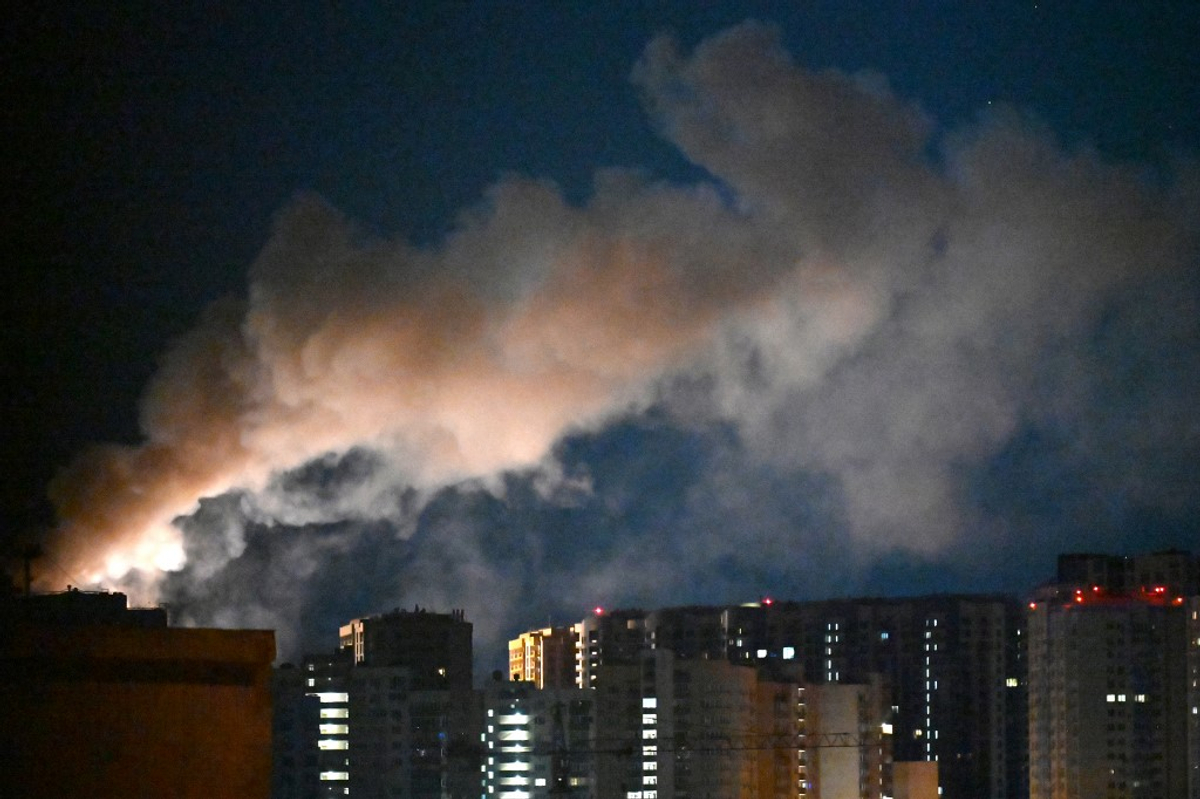
At least 13 people were killed and more than 56 others injured after a barrage of Russian drones and ballistic missiles struck Kyiv early on Thursday, Ukrainian officials said, as rescuers continued searching for survivors trapped beneath collapsed buildings.
The multi-wave overnight assault damaged more than 20 residential buildings and a medical facility, with destruction reported across several districts of the Ukrainian capital.
JOIN US ON TELEGRAM
Follow our coverage of the war on the @Kyivpost_official.
According to Ukraine’s Air Force, Russia launched 570 aerial weapons during the overnight assault. The barrage included 496 attack and decoy drones – among them Shahed, Gerbera, Italmas, Banderol and Parodiya models – as well as 74 missiles:
24 Iskander-M ballistic missiles (and S-400 missiles used in a ground-attack role), 34 Kh-101 cruise missiles, 8 Kalibr cruise missiles, 4 Tsirkon hypersonic anti-ship missiles 4 Kh-59/69 guided air-launched missiles.
The attack came hours after President Volodymyr Zelensky warned that Ukrainian intelligence had detected preparations for a massive Russian strike.
Explosions shake Kyiv overnight
As air defense units engaged incoming targets, multiple explosions echoed across Kyiv after Ukraine’s Air Force (AFU) warned that ballistic missiles were approaching the capital.
Kyiv Mayor Vitali Klitschko said the capital was under a “furious enemy attack” involving ballistic missiles and drones.
Residents were urged to remain in shelters throughout the night as the assault unfolded in several waves.
Rescuers search for survivors
Emergency crews worked through the night at multiple impact sites as officials reported fires, partial building collapses and people trapped beneath rubble.
Other Topics of Interest
INTERVIEW: Prague Vows to Sustain Ammunition Deliveries to Ukraine
Jaromír Zůna also says Europe must take greater responsibility for its own security.
According to Interior Minister Ihor Klymenko, Kyiv suffered the heaviest damage in the attack.
In the Darnytskyi district, part of a nine-story residential building was destroyed. Klymenko said rescuers had pulled 17 people from the site, including seven who were freed from beneath the rubble. Search-and-rescue operations are continuing as authorities believe more people may remain trapped.
More than 20 residential buildings across Kyiv were damaged, while emergency services continued working at 15 separate locations, Klymenko said.
Police have secured the affected areas while investigators collect statements from victims at emergency response centers.
As of 8:30 a.m., authorities confirmed 13 people had been killed in Kyiv, while more than 30 others were injured. Klymenko warned the casualty toll is likely to rise as rescuers continue clearing debris and additional victims seek medical treatment.
Medical workers among injured
In the Shevchenkivskyi district, a medical facility was partially destroyed. Klitschko said five of those injured were medical workers, including a paramedic in extremely serious condition.
A market in the district also caught fire after falling debris.
Zelensky warned of massive strike
The attack began late Wednesday night with drones entering Kyiv from several directions before officials warned of ballistic missiles heading toward the capital from the north.
The assault followed a warning from President Volodymyr Zelensky during a visit to Ireland that Russia was preparing another large-scale strike against Ukraine.
“We know that [Vladimir] Putin has been preparing a massive strike on Ukraine for some time now,” Zelensky said hours before the attack. “Tonight, this is exactly the threat we face.”
Municipal teams, emergency responders and heavy equipment remained deployed across the capital Thursday morning as rescue efforts continued and officials worked to establish the full extent of the destruction.
Terror as a political tool
Unable to achieve a breakthrough on the battlefield or defeat Ukrainian forces on the front lines, Russia has repeatedly turned its fire on dense civilian areas, seeking to compensate for military stagnation with terror.
Ukrainian officials have emphasized that strikes on hospitals, markets, and apartment blocks are not random acts of war, but part of a deliberate campaign to break civilian resolve and pressure Kyiv into accepting a compromised settlement on Moscow’s terms.
The barrage also carries a message for Russia’s domestic audience, where mounting Ukrainian drone strikes on Russian military, logistics, and energy targets have exposed the Kremlin’s vulnerability to Ukraine’s evolving long-range warfare technology.
By unleashing destruction on Kyiv, Moscow is attempting to project strength at home while trying to intimidate Ukraine abroad.
Instead, the latest devastation in the capital is expected to intensify Ukraine’s calls at the upcoming NATO gathering for expanded air defenses, more interceptors and the removal of remaining restrictions on strikes against Russian military targets used to attack Ukrainian cities.
For Ukrainians, the attack is unlikely to weaken their resolve to continue the fight for every inch of occupied territory.