
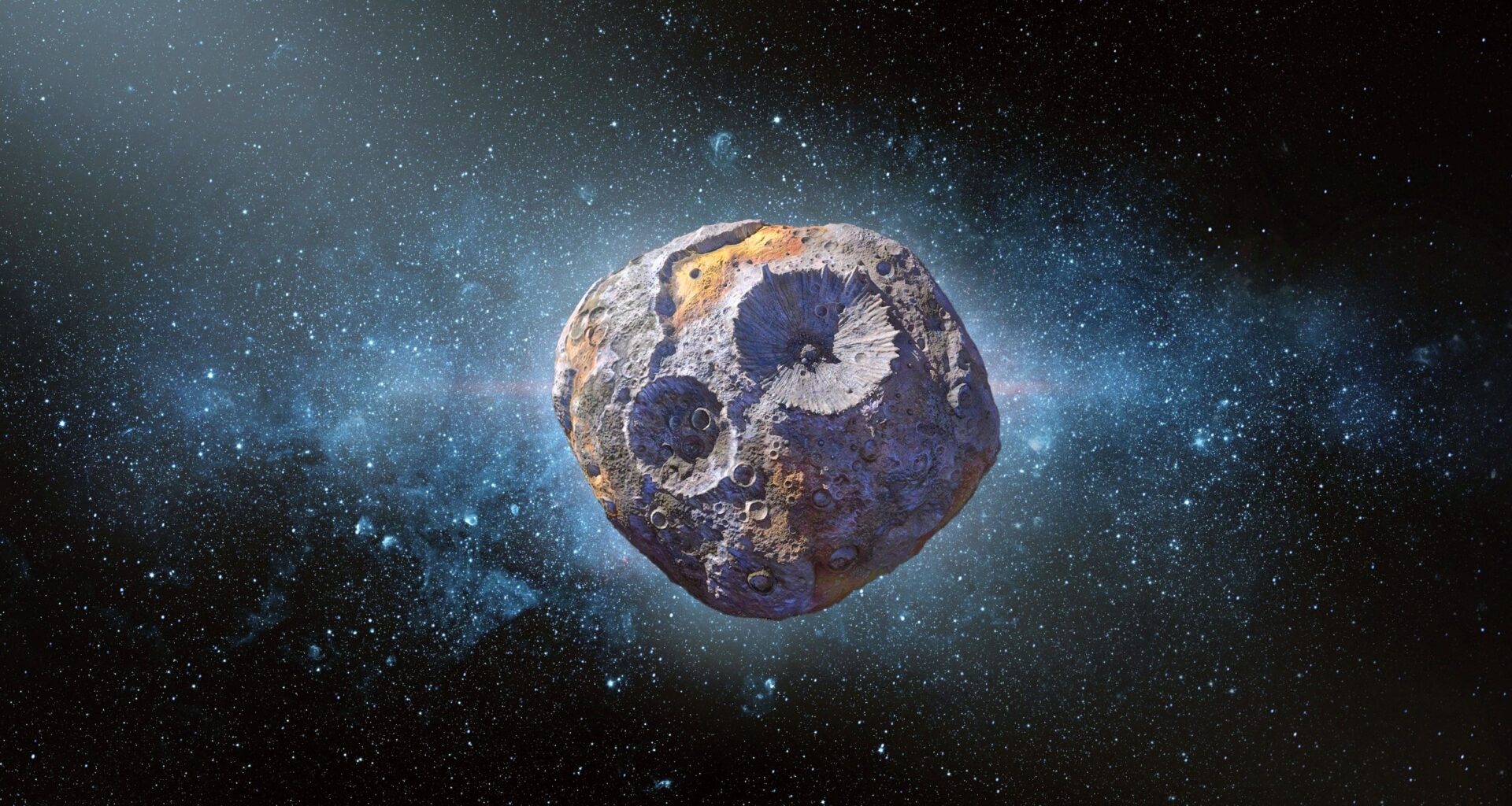
Scientists believe a giant asteroid helped wipe out the dinosaurs about 66 million years ago, and smaller impacts have also caused serious damage over time.
Today, astronomers track thousands of near-Earth asteroids, but many large ones are still waiting to be found.

That leaves one difficult question. What happens if a dangerous asteroid appears with very little warning?
The challenge becomes much harder when the object is very large.
Detection of large asteroids
Asteroids more than 330 feet across can cause destruction on a regional or even global scale if they strike Earth.
Some recently discovered asteroids have been spotted only days before making a close pass.
One example was asteroid 2024 MK, which was detected just 13 days before its approach.
For threats like these, scientists continue searching for ways to move an asteroid off course before it reaches Earth.
Looking beyond current defense plans
Many proposed planetary defense methods rely on hitting an asteroid with a spacecraft to slowly change its path.
NASA’s DART mission proved that this idea can work by successfully changing the orbit of the small asteroid moon Dimorphos in 2022.
But that method may not be enough for much larger asteroids or for objects discovered shortly before impact.
A new study examines another option. It introduces work led by Wang Xiaowei, a researcher at the China Academy of Launch Vehicle Technology.
The team explored how nuclear explosions could be used more effectively to either break apart a dangerous asteroid or push it into a safer orbit.
Two different ways to stop an asteroid
The researchers compared two defense methods.
The first, called the direct rendezvous impact detonation mode, sends a spacecraft directly into the asteroid. The collision creates a shallow crater before a nuclear device explodes inside it.
This system is relatively simple and could be launched quickly during an emergency.
However, the impact point cannot be chosen in advance, the explosion transfers less energy into the asteroid, and the nuclear device must survive an extremely high-speed collision.
The second method takes more preparation but promises much better results. Known as the flyby pre-excavation detonation mode, it first sends a conventional penetration device to dig a deep crater.
A nuclear device is then guided into that crater before detonation. Because the crater location is selected ahead of time and the explosion occurs deeper inside the asteroid, much more energy is transferred into the rock.
Testing thousands of possible threats
To measure how well both approaches perform, the research team created a virtual database of dangerous asteroid scenarios.
The simulations included different asteroid orbits, warning times, impact speeds, launch conditions, and explosion depths.
The study also examined how spacecraft performance affects success.
For the first defense mode, when the launch vehicle characteristic energy (C3) was 30 km²/s² and the maximum impact velocity was 10 km/s, only 30% of asteroids could achieve a deflection time exceeding 50 days.
Raising the impact speed
Raising the impact speed to 20 km/s allowed all simulated asteroids to achieve deflection times greater than 30 days, while about 16% exceeded 150 days.
Increasing the speed to 30 km/s produced only small improvements, suggesting that 20 km/s offers the best balance despite creating major engineering challenges.
For the second method, the simulations showed that every virtual asteroid required less than 10 km/s of additional velocity from the space transfer platform, while about 45% required less than 6 km/s.
The researchers concluded that spacecraft using either chemical propulsion or electric propulsion could reach most threatening asteroids.
Deep explosions make a big difference
The simulations found a clear advantage for the second approach.
For asteroids about 330 feet across, both methods could destroy the object directly. Larger asteroids measuring about 0.6 mile across proved much more difficult.
Using a 3-megaton TNT equivalent explosion inside a shallow crater 16 feet deep, the first method produced a velocity increase between 8 and 9.2 centimeters per second.
When the second method detonated the same yield inside a crater about 66 feet deep, the asteroid gained more than 30 centimeters per second, making it several times more effective.
The researchers also simulated the damage caused by a 3-megaton TNT equivalent explosion buried 16 feet beneath the surface of a mile-scale asteroid.
The explosion created craters hundreds of yards across while generating a significant change in the asteroid’s speed.
Warning time still matters
Even the most powerful defense depends on how early the threat is discovered.
The study calculated how much warning time would be needed under different levels of asteroid deflection.
A velocity increase of 0.5 centimeter per second required at least 4.45 years of warning. Increasing that to 3 centimeters per second reduced the requirement to 560 days.
At 18 centimeters per second, only 139 days were needed. When the velocity increment reaches 1 m/s, the deflection target can be achieved in only 60 days.
Those results suggest that stronger deflection methods could give Earth a much better chance of avoiding disaster, especially when time is limited.
Preparing for future threats
The researchers conclude that each defense strategy has a role.
The direct rendezvous approach may be the best choice when almost no warning time is available, despite its technical challenges.
The flyby pre-excavation method requires more preparation but offers greater reliability and much stronger deflection when there is enough time to plan the mission.
As asteroid surveys continue to discover new near-Earth objects every year, scientists expect planetary defense to become an increasingly important part of space research.
Finding dangerous asteroids early remains the first line of defense, but studies like this help prepare for the day when detection alone may not be enough.
The full study was published in the journal Space: Science & Technology.
—–
Like what you read? Subscribe to our newsletter for engaging articles, exclusive content, and the latest updates.
Check us out on EarthSnap, a free app brought to you by Eric Ralls and Earth.com.
—–