
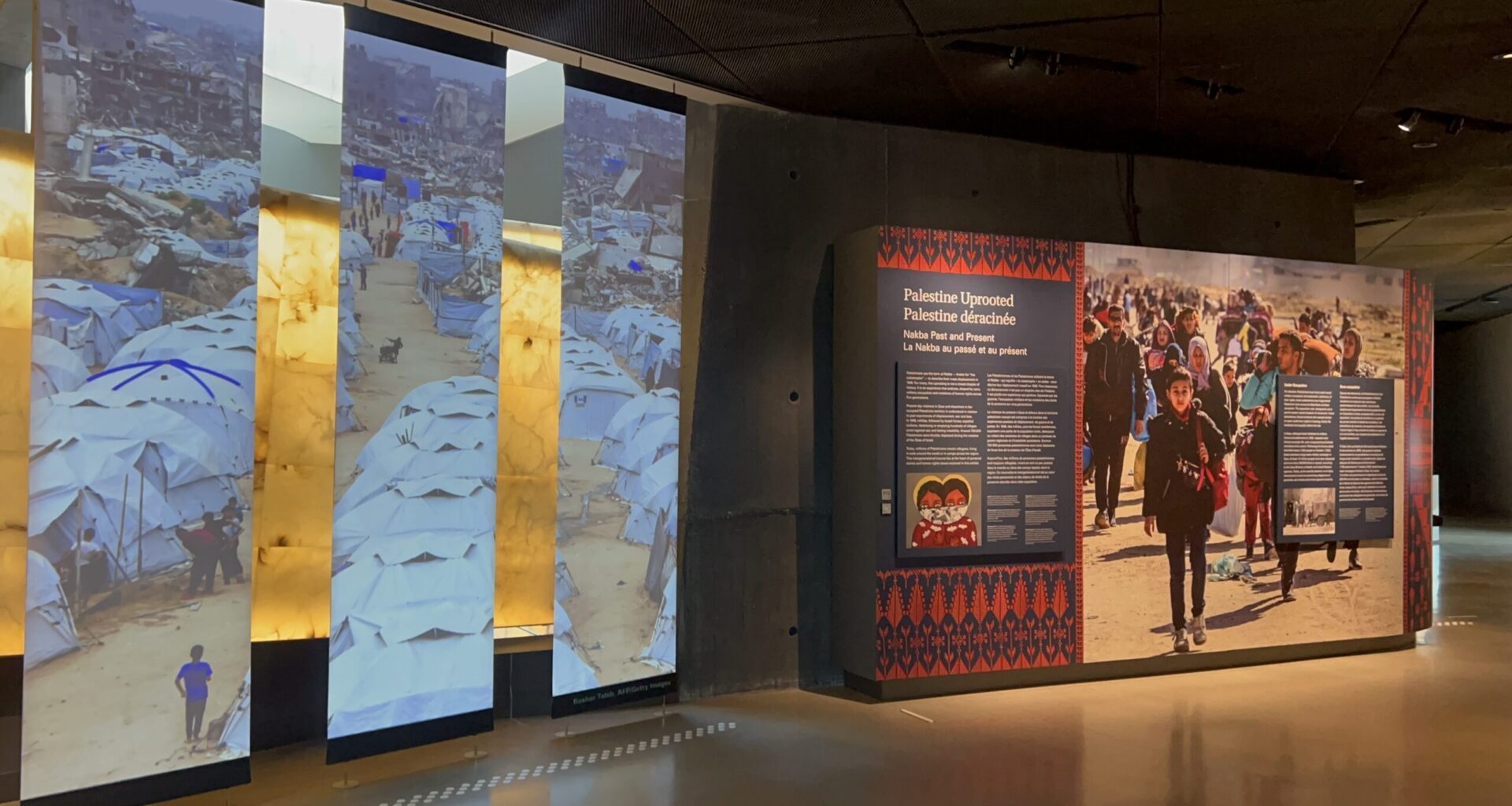
The controversy surrounding the Canadian Museum for Human Rights’ new “Palestine Uprooted: Nakba Past and Present” exhibit isn’t going away yet.
Canada’s minister of Canadian identity and culture, Mark Miller, toured the exhibit before it opened last weekend, and has since publicly criticized some of what he saw. In an interview published June 29 by The Canadian Press, Miller said some wording “should be rectified,” and suggested that the museum’s board should have been shown the exhibit before it opened. He also said it was a “failure” that curators chose not to describe Hamas as a terrorist organization, or state that Jewish Israelis were targeted during the Oct. 7 attacks.
The museum told The CJN it stands by its word choices, but has sent Miller’s concerns to its curation team, which has a content revision process.
Before the minister’s comments became public, The CJN’s Izzie Helenchilde travelled to Winnipeg as one of the journalists invited inside to preview the exhibit on June 26. On today’s episode of North Star, she joins host Ellin Bessner to describe exactly what she saw and whether the exhibit matched the controversy that’s been surrounding it.
You’ll also hear from some of the people she interviewed: the museum’s CEO, Isha Khan; Fouad Sahyoun, a Palestinian Canadian whose experience is one of the few video testimonials in the exhibit; Gail Asper, whose family founded the museum; and Rabbi Yosef Benarroch, who recently retired as spiritual leader of Winnipeg’s Adas Yeshurun Herzlia synagogue.
Transcript
Voice of curator Isabelle Masson
The exhibit talks about the forced displacement and dispossession of Palestinians. Palestinians use the word Nakba, “the catastrophe”, to describe that experience. For many, that experience is not of dispossession and forced displacement is not a closed chapter of history. It’s an ongoing experience across five generations.
Ellin Bessner: The curator of the new Palestine Uprooted: Naqba Past and Present exhibit at Winnipeg’s Canadian Museum for Human Rights, Isabelle Masson, giving The CJN’s Izzie Hellenchild a guided tour last week. The CJN was one of the media outlets invited by the museum for a preview on June 26, the day before the exhibit opened to the public. After months of headlines and controversy, it was the first chance outsiders had to lay eyes on the final exhibit, and Izzie was taken through the museum and was able to conduct sit-down interviews with the CEO and with one of the Palestinian Canadians whose story is part of the exhibit.
As she discovered, the exhibit is really small.
It took her about 10 minutes to view it. It has fewer than 600 words of text, a few pieces of clothing and artifacts, some artwork, and video testimony and poetry by a celebrated Palestinian writer, the late Mahmoud Darwish.
So after months of reporting on concerns from many in Canada’s mainstream Jewish community that the exhibit would tell only one side of the story, fuel more antisemitism, and unfairly vilify Israel, what was Izzie’s conclusion?
Izzie Helenchilde: The overwhelming sentiment among these groups, among protesters, is, that with the current state of antisemitism being at an all-time high, this exhibit may fuel that fire, and that’s what the Jewish community was so concerned about. This exhibit is missing some context. There’s some troubling parts.
Ellin Bessner: I’m Ellin Besner, and this is what Jewish Canada sounds like for Friday, July 3rd, 2026. Welcome to North Star, the flagship podcast of The Canadian Jewish News, made possible thanks to the generous support of the Ira Gluskin and Maxine Granovsky Gluskin Charitable Foundation.
Ellin Bessner: Before Izzie joins to give her on-the-ground report, first let’s update the latest development.
We’ve now learned Canada’s minister responsible for museums, Mark Miller, was in the museum for a tour on the Thursday, June 24th.
He didn’t say anything publicly about it for several days. Then he told The Canadian Press he won’t intervene because museums are independent, but, he criticized some of the content. He used words like “failure”, “regrettable”, and pointed to the display that didn’t call Hamas a terrible terrorist group or that it intended to kill Jews in Israel, “an unfortunate error in curation” that should be “rectified”. He also questioned why the museum’s board didn’t review the exhibit before it opened and called it an “error in governance”.
While the museum’s staff responded that it stands by the content and isn’t promising to make any changes, it did announce it sent the minister’s comments to a review committee.
The exhibit opened after years of advocacy by Palestinian Canadians who wanted museum to recognize their community’s experience, past and present. Many mainstream Jewish organizations argued the exhibit omits essential historical content, including that the Arab invasion of the newly declared State of Israel in 1948 happened, and the simultaneous displacement of hundreds of thousands of Jews from Arab countries.
The controversy culminated June 22nd when Mark Berlin, a lawyer and human rights scholar and the only sitting Jewish trustee, resigned, saying the museum’s board had never been shown. own the exhibit’s contents before it opened.
And he alleged the museum has an institutional anti-Zionism problem.
Now, after seeing the exhibit for herself and speaking with museum officials, visitors, and protesters outside, The CJN’s Izzie Helenchild joins me from Winnipeg.
Good to have you on this side of the microphone, Izzie.
Izzie Helenchilde: Yeah, thank you for having me.
Ellin Bessner: Well, thank you for covering this. The CJN got invited to a media preview day, which was Friday. So walk us through how that rolled out for you.
Izzie Helenchilde: Okay, so they were very nice. I walked in. I was immediately greeted. There was a person to kind of show me around.
And the first thing they started with was, “Hey, we want you to see the entrance of the museum, not the exhibit.” The exhibit’s on the 5th floor. They said “We’re going to take you through how a visitor would see this exhibit.
When you walk into the entrance of the exhibit, there’s this huge timeline of all these different human rights issues that have happened over history. With that, they have interactive screens where you can tap on any of the events and it will present you with more information. One of the events on this timeline is about the 850,000 Jews who were displaced around the same time. You have to know it’s there. You have to tap it yourself, but the museum does provide more information.
I was then taken a little bit through the museum where other Jewish history events were pointed out to me. One of which was the MS. St. Louis that Mark Carney mentioned in his speech a couple weeks ago. The person guiding me did not know where that was situated within the museum, but it is apparently there.
Then on the fourth floor, there was the Holocaust Museum, and to museum’s credit, that is the largest single topic explored anywhere. Then you make your way to the fifth floor and kind of tucked in, is this pretty small exhibit. It’s only 12 metres big. It’s 3 displays and less than 600 words of text.
So immediately you see these three cloth panels that have different images cycling through and they’re projected on the panels. They’re different images, some of which are from the late 1940s and some of which are from now.
Then they have this giant blown-up image with text overlaying. The image is from 2024, and it’s Palestinians fleeing in the aftermath of October 7th and things that have happened.
And now on this text, there is an acknowledgement that Hamas killed, quote, about 1,200 people. I know in speaking to Gail Asper, she had an issue that they would not refer to the J- word, as she put it.
Ellin Bessner: So they didn’t say Israelis? Or they did.
Izzie Helenchilde: No, they said people.
Ellin Bessner: That’s interesting.
Izzie Helenchilde: Right after it says the 1,200 people in Hamas, it immediately says, yeah, but Israel displaced 2 million people and killed or injured, which, that’s a big difference, killed or injured, 240,000. And they’re using the Gaza Ministry of Health’s numbers.
Ellin Bessner: And did they say they were combatants or civilians? None of that was there? And they lumped them all in.
Izzie Helenchilde: Yes.
So you read this big sign, and then if you turn the corner, there’s what they’re calling a memory box. And it does have some beautiful pieces. It has some artifacts. It has these scarves that the curator was telling me, it’s this big tradition where the women and girls. they make these beautiful beads. On the memory box, there are three people who were interviewed, who are Canadian, who tell their stories of displacement, and those are playing. That would be the main sound. There isn’t a ton of sound other than that.
Ellin Bessner: The Canadian-Palestinians’ experiences, do they talk about anything about how they were displaced from the ’40s?
Izzie Helenchilde: Yeah, they do. We can play a little clip of it.
I spoke with one of them who was prominently featured, and he told me his story about how he was living as a child, he was very, very young. In the ‘40s, his family looked around. The state of Israel was being created. It wasn’t looking great for them, and they decided it was time to leave. He made his way across the Middle East, and eventually, I think he came to the ‘States first, and then eventually settled in Canada in the 90s.
Ellin Bessner: Here’s a bit of your interview with Fouad Sayoun. He was born in Haifa into an Arab Christian family. He now lives in Montreal, and he’s in his early 80s.
Fouad Sahyoun: I was born in Haifa.
Izzie Helenchilde: Okay. In the north, right?
Fouad Sahyoun: In Palestine at the time, in 1944. And my grandfather was the vice-mayor of Haifa. He had several properties, and my father worked for him.
When trouble started in Haifa, it was bombardment of the residential areas from the mountains of the Carmel, that my grandfather started to get worried. And there was apparently people shooting from our terrace, and basically protecting the vendor I was in. And the Haganah was at the bottom of a steep street, which is still called Sahyon Street by our name today. So they received a letter that they’re going to blow up the whole building.
And my grandfather started getting even more worried, my father obviously. And until a cousin of my mother is bringing bread to us, and was shot by the Haganah. So my grandfather said, “I have my daughter in Alexandria in Egypt. Let’s go and spend the summer there”. So we departed voluntarily.
So he had 10 children, 10 children. We all went to Alexandira to spend the summer with ten suitcases. And that’s basically how my life started.
And when I got my Canadian passport, I was able to travel as a Canadian to Haifa. It was a very touching trip.
Izzie Helenchilde: When did you go? What year? Approximately.
Fouad Sahyoun: So, it must have been 1994. It was it took us about three, four years to get the passport, yeah, when we went there. Met some family from my mother’s side, they had never left.
Izzie Helenchilde:
That’s fascinating. Thank you for sharing with me. Do you still want to go back?
Fouad Sahyoun: The only place where I truly am on this with you all. You know, as a refugee, throughout your life, you lived in the margin of society, especially with the reputation that “Palestinians are terrorists”, Palestinians are Israelophobia, you’re always on margin of society. We’re good citizens wherever we are. In every country I went from, I can truly take with the society. Including Montreal, I was a city councillor.
Izzie Helenchilde:
How do you think an exhibit like this helps to kind of counteract that?
Fouad Sahyoun: You know, one thing I learned in this exhibit, Palestine is really, honestly, a human rights issue, which, in my mind, always was a political issue. It was a right for self-determination in the Palestinian people, which is a political statement. And here, I’ve been educated a lot and a different way to look at it as a human right, that we have the right to choose wherever we want to live.
Izzie Helenchilde:
So you think this exhibit is going to help with that?
Fouad Sahyoun: You can’t criticize for telling people to tell their stories, so I think they’re doing an amazing job. But it comes at the culmination also of the Palestinian issue having been brought up in the last three years.
As a popular movement, the demonstrations pushes that out. And the museum exhibit is basically a culmination.
And I’m happy to address Jewish audience, to tell them that eventually we have to live together. We can’t keep on bombarding people, displacing people and killing people in order to have peace. We did before 1948. You know, if you see those documents in detail, you will see that 50% of those 115 documents, my father was a partner with a Moe Levy, he was a Jewish guy. I mean, he was a Palestinian Jew, like we’re Palestinian Christians, there are Palestinian Muslims. It’s possible.
Ellin Bessner: Let’s go through two of these actual artifacts and what you learned about them.
Izzie Helenchilde: First was Jaffa orange wrapper. And it was really cool. They have the original wrapper. It was really cool to see this woman’s family had the wrapper from her family’s orange farm. And then the other thing is they have this poem they have, and it’s distributed in Arabic and then it’s also distributed in English and French. There’s a phrase they use and then you add your own.
I have the English version. And then it says, “As you prepare your breakfast, think of others. As you wage your wars, think of others.”
And then at the bottom, it has a little “As you think of others”, and then you can fill in your own. And I think you’re meant to leave it at the exhibit.
And that’s, you know, cool and interactive. And the Human Rights Museum is kind of known for doing that kind of thing. At the end of the exhibit, there’s a Post-it wall where you can kind of share your thoughts on what you’ve learned.
Ellin Bessner: This Mahmoud Darwish was the Palestinian national poet, member of the PLO, wrote the Palestinian Declaration of Independence, according to our internet search, and is really a symbol of the Palestinian people.
I’ve seen pictures where there’s this cage with a keffiyeh in it and legs. What is that?
Izzie Helenchilde: It’s an art piece that’s actually on loan from an American exhibit and it was about the period of time from 2000 to 2005 where they are under occupation and there were curfews and the idea is the keffiyeh is like so locked in the cage and can’t get out because of the Israeli’s strict curfew policies.
Ellin Bessner: So that’s the Intifadah?
Izzie Helenchilde: So Israel pulled out in 2005, but before that.
Ellin Bessner: And was any mention in context of why there were military lockdowns happening?
Izzie Helenchilde: Definitely not.
Ellin Bessner: You spoke to also the president or the CEO of the museum. What was your conversation about?
Izzie Helenchilde: She immediately reaffirmed her commitment to fighting antisemitism. She was very open to hearing that concern. She was also very open to hearing from Jewish groups who have felt that the displacement of Jews around that time has been ignored. However, her main argument was that a lot of the outcry has been from people who haven’t seen the exhibit.
Ellin Bessner: Here’s some of your interview with the museum CEO, Isha Khan.
Isha Khan:
What I know, know well, and try to validate in conversations with anyone who I spoke with, including the leaders of major Jewish organizations, foundations, Federations, and individuals who reached out, is:
We share the concern, we unequivocally share the concern about antisemitism today. That’s part of our mandate. It always has been and it always will, which means that’s how we continue to do that work. But telling the story of Palestinian Canadians doesn’t negate that work. It doesn’t diminish that work, nor the stories of Jewish displacement, which are also stories they need to be told. And we have shared months ago with leaders of the Jewish organizations that were the main ones to critique us : We want to work constructively with you to share our stories.
Izzie Helenchilde: So can you tell me a little bit more about that? So I know there has been talk of adding a little bit more about Jewish displacement. What is that going to look like?
Isha Khan: So for one, there’s already, you know, when I talk about the interconnectedness of the stories in the museum and what we’ve tried to share, it’s, that’s important context. And by that, I mean, if you go into the introductory gallery of this museum, it’s a question, what are human rights? And in that gallery is a timeline. And it has 100 moments in history. One of them is the 1948 Arab Israeli…
Izzie Helenchilde:
Yeah, they took me through it.
Isha Khan: So my point in sharing that is, and it talks about displacement of Jewish people and Palestinian people. It talks about the, you know, Arab leaders not agreeing to the partition clan that was proposed. I tell you that because this work, the work that we’re doing, have begun, on telling stories of Jewish displacement from areas in North Africa, and this exhibit on Palestinian-Canadian forced displacement, it builds on that theme of forced displacement and now sits amongst many stories of forced displacement, the Rwandans, Acadians, Indigenous people, Hindu people, Japanese, Canadians, I could go on. I express.
Izzie Helenchilde: So no official…
Isha Khan: Sorry, I didn’t answer your question. I apologize. So we started that work. So part of, as I share, part of that work is we start with research, determining who ought the interview for an oral history.
That’s always the basis, the research base for the work. We started that just in the last couple months. That’ll happen throughout this year. I don’t know. I don’t know if it will be an exhibit. I don’t know if it will be online. I don’t know if it will be a program. And we should know more about how it be scoped and what will looked like.,
Izzie Helenchilde: I hear there is going to be a study guide about this. Is it going to be sent to schools? Is it, you know.
Isha Khan: So for one, we have resource guides. They’re essentially like our list of research sources for someone who wants to know more about the topic that is presented in an exhibit. We’ve been doing that for the last few years. It’s hyperlinks, et cetera, to sources. And it’s for anyone who’s, you know, the general population was interested in learning more. We also do education programs. We also do interpretation and tours for students and for the public. We have not completed development of any of those tools yet. Right now, we wanted to open the exhibit, have it stand for itself, see if, you know, maybe some of the anxiety and concern around it will come down to see what it is.
And, you know, a lot of people don’t believe me, haven’t believed me when I’ve shared what it’s about. I hope they will what they see it for themselves.
Izzie Helenchilde: If there was one thing to tell a specifically Canadian Jewish audience, what would you want them to know?
Isha Khan: I’ll give you two things. I think one thing is I really hope that people will come and visit because I know they will feel something.
I know that they will be able then to see this exhibit in the context of the really good work this national public institution is designed to be.
What I would also say to the members of the Jewish community who are upset and angry or otherwise: We will be accountable. We are always accountable to the public that we serve, and our relationships in those communities, matter.
And we will continue to be open to having discussion and dialogue and to doing the work that the Jewish community right now, I know, wants us to do, which is to combat antisemitism and all forms of hate. I know because it has been shared with me by many that, you know, the concept of human rights is central to the Jewish faith. And so I know we have common purpose. We just have to find our way back to that.
Izzie Helenchilde: What would you say to, you know, people like Gail Asper or Marc Berlin who have been very vocally critical?
Isha Khan: We have a lot of gratitude for the Asper family, including Gail Asper, for giving us the privilege of being able to work in this museum. For creating it, for her father’s vision.
So I start there, and it is called the Israel Asper Tower of Hope because that vision to bring Canadians here to understand human rights, and now we’re a national public institution, we serve all Canadians, but that vision is still at the centre of what we do.
To folks like Gail, like our former trustee Mark Berlin, they know the good work that we do.
They have led this organization while we have developed impactful exhibits that are challenging in times where there’s controversy and concern of our communities, and they know that at the root of it, we are guided by some very clear principles, which are about rights and dignity and respect for everyone.
And so I hope that some of the narrative out there around erasing Jewish voices or this museum doesn’t tell story of the Jewish people, I hope they would counter that because they do know, as do so many people who, you know, thousands of people who come to the Museum, millions over time, we do tell Jewish stories. They’re important to our understanding of human rights as a whole, which is why we have an Examining the Holocaust Gallery to understand the universality of human rights. And I know that things are divided and feel that there’s a binary. Our job as a national institution is to create that reflection and dialogue that actually brings people together. I hope we can all do that together.
Izzie Helenchilde: Thank you so much for talking to me.
Isha Khan: I would talk about that one forever, so.
Ellin Bessner: And so you now have seen it. Now, you’re not an expert in Middle East history, with a PhD in Middle East history, but as an average person who comes from the Jewish community, what was your impression? Were the critics from the Jewish community, right?
Izzie Helenchilde: There was cause for concern, I’ll say that. I think the Jewish community has been very outspoken about this for a couple of years and had this big protest later that evening.
And all of this could perhaps arguably be characterized as a roar in response to a murmur, given the size of the actual exhibit. But the overwhelming sentiment among these groups, among protesters, is that with the current state of antisemitism being at an all-time high, this exhibit may fuel that fire. And that’s what the Jewish community was so concerned about.
This exhibit is missing some context. There are some troubling parts, but, also I think it’s also OK to have a story that where the Palestinian people are the main character and are the main voice.
Ellin Bessner: All the Jewish critics said, including our interview with Mark Berlin when he resigned and with Gail Asper, as you know and you spoke to them, was “We want this story told, but it has to be told correctly”.
Izzie Helenchilde: And that was every single person I talked to at the protest said the same thing: “We’re happy to have this story be told. We just want a little more context.”
Ellin Bessner: So tell me about this protest. The Jewish community, the organized Jewish community, asked people to come out for what time and what day. Tell me what it was like.
Izzie Helenchilde: So they asked people to come out and protest this on Friday evening. The exhibit, and I do think this is relevant, the exhibit opened Saturday morning. The media preview was Friday morning. There was a VIP little get together Friday evening, for board members.
This protest was meant to be seen by the board members and by the museum. That’s why it was at 5 o’clock. Winnipeg doesn’t have the biggest population just in general. So the fact that there were a couple hundred people there really says a lot. They all had tons of signs, “Facts, not feelings”. “Not about us without us”. I think Gail Asper had that sign.
Ellin Bessner: Right. First, we’ll play some of your interview with Gail Asper, who was at the protest. And next, we’ll play your interview with Rabbi Yosef Benarroch. He recently retired as a longtime rabbi at Adas Yeshrun Herzliya Synagogue. He lives most of the year now in Efrat.
Izzie Helenchilde: What brought you out here today?
Gail Asper: I am protesting the opening of the Nakba exhibit at the Canadian Museum for Human Rights, which from what I’ve seen from certain panels and from a website, is a very one-sided, biased narrative. It is not befitting a national federal museum.
Izzie Helenchilde: You haven’t seen it, right?
Gail Asper: I’ve seen three major panels that lay down the basis for the exhibit, and reading those, I realized that despite numerous pleas over many, many, many months by many different people, there has been a very careful effort to provide no context for the Palestinian displacement whatsoever. It’s like the Jewish side of this historical event has been erased.
Izzie Helenchilde: So as a previous board, there’s obviously some frustrations. What do you think about Mark Berlin resigning in protest or this?
Gail Asper: It’s a huge loss for Mark Berlin who’ve resigned as a board member. I worked with him for many, many years. I totally understand why he had to do it. Nobody could have worked harder than Mark. In his letter of resignation to save the museum from itself, to safeguard the reputation of the museum, to ensure that people can still see it as a trusted purveyor of historical facts and information. And so I think he had to resign, or else he’d be associated with this exhibit.
Izzie Helenchilde: Now, there’s been some talk of doing something very vague about Jewish displacement. What do you think that will happen? What do you think about that?
Gail Asper: I think that anything that’s going to be done will be a little too late. And so anything that’s done later, the damage have already been done. And as far as I’m concerned, the resource study guides are going to go up to, you know, students across the country is already going to be laying in information that is missing key facts about this whole conflict.
Rabbi Yosef Benarroch: My name is Rabbi Yosef Bennaroch.
I was the rabbi of one of the synagogues here until I retired about four months ago. I live in Israel. Even when I was the rabbi, I went back and forth from Israel, Ephrat, Gush Etzion, to Winnipeg.
I still come three months of the year now here. What brought everybody else out here today, this is a scandal beyond belief for the Jewish community. I mean, not just for Jews, I mean, for all Canadians, and we need to stand up. There’s no question about it.
The injustice that this is going to create. In my opinion, it’s just going to fuel antisemitism. I can’t imagine anyone who will come to see this exhibit, and I imagine they want school children to come here, people of all ages to come here. I can’t imagine anyone who will see this one-sided exhibit, will have a more positive feeling about Jews. And, you know, with antisemitism now on the rise, like, huge rise, how can this help? How can this in any way shape or form help to fight antisemitism?
Izzie Helenchilde: So you haven’t seen it, right?
Rabbi Benarroch: I haven’t seen it.
Izzie Helenchilde: Okay, so what is your biggest concern, if you had to name one. that they’re going to talk about in the exhibit?
Rabbi Benarroch: My concern is that the truth doesn’t matter and that… People will get one side of the story, and unfortunately, it’s not the side that’s going to be favorable for the Jewish people. I don’t have a problem with the exhibit. I have no problem that there should be such an exhibit, as long as there is also a balance in the exhibit.
We’re living in a country where, you know, people have the right to tell their stories, but it needs to be done in a way that will create dialogue, that will be balanced, and that’s not going to happen here.
Izzie Helenchilde: Some of the people I talked to at the protest, their families had been displaced from surrounding Arab countries, and they were there to kind of say, you know, why isn’t my story being told?
It wasn’t just the Jewish community. There were people from the Indigenous community. There were a couple different Christian groups there. Some people from Winnipeg’s Iranian community. Some allies.
Ellin Bessner: Friday, we got a press release. I got the press release as well from the museum when the exhibit sort of went live for the media. And there were some words in the press release which said, you know, it wasn’t just the Israeli military and militia that are to blame for the displacement. There were other people in the Arab world who were to blame as well. Can you walk us through what that text is, and did you see any of that easily in the exhibit?
Izzie Helenchilde: It is not obviously displayed in the exhibit. It says on their website, it briefly mentions “Arab leaders who called on women and children and the elderly to leave some areas of fighting until conditions became safer”.
And then in the resource guide that I know Gail Asper was particularly concerned was going to be spread out to schools and so on, in the resource guide, which is at this moment, I actually did speak with the CEO about the distribution of that, And for now, it is just going to be an online sort of thing, if you the viewer goes to look at it. In that resource guide, it says, “In May 1948, 750,000 Palestinians were forcibly displaced from their homes, some by militias and by the Israeli military, some based on ill-founded advice of local leaders and some fleeing in fear of violence.” So if you know where to look, it is mentioned. It is not prominently displayed in the exhibit.
And I think, you know… On the one hand, it’s gotten so much attention that, yeah, people going to this exhibit are probably looking out for it. Had that not been the case, it’s tucked away in the corner on the fifth floor. It’s easily missable.
It’s situated in the “Rights today” (section) which that is notable that it, you know, they’re very focused on the ongoing issue and it’s not just, historical. I think the curator said something to this effect that it’s very about what’s going on right now. And I don’t know if that’s entirely fair, at the view they present.
But in that same exhibit, I think they have an LGBTQ+ exhibit about the Canadian military or something, going on right now.
Ellin Bessner: So any final anecdotes or observations that you want to share that sort of doesn’t make it into the hard news reporting, but now that we’ve got you, behind the scenes, what do you wanna share?
Izzie Helenchilde: Everyone I spoke to at the protest was just so on edge about antisemitism today. And I think that is the overarching message that, “Okay, there is room to say maybe we did overreact a little bit” but it goes to this larger point of people are very concerned about antisemitism. And you hear about, you know, the firebombings and the synagogue shootings every other day, that they have their guard up and they’re so concerned. And again, none of them had a problem with the story being told. They just wanted more context.
Ellin Bessner: So that is your report. And our listeners will be able to go to our YouTube channel and see your videos and your actual photos and things, and also read your excellent breaking news story that was published on TheCJN.ca’s website on Monday. Thank you for going to Winnipeg to cover this for us, and for doing all this on-the-ground reporting.
Izzie Helenchilde: Happy to do it, anytime.
Related stories
Minister responsible for Canada’s museums says Nakba exhibit “should be rectified”, in The CJN.Nakba exhibit opens amidst protests and controversy, in The CJN.The Canadian Museum for Human Rights’ only Jewish trustee explained why he quit, on The CJN’s North Star podcast.
Credits
Host and writer: Ellin Bessner ( @ebessner )Production team: Zachary Kauffman (senior producer), Izzie Helenchilde (producer), Michael Fraiman (executive producer), Alicia Richler (editorial director)Music: Bret Higgins
Support our show