
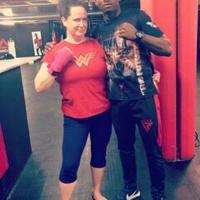

Training in Johannesburg, South Africa where Martelli leads a winter break program for writing students.
Martelli
What would lead a 52‑year‑old woman to step into a boxing ring for the first time? For Elizabeth Martelli, an associate professor in George Mason University’s English department, the sport has become a metaphor for cancer — a disease that deeply affected her family and continues to shape her outlook.
Martelli is training for her first fight on Sept. 16 with Haymakers for Hope, an organization that raises money for cancer research and support. Her path to the ring, she says, traces back to her childhood and the experiences that taught her how to confront hardship head‑on.
Growing up, Martelli liked to play sports.
“I spent my childhood, like elementary school, in Lexington, Ky. I played little league baseball,” said Martelli. “I was the only girl in the whole city playing baseball. After that, I transferred to softball. It was so much fun.”
When Martelli was in eighth grade, her mother, Alyce Robinson, who had returned to college, graduated and took a job helping turn around nursing homes that failed to meet state regulations. Robinson was very good at her job, which meant Martelli ended up moving frequently. She attended seven high schools in three states.
Martelli and her mother in 1995.
Martelli
At one point, a basketball coach told her the quickest way to build friendships was to play as many sports as possible. Martelli continued playing softball. She added basketball and volleyball to her rotation. At one school, she even ended up on the boys’ soccer team because there was no girls’ team.
In 1995, while Martelli was getting her undergraduate degree, her mother was diagnosed with a highly aggressive form of breast cancer. Treatment was extensive; she underwent surgery, radiation, a bone marrow transplant, and chemotherapy. She also got into a treatment program at a cancer research center at Duke University. The treatments were successful, and Robinson went into remission. Unfortunately, the intensity of treatments left her with chemotherapy-induced cognitive impairment, or chemo brain, and she could no longer work full time.
Her mother still had a full life. She traveled with friends to national parks and was active in her church. She volunteered with a mental health hotline and a hospice group. Robinson remained in remission for 13 years. Then she was diagnosed with a new cancer in January 2008. She passed away that April.
Martelli took up boxing as a physical outlet while she was working towards her PhD in English Rhetoric at George Mason University. It was strictly for exercise and not for fighting.
“I was given the advice by the person who directed my master’s thesis. She was like, when you go for your PhD, you need to do something physical,” said Martelli. “When she got her PhD in the 70s, she did karate. She was like, it’s good for competition and for focus.”
Martelli connected with the brother-in-law of one of her colleagues, who was a boxing coach at a UFC gym in Fair Oaks. After one class, she knew boxing was the physical outlet she needed.
“When I was working on my dissertation, I literally took my dissertation draft- when I got it back from my committee with the notes on it for revision- into the gym in the middle of the afternoon,” said Martelli. “I would read a little bit of the notes, and then I would sort of work through it on the bag.”
Fast forward to a social media post she made on her 50th birthday, which prompted a random direct message from a boxing coach involved with Haymakers for Hope. He asked Martelli if she had ever thought about fighting in an actual boxing match. She had not.
Today, she is training, eating right, and mentally getting ready to step into the ring. This is where the idea that boxing is a metaphor for cancer came from. Boxers have a lot of people in their corner, but they are in the ring by themself.
With cancer, “you’re getting punched by the insurance companies, by chemo, by the side effects, by the diagnosis, by all of these adjustments and things that you have to go through,” said Martelli. “You’re physically putting your body on the line. And that’s what the fighters are doing as well.”