
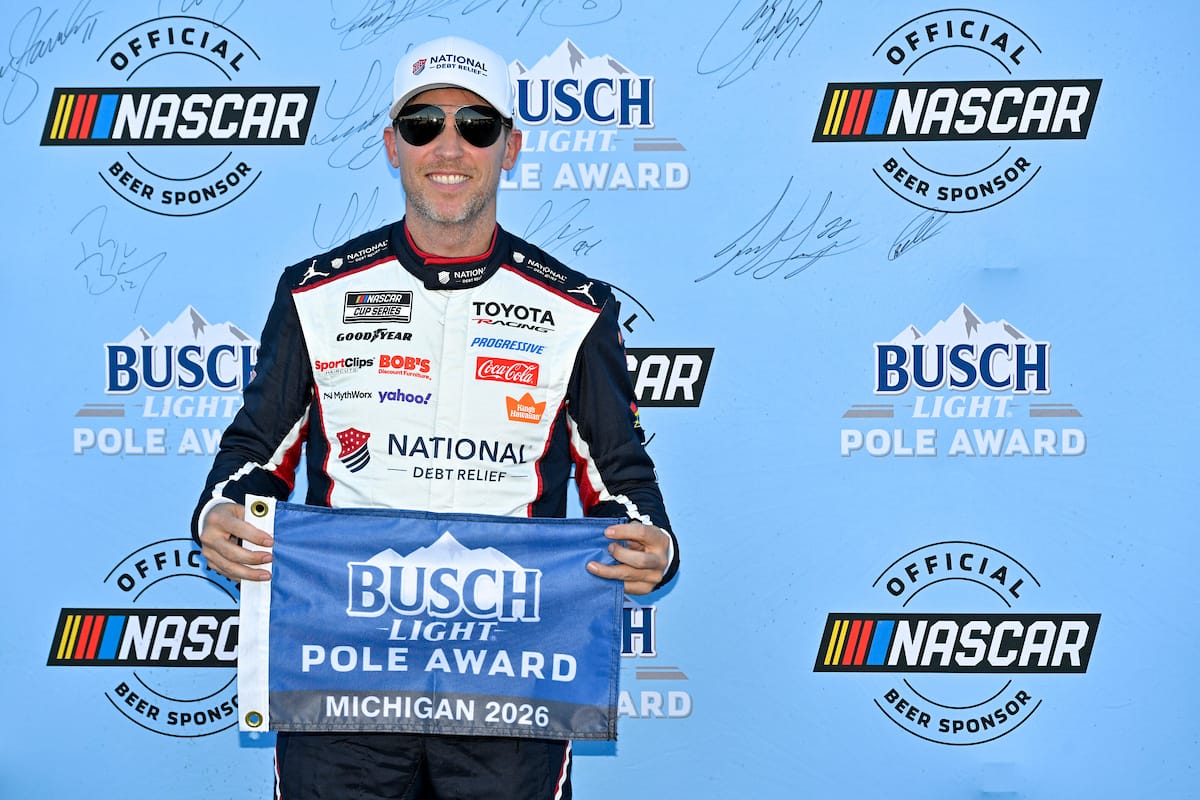
JOLIET, Ill. — Denny Hamlin believes NASCAR’s return to Chicagoland Speedway comes with plenty of unknowns, but the veteran Joe Gibbs Racing driver is confident the track’s characteristics could produce some of the best racing the Next Gen car has to offer.
Hamlin, who participated in a recent test session at the 1.5-mile oval, cautioned against putting too much stock in what drivers learned several weeks ago. While the test provided some baseline information, he expects race conditions to create an entirely different challenge when the NASCAR Cup Series takes the green flag Sunday.
“A test racetrack and a race weekend track are two vastly different things,” Hamlin said Friday. “Lots of unknowns, just what line are we going to run? What’s going to be the fastest?”
The biggest question centers around whether drivers will be able to move away from the preferred groove and utilize multiple lanes, particularly in Turns 3 and 4, where a significant bump remains a talking point throughout the garage.
During the test, Hamlin said drivers rarely ventured far from the bottom lane.
“We didn’t really go up the racetrack at all during the test,” Hamlin said. “We don’t know whether the bump is more or less the higher you go.”
Despite those uncertainties, Hamlin believes Chicagoland’s wide racing surface and long straightaways should complement NASCAR’s current car.
“The wider the racetrack, the longer the racetrack, the better the racing in the Next Gen car tends to be,” Hamlin said.
He pointed specifically to the balance between horsepower, aerodynamic drag and the ability for drivers to move around in traffic as reasons for optimism.
“It just runs barely slow enough down the straightaway where you barely get a draft,” Hamlin said. “In the corner, this racetrack has options to get out of the wake of the car in front of you, so you can usually keep that momentum up by moving around.”
Beyond the weekend’s on-track action, Hamlin also offered strong support for NASCAR’s revamped championship structure, which replaced the elimination-style playoff format with what drivers refer to as the “Chase” format.
The three-time Daytona 500 winner said the larger sample size creates a fairer championship battle by reducing the impact of one bad race or untimely incident.
“I certainly feel like the destination of where you want to go is more in your hands,” Hamlin said. “The sample size is bigger.”
While acknowledging the title race could still hinge on a late-race restart at Homestead-Miami Speedway, Hamlin likes that every race throughout the playoffs now carries equal weight.
“I don’t think that one freak race or incident or win just completely changes the outlook of your championship hopes,” he said. “Generally, the bigger the data set, the better off our chances are going to be.”
Hamlin also discussed his dual role as both a championship contender and co-owner of 23XI Racing, offering insight into the relationship between Toyota’s affiliated organizations.
He emphasized that manufacturer alliances are driven more by business decisions than corporate mandates.
“It’s not like Toyota forces us to work together,” Hamlin said. “We chose to be affiliated with Joe Gibbs Racing and we felt like it would shorten up the learning curve and get us competitive quicker.”
The partnership, he said, allows both organizations to share information and resources while avoiding unnecessary duplication of effort.
“It allows us to hire a lot less people,” Hamlin said. “You could just take the money and hire additional people, but then is that the best way to do it?”
Hamlin also shed light on how he evaluates young talent as a team owner. Rather than focusing solely on statistics, he looks for drivers who consistently outperform the equipment they’re given.
“There’s no exact science to it,” Hamlin said.
One example that stood out was current Toyota prospect Corey Heim, whose performance in underfunded equipment caught Hamlin’s attention.
“I know that car should not be running that fast,” Hamlin said of a race Heim ran for Sam Hunt Racing. “There are little moments that happen like that which get your attention.”
Ultimately, Hamlin believes racecraft outweighs any specific vehicle experience when projecting a driver’s future success.
“The great drivers can adapt to the car they are in,” he said. “You learn racecraft, then you just adapt your style to get the speed out of the machine that you are in.”