
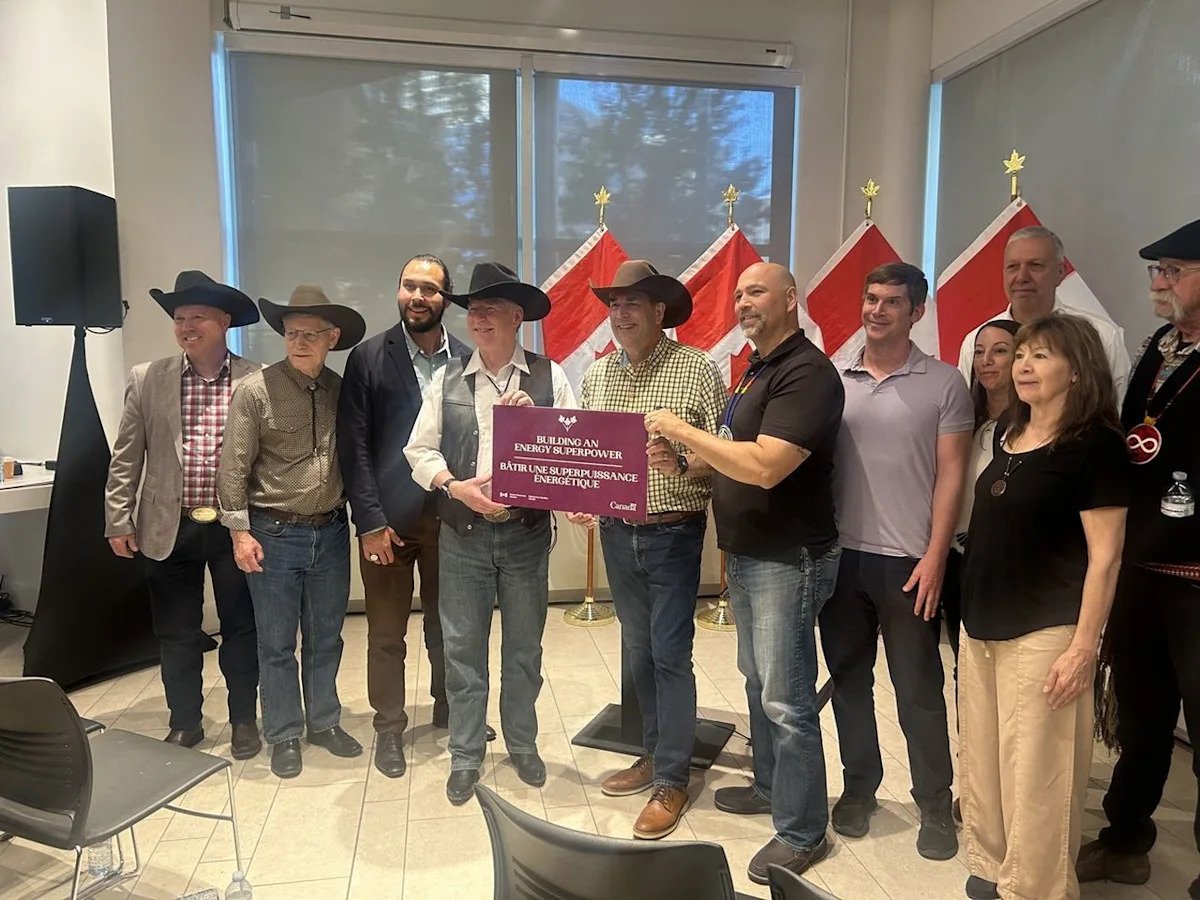
More than $4 million in federal funding is headed to the University of Calgary as part of a broader $26-million investment in clean energy projects across Alberta and Saskatchewan, aimed to modernize Western Canada’s energy grid while creating new opportunities for Indigenous communities.
It is one of 17 projects receiving funding, with the majority of funds coming from the Government of Canada’s Smart Renewables and Electrification Pathways Program and $649,000 from Indigenous Services Canada for solar energy projects led by Indigenous groups.
Speaking at the University of Calgary’s downtown campus Saturday, Energy and Natural Resources Minister Tim Hodgson said the $4.2-million investment will support the Western Transmission Catalyst (WTC) program, aimed at expanding electricity transmission connections across Western Canada, with the goal of improving grid reliability, affordability and the sharing of clean energy between provinces.
“We’re contributing to finding ways to respond to urgent challenges facing modern electrical systems,” said Dr. Bill Ghali, vice-president of research at the University of Calgary. “Whether that comes in the form of data centres, connecting to the grid, the increasing demands on the grid for industry and our homes and a push to get more electric vehicles on the road.”
The program will be headed by Dr. Blake Shaffer, who co-leads the U of C’s interdisciplinary electricity centre, alongside the Indigenous Power Coalition, a non-profit organization that pushes for Indigenous involvement in energy projects to progress economic reconciliation.
The coalition’s executive director, Kwatuuma Cole Sayers, said the program is the answer to how Canada will interconnect its grid and ensure generations to come have access to affordable and reliable energy.
“Our mission is clear: to clear the path and overcome the hurdles of expanding interprovincial transmission in Western Canada,” he said. “We’re doing this by directly tackling the challenges that have gotten in the way of getting infrastructure built in the past.”
He said they are doing so by focusing on Indigenous-led ownership and leadership, independent technical and economic analysis to provide decision-makers the facts and facilitating collaboration across industries and jurisdictions to make coordination seamless.
“An an independent convener, we can help transform competing interests into collective wins,” Cole Sayers said.
The WTC is one of 10 projects receiving funding to develop clean energy solutions and Indigenous-led projects, totalling $14.9 million of the funding. A total of $5.9 million will go towards developing two facilities for converting organic waste into renewable natural gas while capturing carbon emissions.; and $3.5 million will be used for two projects to reduce methane emissions from oil and gas operations, while also advancing cement alternatives with lower emissions. The remaining $2.3 million will go towards three projects that support more energy efficient building codes.
“These projects will modernize our electric system, they will grow our clean energy industries, they will cut emissions and they will train the workers who will build Canada’s energy future,” Hodgson said.
The funding announcement builds on the National Electricity Strategy that was announced in May, as well as last week’s announcement at the Energy and Mine Ministers’ Conference where Hodgson committed support to linking grids across the Western provinces and in the Yukon.
Hodgson rejected the notion that the federal government’s clean energy investments conflict with its support for new oil infrastructure, referencing this week’s West Coast oil pipeline announcements. He said both are necessary if Canada is to remain competitive.
“We need to be a clean and conventional energy superpower, we’re advancing things on the conventional side and we’re advancing things on the clean side,” he said. “When people try to make this about one project, they’re missing the point. A year ago, the federal government and the Alberta government were not working towards the same objective. Today we are.”
The clean energy investment comes a day after the federal government committed $40 million towards Contemporary Calgary’s transformation of the historic Centennial Planetarium, another major federal investment for Calgary.