
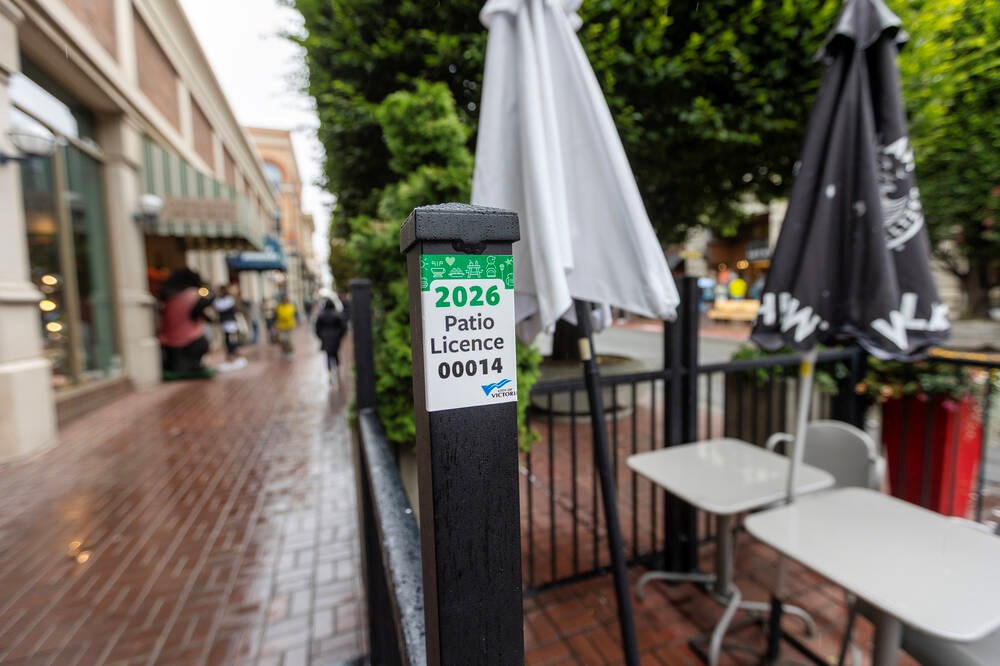
Council agreed to peg annual patio licensing fee increases to the Consumer Price Index, rather than go with an existing fee schedule with sharp increases next year.
Victoria businesses with street patios will have to start paying a little more for the right to keep operating them next year.
But the increases will be far lower than what was initially proposed when the city modernized its patio bylaws in 2023 in the wake of the COVID-19 pandemic.
Council unanimously voted in favour Thursday of a staff recommendation to peg annual patio licensing fee increases to the Consumer Price Index, rather than go with an existing fee schedule that would have seen patio-licensing costs sharply increase next year.
The cost of a patio licence in Victoria fluctuates depending on location and the complexity of the patio.
Fees for a patio that is set up daily were set to jump from $1.96 to $4.07 per square foot annually to $3.91 to $8.13 per square foot, starting in 2027.
Permanent patios would have seen fees increase from $2.78 to $5.78 per square foot annually to $5.55 to $11.55 per square foot.
The increase was supposed to go into effect last year, but was delayed to 2027, with fees frozen at 2023-2024 rates until then.
Council’s decision not to go ahead with the sharp fee increase next year will be a relief for the more than 80 businesses that participate in the city’s outdoor-patio program.
A city staff report says Victoria’s patio licensing is one of the most comprehensive in the province.
The city’s Patio Regulation Bylaw allows business owners to choose everything from setting up patios with fold-up chairs and tables on the sidewalk to installation of semi-permanent structures on the street. There are options for seasonal and annual licenses.
Downtown businesses pay the most, with cheaper fees for businesses farther away from the core, in village centres like Fernwood and North Park.
Mayor Marianne Alto said the decision to peg patio fees to the cost of inflation provides consistency and continuity for businesses that have patios or are considering them.
While restaurants and bars will directly benefit from the changes, patios create a more ambient and lively streetscape for everyone, Alto said in an interview.
Patios proliferated under pandemic-era programs that allowed businesses to meet pandemic-related social-distancing requirements.
Coun. Jeremy Caradonna said Victoria’s patio bylaw has been wildly successful, and the fee change is a way to show support for small businesses while still accounting for the city’s cost in administering the bylaw.
Calen McNeil, a founding board member of the Bread and Butter Collective, a group of hospitality business owners in Victoria, said the change is more equitable than an “indiscriminate doubling” of the fee in 2027.
Restaurants have small profit margins, and municipalities should be focused on simply covering their costs of administering business licenses rather than trying to profit from them, said McNeil, owner of Big Wheel Burger and Zambri’s restaurants. “Businesses have enough costs.”
McNeil said it’s evident that patios are great for encouraging community vibrancy.
About a decade ago, the city helped with a portion of the costs to install an outdoor patio at Big Wheel Burger’s Cook Street location through a community grant, and the space has become a cherished hang-out spot in Cook Street Village, he said.
“That’s the one thing we need more of in the city — more place-making and more places for people to go and to get together.”
City spokesperson Colleen Mycroft said letters will be sent to participating businesses informing them of the change next month.
The Patio Regulation Bylaw will still need to be amended at a future council meeting before the changes are officially made.