
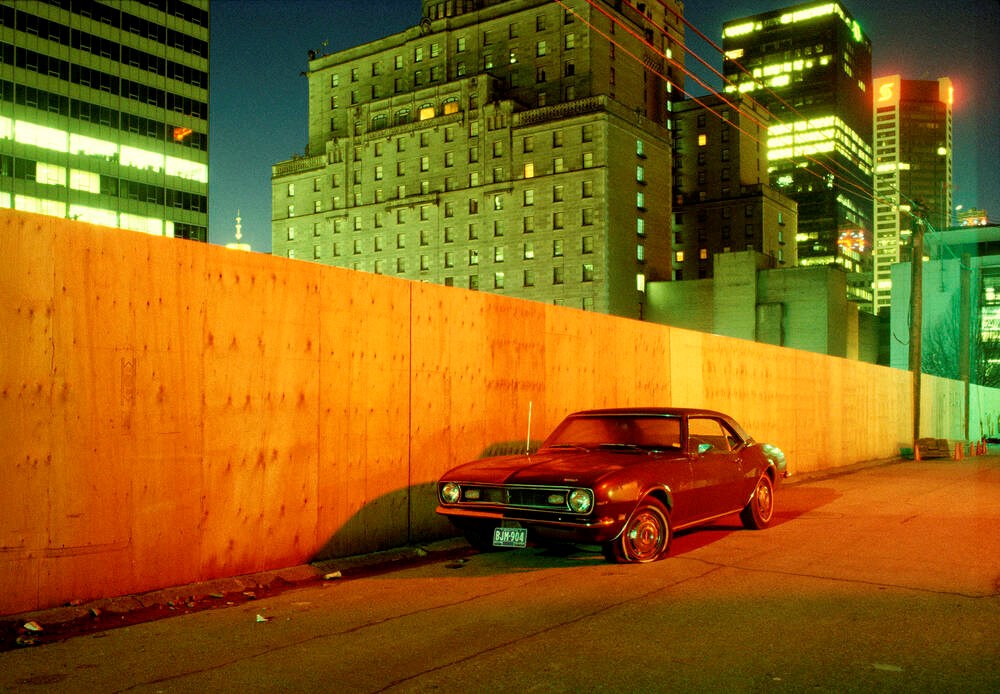
In 1972 – decades before Instagram – 16-year-old Greg Girard checked himself into a Downtown Eastside hotel with little more than some rolls of film and gut feelings.
The teen produced arresting images of the neighbourhood and its people, capturing the contrasts of neon on night, streetscapes and skylines, old and new.
“I discovered downtown Vancouver through my camera. I didn’t know the city. And it was a kind of fascination about this unknown, hidden, adult world,” he said. “It was cheap hotels, cheap restaurants and cafes, but it was a whole functioning blue collar down-at-heel world… It was dense with interesting stuff once you start paying attention to it.”
They were the beginnings of a trajectory that has led Girard around the world and into international accolades for his volumes of photos. Now, the pre-eminent Canadian photographer is being honoured with an extended exhibition at North Vancouver’s Polygon Gallery.
The exhibit presents more than 160 photographs shot between 1972 and 2026 – many of them never published before – tracing Girard’s evolution.
“It’s terribly gratifying, as you might imagine. I mean, when you begin, you have no idea if anybody’s ever going to see anything,” he said. “It’s one of the key lens-based photographic museums in Canada.”
A large swath of the contact sheet is from his decades living in Asia where Girard worked as a photojournalist. Covering natural disasters, civil war, coups and royal visits paid the bills but shooting for magazines is a different discipline than shooting for one’s own interest, he said.
“Hong Kong is an incredibly stimulating, modern city with interesting scruffiness at its immediate edges and so I loved the city and was trying to photograph it as best I could. And that just meant walking around a lot day and night,” he said. “I sort of felt like I had everything to myself, which was great.”
Eventually, Girard returned to Vancouver in 2012 to find a much changed city. The port where he shot industrial landscapes and blue collar workers had become cordoned off by security fencing so he sought new vantage points on the North Shore.
And he did find an audience that his 16 year-old-self would have found difficult to conceive – almost 250,000 who follow him on Instagram where he shares his works. It’s the vintage material from the 70s and 80s that draw the most engagement.
“I think there’s a lot of attention to the way things used to be in the pictures,” he said. “I think nostalgia, of course, plays a role but also there’s a sense of discovery.”
The launch of the Polygon exhibit coincides with the release of Girard’s latest book, Photographs 1972-2026, a compendium that, much like the Polygon show, captures the scope of his career.
“When people think of Greg Girard, they often call to mind images of urban settings at night, long exposures, empty streets, and neon lights,” commented Elliott Ramsey, who co-curated the exhibition with gallery director Reid Shier. “His reputation for photographing cities in transition is so established that what often gets left out of the conversation is how excellent he is as a portraitist.”
If there’s anything Girard hopes that audiences will take away from his show, it’s that virtually anyone can follow the same creative pursuit. And it’s a key time for that message to be heard, he said.
“These days, images can be generated by sitting in front of a screen in a room by yourself about anything… I think that would be abandoning something that matters that can be interesting, revealing, moving, engaging,” he said. “There’s that thing that photography has, walking out the door and going out into the world.”
The exhibit runs at the Polygon Gallery from July 10 to Oct. 25.