
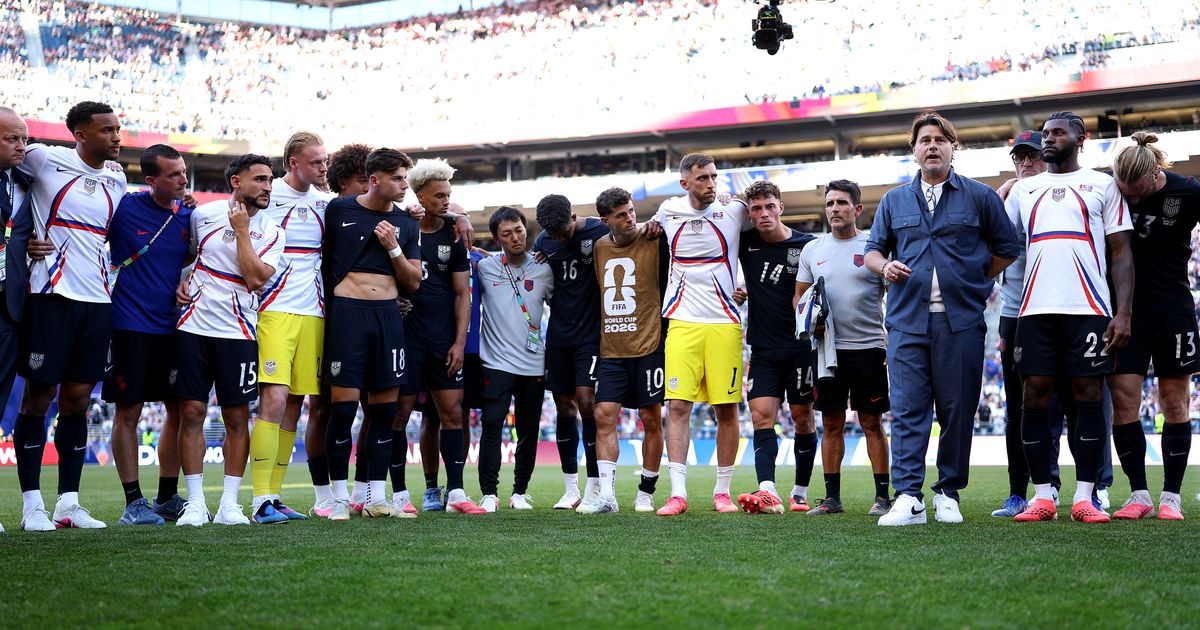
Photo: Sarah Stier/FIFA/Getty Images
Before Monday night’s World Cup Round of 16 game, Belgium coach Rudi Garcia was asked about the importance of the event. This is not a difficult question, and in any other context it would be a rather silly one. His team was playing an elimination game against the United States in the World Cup, the biggest sporting event on the planet, with the opportunity to reach the quarterfinal against juggernaut Spain. What could possibly be more important than that?
But after what had happened in the previous 24 hours, in which the president of the United States and his administration apparently strong-armed FIFA into allowing one of the host country’s best players to compete despite facing a red-card suspension, setting off a firestorm that threatened to engulf a tournament that had previously been going smashingly for everyone, Garcia understood what he was being asked. This was about more than Belgium, or a quarterfinal game, or even the United States team his squad was playing.
“We’re not defending the national team or federation,” Garcia said. “We are defending football.”
So, as it turned out, his team played with the passion of a nation, a continent, an entire sport defending its honor. And its opponents, our USMNT, a team that had played magnificently the entire tournament and had been just about the only non-Knicks thing unifying anyone in this clawing-itself-apart country … played like it knew the entire world was cheering against it. It crumbled accordingly. The U.S.’s World Cup dream ended on Monday night with a 4-1 loss to Belgium, but all told it was over long before that. Belgium pressed the U.S. team from the opening seconds, and the response was not increased aggression but undeniable fear: The U.S. looked spooked. It was as if it felt the weight of the soccer world’s anger all at once.
It’s important to remember that this is a new thing for the U.S. men’s soccer team. They are not the women’s national team, or USA Basketball, or any other sport in which the United States is the empire everyone’s targeting. The USMNT, as I have written for many years, is what Americans always consider themselves to be but never actually are: scrappy underdogs. On the world stage, they’re the perpetually undermanned, outgunned but improving team that is on its way up, a growth stock that’s worth getting in on the ground floor for. It’s a team, as we’ve seen throughout the tournament, that’s extremely likable and potentially ready to take its next step forward. But with one shocking reversal on Sunday — one that had a lot more people around the world talking about the integrity of global football and FIFA than just Belgium’s coach — that all turned around on them: They were the enemies, the bad guys … the empire. The U.S. team was not ready for that. Not many would be.
It was immediately obvious. (A friend joked that the first ten minutes of play felt achingly similar to the first ten minutes of watching Joe Biden on the debate stage two years ago. It was clear we were well and truly fucked.) U.S. keeper Matt Freese made a terrific save, his best of the tournament, in the first minute, which was exciting at the time but a harbinger of the many more attacks to come. It was also the last real positive defensive play the U.S. would make. The U.S. made a series of stunningly boneheaded defensive mistakes — the defense had been a worry heading into the World Cup as evidenced by the fact that they had to start Tim Ream, a very slow 38-year-old man with a man-bun. But Monday’s howlers were more mental mistakes than inherent physical deficiencies — and a very inspired Belgium team took advantage of every one of them. The one highlight the U.S. even had was Malik Tillman’s second remarkable free-kick goal in two games, which had the Seattle crowd (and watch parties across the country roaring), but the joy lasted for roughly 90 seconds until Belgium’s Charles De Ketelaere scored his second goal of the game on another defensive misstep. Every player’s shoulders were slumped the rest of the way.
For all the talk about Folarin Balogun, the man who apparently U.S. Soccer and the president were willing to infuriate the entire soccer world to get reinstated, the striker was a nonfactor in the game; he never got loose in space, and his teammates were unable to create anything for him. You have to feel for Balogun, who, of course, asked for none of this: not the undeserved red card, not the suspension, not the reinstatement, not becoming the instant avatar of everything the world (and especially Europe) despises about the president, America, and (especially) FIFA. His teammate Christian Pulisic, the supposed American superstar, was even less of a factor before leaving early in the second half with an injury … mere minutes after a nightmarish, almost inexplicable mistake from Freese gave up the third, most crushing goal. The U.S. simply did not look ready for all that was against them. They played accordingly.
The good news for Balogun, Pulisic, Freese, and the entire U.S. Soccer Establishment is that they’re unlikely to be seen as the lingering villains of all this. FIFA spent most of Monday trying to come up with increasingly vacant explanations for its decision, with president Gianni Infantino and the chairperson of the FIFA Disciplinary Committee trying to justify a process that never made much sense. Even if you wanted to believe that Donald Trump’s call to Infantino wasn’t the only reason the suspension overturn happened — and it does seem to be more the result of intense lobbying from U.S. Soccer and, notably, executive director of the White House Task Force for the World Cup Andrew Giuliani, who arguably is the one member of the Trump administration who has had a good summer — all credibility anyone involved with FIFA had on this of course vanished with the FIFA Peace Prize debacle of the winter. Trump has been the looming tower, the unfired Chekov’s gun, of this entire tournament, which has been, consistently, a glorious celebration not just of the sport but of the world, and even the U.S.’s place in it (and how different the actual United States looks from what the administration is trying to wrench it into being). That it went off was inevitable. But it, as Belgian journalist Samindra Kunti told our Andrew Rice, probably says more about FIFA’s inherent weakness — and its desire to do whatever it takes to maximize every last penny from this World Cup before packing up and heading out of town — than it does about Trump’s supposed strength. And it definitely doesn’t say anything about Balogun or this team’s players and even less so about its fans.
Viewing this loss through the prism of Trump and Infantino is perhaps more flattering to the USMNT and U.S. Soccer than seeing it from the perspective of a longtime U.S. Soccer fan, who, for all the hype and drama heading into the game, couldn’t help but find this sort of loss rather familiar. None of the four teams the U.S. played in this World Cup heading into this game — Paraguay, Australia, Turkey, and Bosnia and Herzegovina — are remotely in Belgium’s class, and, when you take a step back from it, the Belgium loss looked a lot like what happens when the United States has played teams of this quality throughout their history: Like the U.S. just isn’t in their league. The USMNT didn’t lose on Monday because of Trump’s intrusion or the anger the football world had toward them. But it may be more comforting to feel that way.
It was, in the end, a positive run for the United States in this tournament. They won a knockout round for the second time ever, they captured the national attention in a way they haven’t in more than a decade (and maybe ever), and they played a far more exciting style of soccer than we have ever seen from them in the World Cup and really any other tournament. They should be proud, and we should remember them fondly for it. But if there’s one thing Trump and Infantino and FIFA made certain of on Sunday: That is absolutely not what we will end up remembering them for.
Sign Up for the Intelligencer Newsletter
Daily news about the politics, business, and technology shaping our world.
Vox Media, LLC Terms and Privacy Notice