
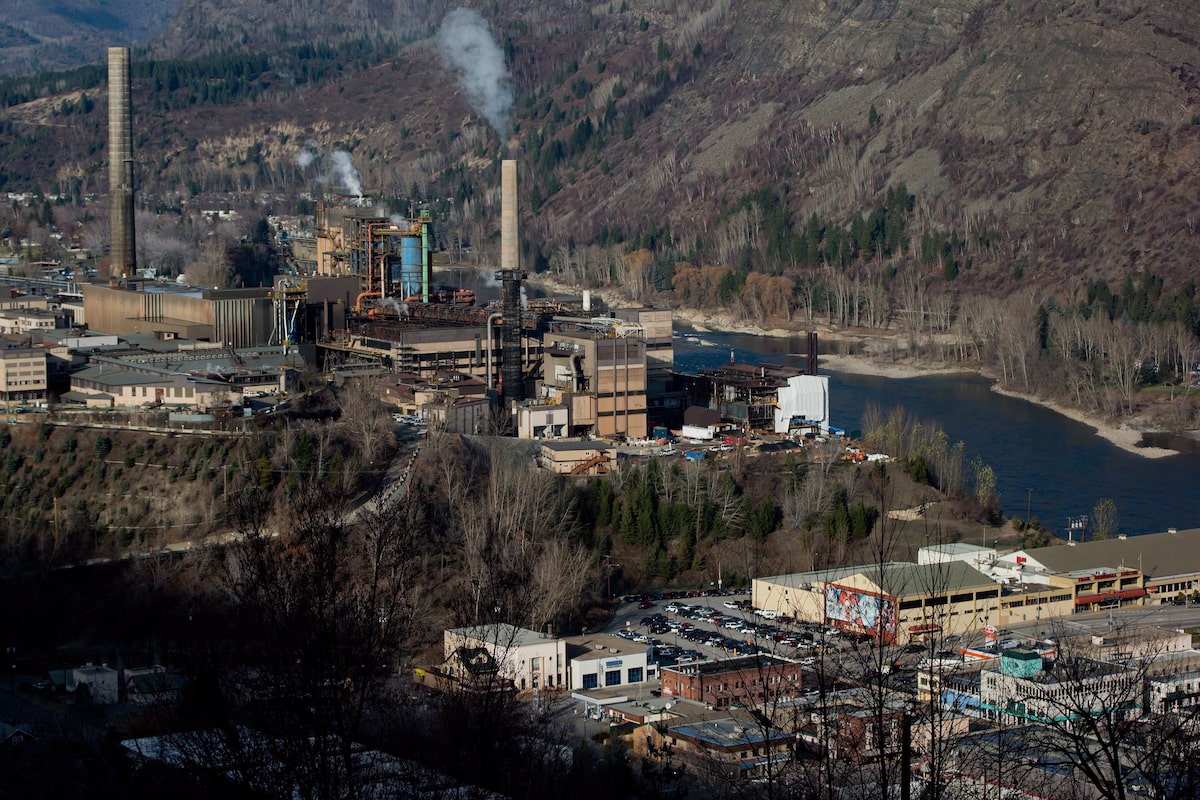
Teck’s zinc and lead smelting and refining complex, left, in Trail, B.C., in 2012.DARRYL DYCK/The Canadian Press
Ottawa is investing up to $400-million into Teck Resources Ltd.’s TECK-B-T Trail smelter in British Columbia and committing to stockpiling germanium, gallium and antimony as part of its multibillion dollar drive to bolster North American supplies of strategic metals and financially prop up Canadian mining companies.
The investment, first reported by The Globe and Mail on Monday, is the inaugural one from the new $2-billion Critical Minerals Sovereign Fund, now called the Canada Critical Minerals Accelerator (CCMA). First announced in last year’s federal budget, the fund will be managed by Export Development Canada, the government said in a release on Tuesday.
Tim Hodgson, Minister of Energy and Natural Resources, said in the release that the spirit of CCMA is about “turning Canadian resource abundance into real projects by giving industry the certainty they need to invest and grow, even in a volatile global market.”
The investment by Ottawa into Trail will be alongside an infusion of up to $850-million into the metals complex already committed by Anglo American PLC, which is in the process of acquiring Teck. London-based Anglo last year reached an agreement to buy the Canadian miner for about US$20-billion.
The direct investment from Ottawa into Trail will come via an equity-like investment by Canada Growth Fund. The financial terms were not disclosed. CGF is a $15-billion arm’s-length fund that has already invested hundreds of millions in Canadian mining companies over the past year.
Canada Growth Fund invests $25-million in Ontario rare earths recycling company
Ottawa in a press release said its investment could double Trail’s existing production capacity for germanium and antimony.
Antimony’s uses include flame retardants, and high-efficiency batteries. Germanium is used in fibre optics for telecom cables, semiconductors, and in military applications such as infrared optical vision. Gallium is used in semiconductors, and radar systems.
Well before the deployment of this first investment under the sovereign critical minerals fund, Canada has been ramping up the amount and frequency of its investments into the critical minerals sector. The Carney government has argued the investments are necessary to both help Canada diversify away from the U.S. during the trade war and fight off Chinese dominance in critical minerals.
The government on Tuesday said it will enter negotiations on an offtake agreement with Teck which would give it the right to purchase a portion of the future germanium, antimony and potentially gallium produced at Trail.
Ottawa had earlier agreed to stockpile other critical minerals to give mining companies the confidence to follow through on developing projects. The government has existing offtake agreements with Nouveau Monde Graphite for graphite production and with Rio Tinto for scandium, both in Quebec.
The Trail facility, which employs more than 1,400 people, has been in continuous operation for 130 years. Strategically located close to the Washington border, it was built by American businessman Frederick Augustus Heinze to smelt copper and gold from mines in nearby Rossland. Trail’s other owners have included Canadian Pacific Railway and Cominco Ltd. Teck took over the operation in 2001 when it acquired Cominco.
Editorial Board: Ottawa shouldn’t stake a direct claim on critical minerals
This year alone has seen several large public-sector investments by Ottawa in the mining sector, including a $500-million investment in the Red Chris mine expansion in British Columbia by the government last week. Red Chris is 70-per-cent owned by Colorado-based Newmont Corp., with Vancouver-based Imperial Metals owning the rest.
A few weeks ago, Canada Infrastructure Bank invested $200-million in debt into Generation Mining Ltd. Generation owns a promising copper and palladium project in Ontario. EDC last month participated in a $424-million debt financing alongside ING Capital LLC, and Société Générale S.A. into Generation Mining.
EDC and Canada Infrastructure Bank earlier in the year invested $459-million in Nouveau Monde to advance the company’s Quebec mine.
In all of these cases, government financings are accounting for a major component of financings that two or three years ago would have typically been done exclusively by the private sector.
Teck already makes a solid profit from Trail. The complex generated a gross profit of $281-million in 2025, compared with a loss of $66-million the year before.
China in 2024 banned exports of both germanium and antimony to the U.S., citing national security concerns. While China in late 2025 temporarily suspended the U.S. export ban, anxiety over security of supply persists. The U.S. has no domestic production of germanium.
From 2021 to 2024, Canada supplied 17 per cent of the U.S.’s germanium, compared with 23 per cent that came from China, according to the U.S. Geological Survey.