
What is the Magnus effect?
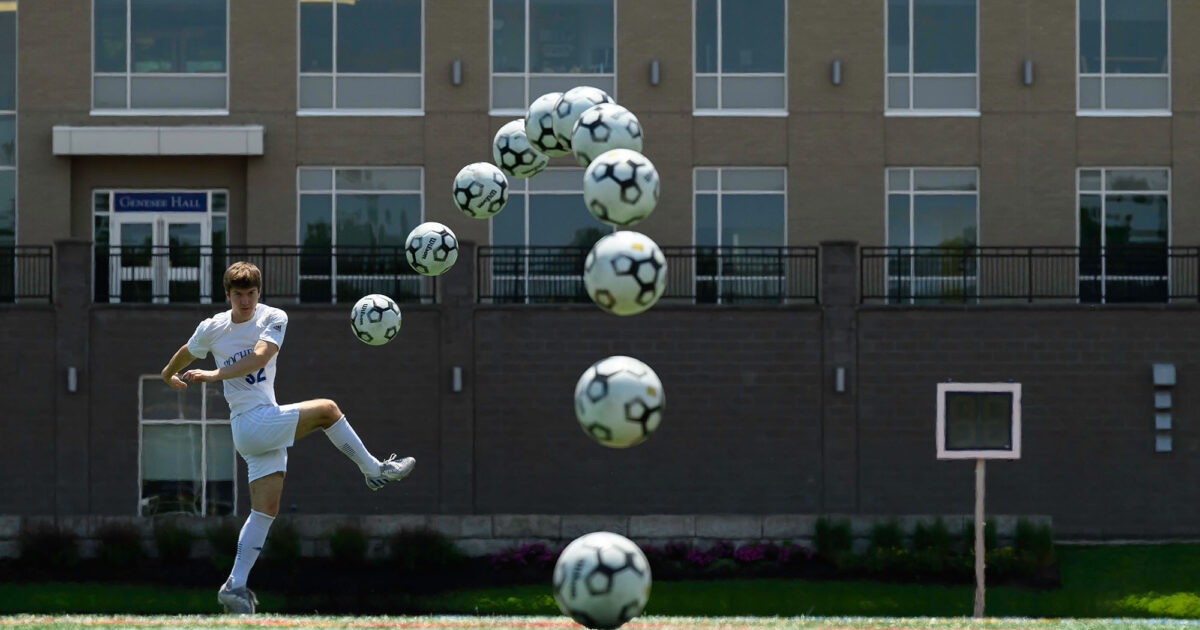
A bending soccer kick. A slicing golf shot. A tennis ball that sinks as it crosses the net. They’re all the result of the Magnus effect, rooted in Bernoulli’s principle.
“Whenever the motion of air over an object is slow, the pressure is high,” explains John Lambropoulos, a professor in URochester’s Department of Mechanical Engineering. “When the motion of air around an object is fast, the pressure is low. The difference in pressure creates a force that will make the ball swerve.”
That force is the Magnus effect, and spinning is essential to creating it, Lambropoulos emphasizes. The faster a ball spins, the greater the pressure differential and the more it will bend. If a ball is spinning on its vertical axis, it will curve to the left or right. If the spin occurs on the horizontal axis, the ball will sink or rise.
“This shot is so rare that when it happens, we have to sit back and admire how a human foot can execute the miracle we have just seen.”
The phenomenon is named after the 19th-century German physicist Heinrich Gustav Magnus, the first person to formally study and explain the effect; however, he didn’t discover it. Lambropoulos points out that the effect was observed centuries before Magnus, most notably by English polymath Isaac Newton, who noticed that spinning tennis balls travel along a curved path.
In soccer, goals scored using the Magnus effect are special. Lambropoulos says those who catch one while watching the 2026 World Cup should consider themselves lucky. “This shot is so rare that when it happens, we have to sit back and admire how a human foot can execute the miracle we have just seen.”
Curl it like Carlos
Given how the Magnus effect got its name, it’s fitting that the player most associated with the Magnus effect wasn’t necessarily its first or even greatest master.
Former English soccer star David Beckham is widely considered one of the greatest dead-ball specialists of all time. He likely cemented that reputation in 2001 with a goal scored on a 30-yard, curling free kick to secure England’s spot in the 2002 FIFA World Cup. Yet, there are many footballers before, during, and after Beckham’s career who are equally, if not more, adept at the skill. The list of elites includes Roberto Carlos, Ronaldinho, Lionel Messi, and the undisputed king, Juninho Pernambucano, who netted 77 free kicks.
The reason Beckham became synonymous with bending kicks is largely the 2002 soccer-based dramedy Bend It Like Beckham. He’s wholly worthy of the association, but it’s worth considering that a different free-kick specialist might have been immortalized in this way had a different screenwriter produced a similar script at a different time.
Lambropoulos, who has been involved with soccer for more than 55 years as a player, coach, and referee at many levels, confirms that one thing about bending a kick can be said with certainty: It’s hard. “Although we understand the physics of how this actually happens,” he says, “executing it to perfection requires a huge amount of practice over weeks, months, and years.”