

VANCOUVER – Murat Yakin had just seen his Switzerland side qualify for the World Cup quarterfinals for the first time since 1954. And yet it was when the Swiss head coach was asked about where the game had been played that his face truly lit up.
“(Vancouver) is a wonderful city, and we have been very successful here with the triple win,” Yakin said after he and his players finished their three-game stay in Canada, a number only matched by the Canadians themselves. “I really want to come back here with my family.”
Yakin’s smile stayed as he left the podium following his press conference. With that, Canada’s time as co-hosts of this World Cup ended. The remaining eight matches of the tournament will be played in the United States.
The 2026 World Cup will be missed in Canada. Because co-hosting it has the potential to prove transformative.
Soccer in Canada has had its moments, sure.
Toronto FC’s 2017 MLS Cup was the biggest sports story locally for a few days, but only because hockey’s Toronto Maple Leafs were at the beginning of their rebuild and, it being December, the season was over for baseball’s Toronto Blue Jays. A 2-1 win against Mexico in the Edmonton snow during World Cup qualifying in November 2021 heightened curiosity about the national team domestically, but did not grab it whole.
Having the World Cup finals in Canada was different.
The games in this country, especially the three the home nation played in, have been the biggest story in Canada this summer. And there is reason to believe that because of this successful run as co-hosts, Canadian soccer culture could elevate to a new stratosphere the way American soccer did after the U.S. hosted the 1994 World Cup.
The reality is that before the tournament began, Canada felt like it had been rather tacked onto this World Cup. The United States is hosting 78 of the 104 matches, compared to 13 each in Canada and Mexico.
Yes, the two Canadian host cities received as many games as the three Mexican cities in total. However, Mexico also played host to the World Cup’s opening match on June 11. That it then played host to one of the tournament’s best games — England against Mexico in the round of 16 last weekend — did make Canada feel like the youngster who was grateful to get an invite to sit at the adults’ table for once.
The first glimpses of Canada truly latching onto the sport domestically came in 2015, when it hosted the Women’s World Cup. The country logged impressive attendance numbers throughout: the 1.3 million total spectators remain the second-most in the tournament’s history. That was a higher number than in France, across the same number of games, four years later. Women’s soccer has hit heights in Canada that men’s soccer has not yet.
But if we’re talking heights in the game, the 13 games Canada hosted over the past month suggested we may not yet understand just how far this country could climb on the men’s side.
Canada showed out as co-hosts for this World Cup. There were raucous atmospheres and full stadiums for every game, despite the exorbitant ticket costs. The two stadiums both showed what some World Cup venues south of the United States border did not: charm.
In Vancouver, crowds gladly and energetically walked along False Creek, with a view of nearby mountains, to take their seats in BC Place. Remember, Vancouver originally dropped out of the bidding process in 2021 before eventually rejoining the following year. It would have been a crying shame for the soccer world not to have experienced Vancouver, and for the city not to show itself off as a true soccer destination.
BC Place might have been one of the smaller stadiums at this tournament with its capacity of just over 52,000 but it drew rave reviews and felt like a stadium that could host soccer for a long time.
“The city of Vancouver, I’ve only been here for a short stay, but I have to say it was a really nice stadium to play in. It feels, for me, like a real football stadium,” Belgium midfielder Kevin De Bruyne said after their 5-2 group-stage win against New Zealand there.
“The other two are massive, but you have all the NFL feeling (Belgium’s other two group matches were in Seattle’s Lumen Field and SoFi Stadium in Los Angeles), so I think for us it’s really nice. You felt it on the pitch. It’s a bit different, so it was a pleasure.”
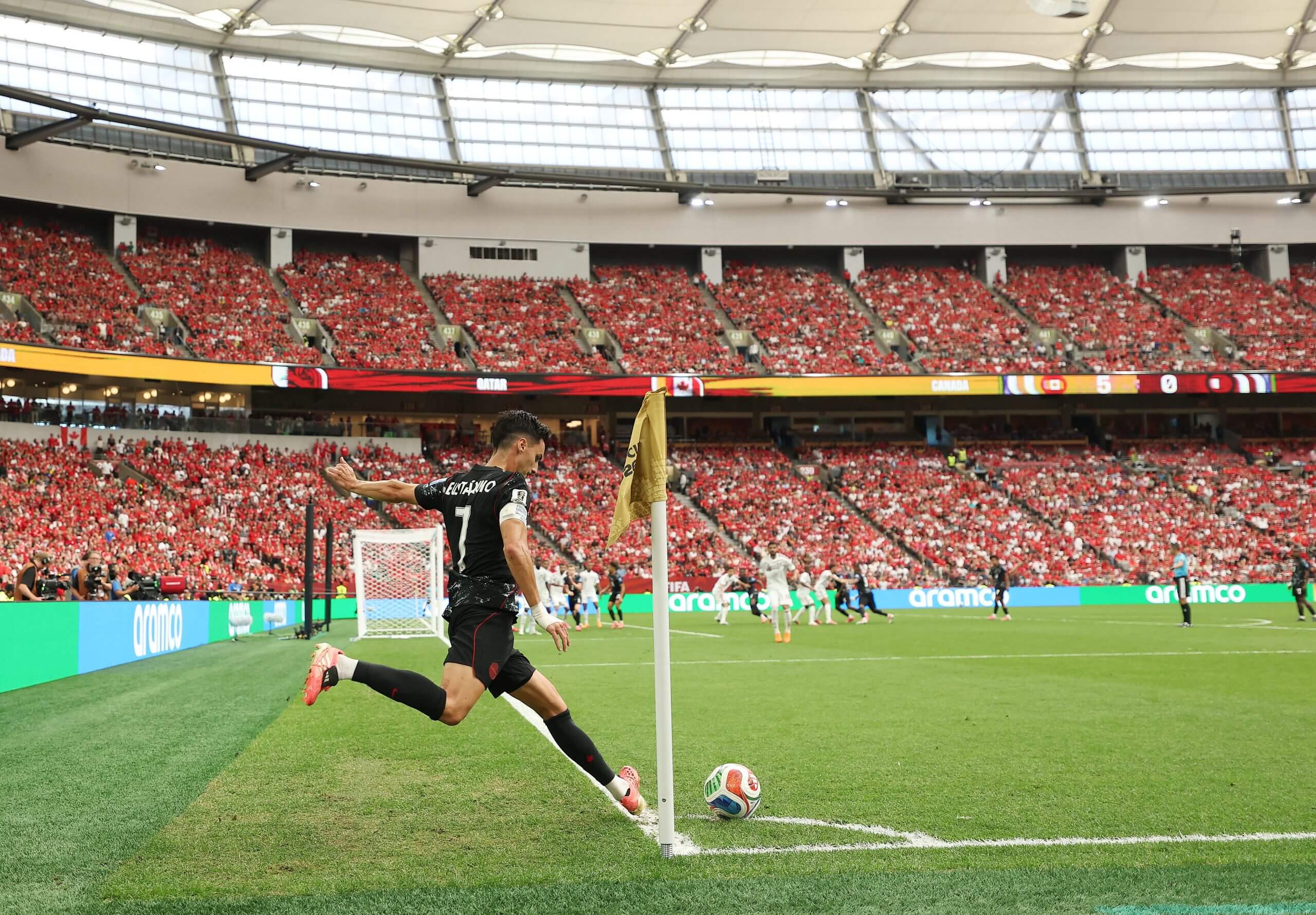
Stephen Eustaquio takes a corner during Canada’s group match against Qatar at a packed BC Place. (Sarah Stier – FIFA/FIFA via Getty Images)
And Toronto’s BMO Field?
Interest in the tournament appeared at a fever pitch when Canada kicked off there on matchday two against Bosnia and Herzegovina. Tension was palpable in the city, as the national team had spent nearly a week there training and welcoming young fans to training sessions before the match. The 17,000 added temporary seats did not feel like enough to capture the excitement around Toronto on the day of that game and through the city’s other five games.
BMO Field looked the part as the most traditional-looking soccer stadium in the World Cup — north of Mexico, of course. Perhaps more people throughout the city will be enticed to spend more time at BMO Field watching Toronto FC play in MLS in the months and years to come.
“It reminds me a lot of the old-fashioned Premier League grounds; a wonderful field, a wonderful field. So, congratulations to everybody,” since-departed Portugal head coach Roberto Martinez said after his team’s 2-1 win against Croatia there in the round of 32 — Toronto’s final match of the tournament. “I think it is a shame there are no more games here, because we really enjoyed it.”
Beyond the stadiums, at a time when the United States’ political influence on the World Cup came into question, Canada’s share of the tournament presented a healthy alternative.
Public transit ran on time and in plentiful amounts to get fans to and from games in stadiums that are incredibly close to the downtown core. Having Canadian women’s soccer legend Christine Sinclair record announcements for Vancouver’s Skytrain was a fitting touch.
Remember as well: Vancouver, generally speaking, is notoriously standoffish. And Toronto is one of the largest cities in North America. There is never any shortage of entertainment options. And yet?
The 2026 World Cup dominated the Canadian public’s interest from start to, for them, finish.
The tournament was omnipresent in both Toronto and Vancouver in a way it was not in every American host city. Every matchday in Canada brought the same energy beforehand. Fans gathered by the thousands and marched through the streets. Fan festivals were routinely packed. Colombia and Portugal fans showed up en masse outside their team’s hotel in Vancouver and Toronto, respectively.
Luis Diaz makes a brief balcony appearance in Vancouver
Phil Hay
“That’s just the way we roll in this country and in this city,” FIFA vice-president and CONCACAF president Victor Montagliani said of Canada and Vancouver as hosts during April’s FIFA Congress. “We’re very welcoming, and we understand what it means to treat our visitors the right way.”
And the interest in soccer stretched beyond Vancouver and Toronto.
An average audience of 5.4 million viewers on Canada’s host broadcasters (TSN, RDS, CTV, Noovo and Crave) watched Canada’s 3-0 loss against Morocco in the round of 16 on Saturday. That made it the most-watched World Cup game, outside of the final, on record in Canada. For context, the current population of Canada is a little over 41 million. Getting approximately one in every eight people watching a Canada game is a sign that this country is latching onto soccer for good.
Between Fox and Telemundo, a combined 42 million people in the United States watched the USMNT’s 4-1 round-of-16 defeat by Belgium on Monday. In terms of the respective percentage of population, the two countries’ viewership numbers are similar. Canada might even have a slight lead, depending on current population numbers.
Few would question the United States’ interest in soccer. And with the TV numbers during a home World Cup and the attitude displayed towards the sport during the 13 games hosted in Canada, no one should doubt its interest in soccer anymore.
Moving forward, Canada has an opportunity to cultivate a long-lasting soccer culture, thanks in part to the interest in the World Cup shown in both Vancouver and Toronto. Both cities are home to MLS teams, as well as two more Canadian Premier League clubs relatively close by. (I write that acknowledging that going to a Pacific FC game on Vancouver Island requires at least a 90-minute ferry ride.)
Although losing the Vancouver Whitecaps to possible relocation after the positive momentum built in the sport this summer would certainly cause the legacy of Canada’s World Cup to be tarnished.
And so, just like after the 1994 World Cup in the States, there is some onus on Canadian soccer fans, both new and diehard, to sustain interest in the sport by supporting local soccer. In Vancouver, there is a duty on the provincial government to find a solution to the Whitecaps’ stadium woes that keeps the team in town.
Public and private investment in local club sides is the easiest way to ensure that the legacy of this World Cup in Vancouver and Toronto will not fade away.
“The more professional soccer in this country, the better,” Canada Soccer CEO Kevin Blue said on Monday.
Blue sees the World Cup in Canada as a gateway to professional soccer thriving here. That could include, in his estimation, media interest and corporate Canada investing in professional domestic soccer after understanding the sport is “Canada’s fastest growing and most globally relevant”.
And now, more than ever, Canada should consider itself relevant in the soccer world.
“The conditions for helping facilitate (growth) are driven by the national teams and their success and the TV ratings,” Blue said. “I think what we just accomplished over the last however many weeks is an example of the power of this sport.”