
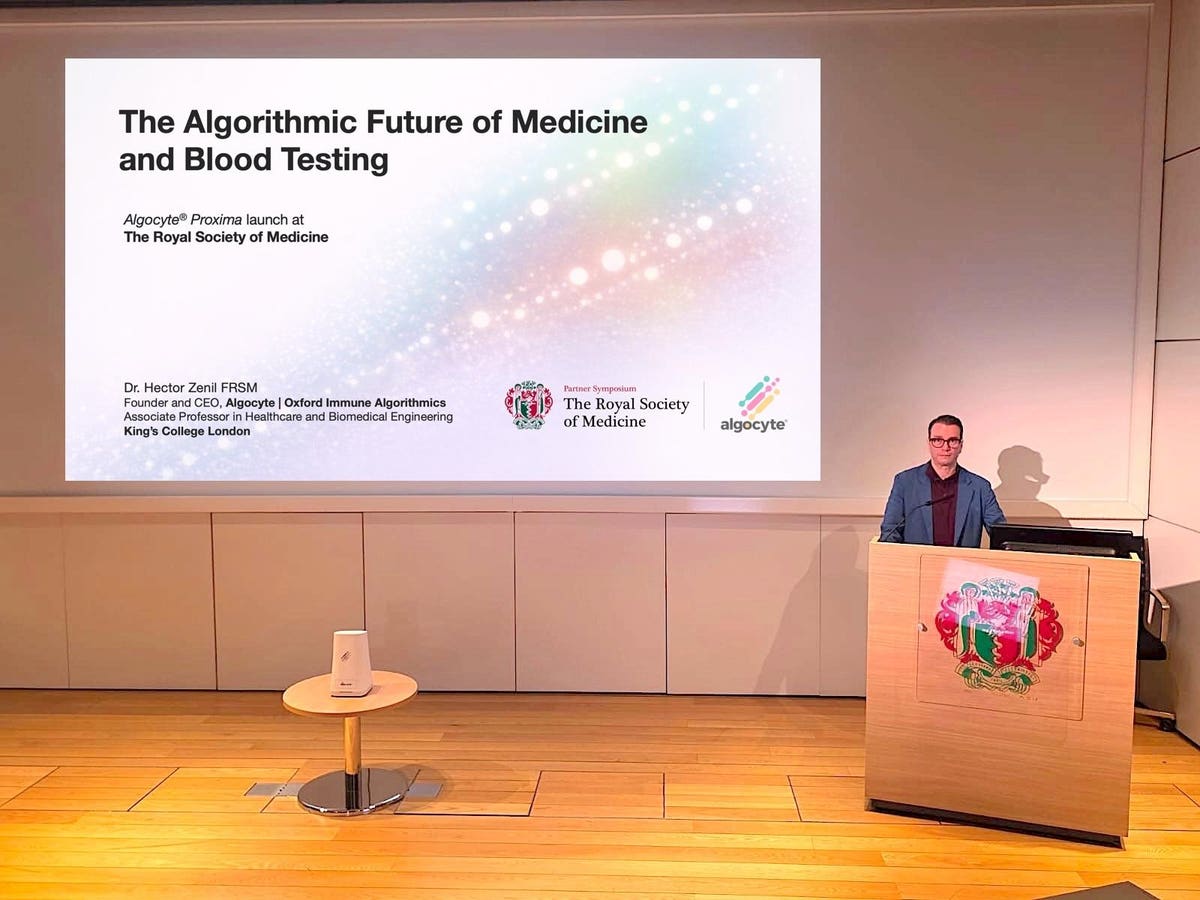
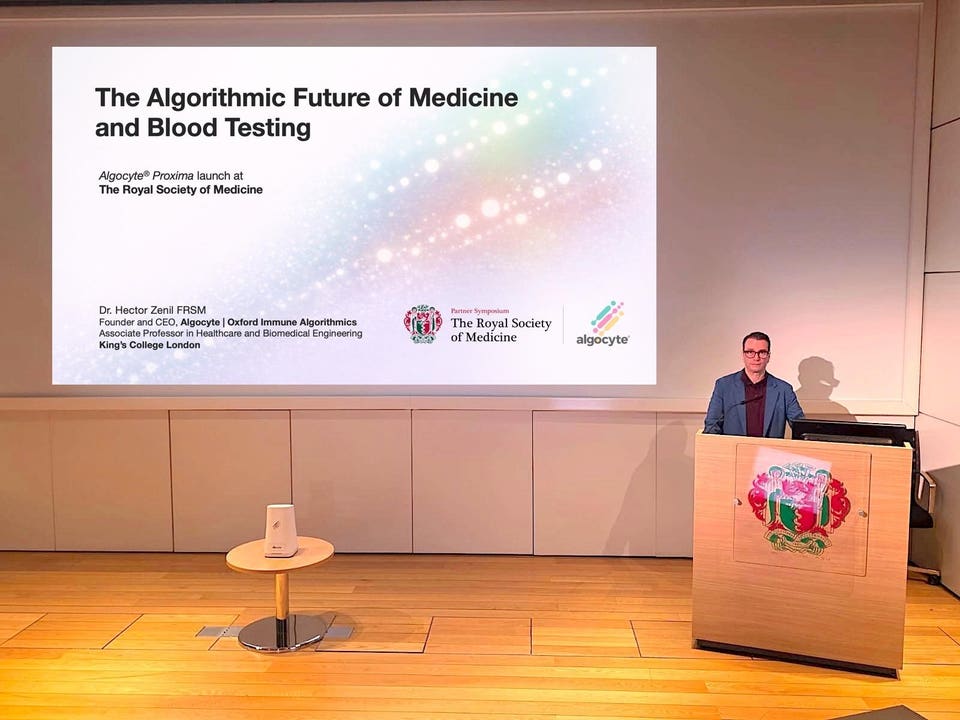
Dr Hector Zenil launching Algocyte Proxima at the Royal Society of Medicine in London.
(OIA/Algocyte).
For most of medical history, a blood test has answered one question: what’s wrong right now. Dr Hector Zenil wants toanswer a different one, what’s about to go wrong, and how much time you have to stop it.
That reframing is the entire premise of Algocyte Proxima, the diagnostics venture Dr Zenil has just launched at the Royal Society of Medicine in London. It’s a bet that the real value in blood isn’t in testing it more thoroughly, but in testing it more often, and reading the pattern of change over time as a health signal in its own right.
The problem with the snapshot
A conventional blood test is a photograph. It captures a single moment, and by the time it’s ordered, that moment is usually already a crisis, a symptom that’s worsened, a threshold that’s been crossed, an event that’s already occurred. Organ damage or arterial plaque can be well underway before a diagnostic test ever flags it.
“Most systems wait for symptoms to worsen, for disease to advance, or for patients to reach critical thresholds before action is taken,” Dr Kourosh Saeb-Parsy, Chief Medical Officer of Algocyte and Professor of Transplantation at Cambridge and surgeon at the NHS, says. “The technology was created to challenge this model.”
His argument is that blood is less a diagnostic tool than a continuous data feed, one that most healthcare systems only glance at a handful of times in a person’s life. Zenil explains, “Blood is the body’s natural information highway, continuously carrying signals about immune status, inflammation, metabolic function, infection, and disease progression.” He argues the opportunities are immense, “By combining blood testing with contextual data, patient-reported experience, and advanced AI, it will become possible in the future, to build a much richer, more dynamic, and more personalized picture ofpeople’s transition between health and disease.”
His central claim, the one that does the most work in this pitch, is deceptively simple: “The greatest opportunity in blood testing is not measuring more biomarkers but measuring change, or lack thereof, more often. This is where earlier, more personalized medicine begins.”
Who’s behind this innovation?
Dr Zenil arrives at this with an unusual hybrid background: a career built at the intersection of mathematics, complexity science, AI and computational biology rather than conventional clinical medicine. He holds a permanent academic position at King’s College London as Associate Professor in Healthcare and Biomedical Engineering, with previous research and academic affiliations spanning Oxford, Cambridge, the Alan Turing Institute and the the Karolinska Institute and with current research affiliations with the Francis Crick Institute and the King’s Institute for Artificial Intelligence,. That grounding in causality and complex systems is what he points to as the intellectual scaffolding for treating disease not as a fixed event to be diagnosed, but as a trajectory to be modelled. His team, on the other hand, with whom he has worked on this technology for over five years, is a group of leaders in areas ranging from deep learning, mechatronics, biochemistry, nanotechnology and quantum computing carefully assembled early on and without whom, he says, Algocyte would not be possible. “I always surround myself with brilliant people and try to keep them close, this is the only way to get things right and done” Zenil says.
A gap that skews by gender
One of the more striking arguments in Zenil’s pitch isn’t about technology at all, it’s about behaviour. Women, tend to enter the healthcare system earlier and more often, through reproductive milestones, contraception, antenatal care and routine screening. That contact builds a habit of testing but women’s health is yet the least understood because the system has for far too long been led and gravitated around the understanding of men’s anatomy and men’s physiology.
Men, by contrast, are also more prone to what is sometimes called the ostrich effect, avoiding the check that might deliver bad news. NHS data suggests only around two-thirds of eligible men attend preventative GP visits, and fewer than half attend the screening checks offered from age 40. The result, is that many men’s first blood test comes only after a major symptom or cardiovascular event, diagnostic, not predictive, and years too late to have been useful as prevention.
On the other hand, many patients, in particular those with chronic diseases including cancer undergoing treatment, both women and men, are often not monitored close enough missing optimal treatment schedules or developing complications because of their immunocompromised bodies.
What Algocyte Proxima actually measures
Algocyte Proxima is a medical instrument built around a full blood count expanded well beyond what’s typically offeredtoday. Zenil says incumbent frontier blood-testing devices for home use check at most three or four markers and are not user-centric, robust or sufficiently portable. Algoyte Proxima is operated with a phone app through Bluetooth. Its AI is grounded in physical and biological measurements, and produces thirteen key markers. These markers constitute a complete blood count, and are among the most commonly measured by medical teams, related to to the immune system: the number and shape of blood molecules and blood cells including red blood cells and multiple types of white blood cells, platelets and haemoglobin, each component specializing in a different immune function, from identifying pathogens to killing bacteria and virus to producing antibodies or preventing bleeding.
A future AI layer under current conformity assessment will sit on top of the blood data itself, pulling in inputs from wearables, medical records and lifestyle factors to build a fuller picture than a lab result alone could provide.
The clinical applications Zenil identifies are specific rather than generic. For cancer patients, tracking changes like neutropenia, leukopenia, anaemia or thrombocytopenia over time, rather than at a single point could support earlier clinical interventions when things are going wrong, or schedule treatment in a more optimal fashion to attack a tumor more effectively. For people managing chronic or autoimmune conditions like lupus, the same continuous-monitoring approach could flag the haematological shifts that precede a flare, prompting further testing before symptoms escalate.
Where this is heading?
The near-term product is a more comprehensive, more frequent blood panel. The long-term ambition is bigger: what Zenil calls a “digital blood twin”, a continuously updated computational model of a person’s blood trajectory that integrates lab data, patient-reported experience and real-world context to anticipate, simulate and intervene in health and disease before complications arise of conditions are too late for treatment.
It’s a vision that depends on solving two very different problems at once. The first is technical: building AI models sophisticated enough to make useful predictions from noisy, longitudinal health data, and validating that those predictions actually improve outcomes rather than just generating alerts. The second is behavioural: persuading the people least inclined to get tested to test far more often than they currently do by finding the right incentives. A better blood test doesn’t help anyone who never takes it.
Whether Algoccyte Proxima closes that gap or simply serves the already-engaged is the open question. But it certainly makes it easier and the reframing itself, from blood test as verdict to blood test as ongoing conversation, is a genuinely different way to think about what preventative healthcare could look like in contrast to the current approach that only treats people who are already ill.