

Listen to this article
Estimated 3 minutes
The audio version of this article is generated by AI-based technology. Mispronunciations can occur. We are working with our partners to continually review and improve the results.
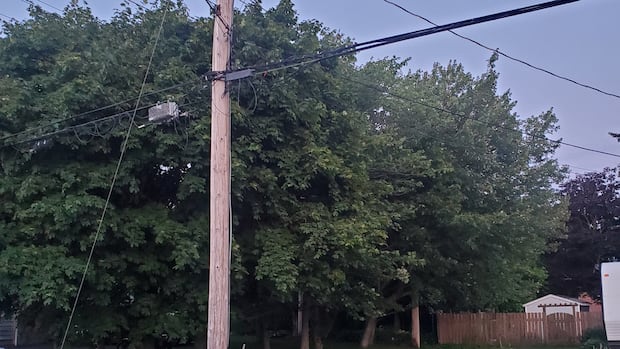
A Dartmouth couple has saved a number of large trees that are encroaching on transmission lines from being cut down on their property after striking a compromise with Nova Scotia Power.
While the utility said it wants to work with the landowners in this case, it is urging people to research which trees can be planted safely near power lines before similar problems take root.
Jeff Rodgers, who has shared the same home with his wife for over 30 years, said they were told by a contractor that 12 trees on their property had to go.
“They would remove them, leave the stumps and be on their way,” Rodgers told CBC Radio’s Information Morning, recalling the conversation.
In the past, he said Nova Scotia Power would have the trees trimmed to keep them safely away from power lines. This time, however, Rodgers learned they were going to limb the trees in preparation to remove them entirely.
“They said they were dangerous, they said that they were too close to the line and … they didn’t want to trim them anymore,” he said.
Jason Lyver, the utility’s manager of vegetation management, said trees can only tolerate so much topping — the practise of removing or cutting back branches from a tree’s crown.
“The tree’s response is to put off vigorous growth afterwards and that growth can sometimes exceed three feet [0.9 metres] in a growing season,” he told Information Morning.
In addition, Lyver said the trees on Rodgers’s property have become a safety concern — they’re within 30 centimetres of a 69,000-volt transmission line. The utility has the right-of-way for clear access to its equipment, Lyver added.
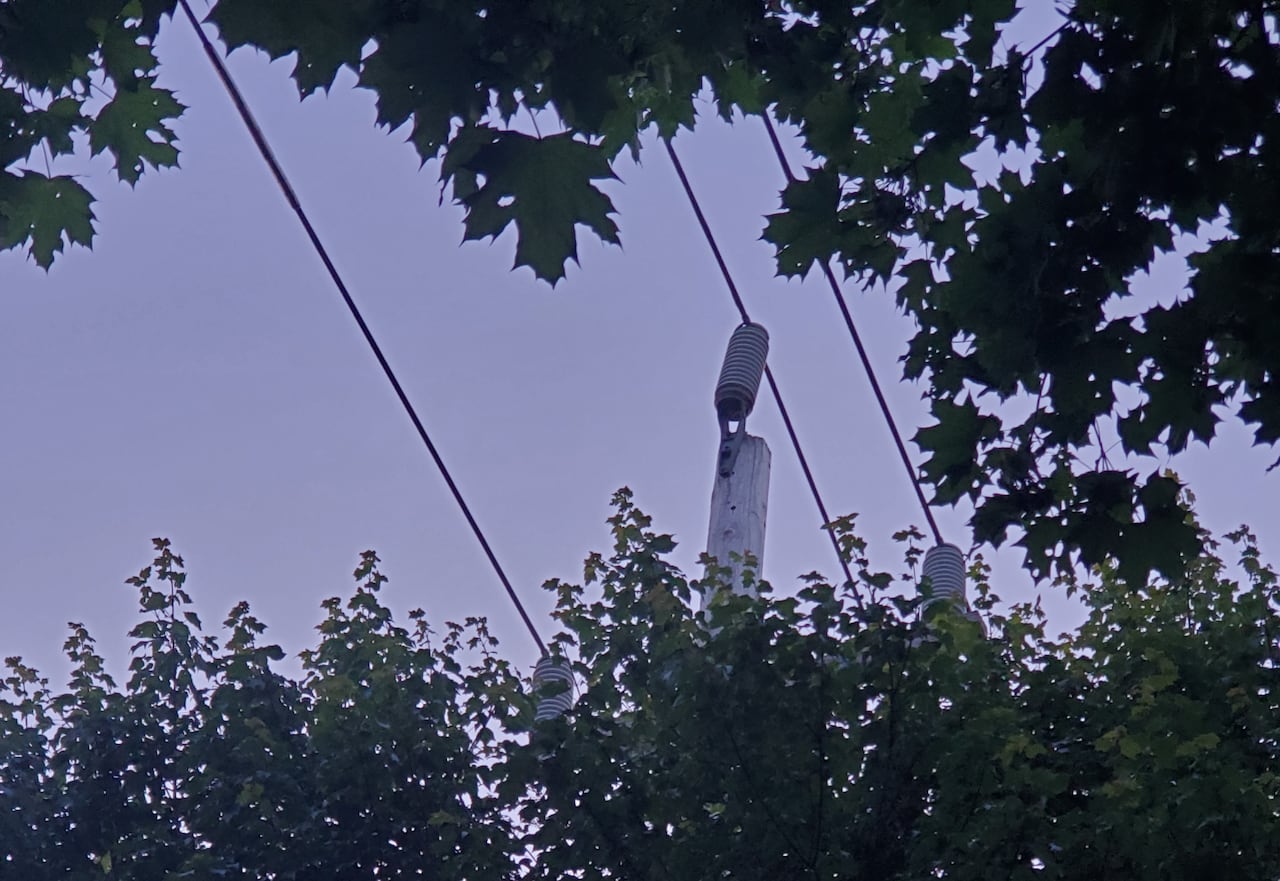 Some of the trees on Rodgers’s property are growing near transmission lines that run 69,000 volts of power. (Jeff Rodgers)
“We don’t want those trees in contact with that voltage,” said Lyver. “It’s a hazardous job to start with, so when you get those trees that are encroaching that zone in that proximity, we’re putting additional risk to our contractors.”
When Rodgers was told about the plan to remove the trees, he demanded documentation proving the trees needed to go and reached out to municipal leaders about his concerns.
“We’ve planted most of those,” said Rodgers. “We know each of these trees.”
In the end, the utility agreed to cut down three trees for now, while aggressively trimming others. It also agreed to remove the stumps and replace them with more compatible trees for the area — something it does not usually do.
Nova Scotia Power’s website lists magnolias, flowering dogwoods, crabapples, globe maples and dwarf Serbian spruce as examples of trees that can be planted near power lines.
“We really want to work with the landowners, it’s not lost on us the intrinsic value of the trees,” said Lyver.
However, Lyver said some of the trees left behind on Rodgers’s land will have to come down in the future.
“They should never have been there in the first place,” he said.
MORE TOP STORIES