
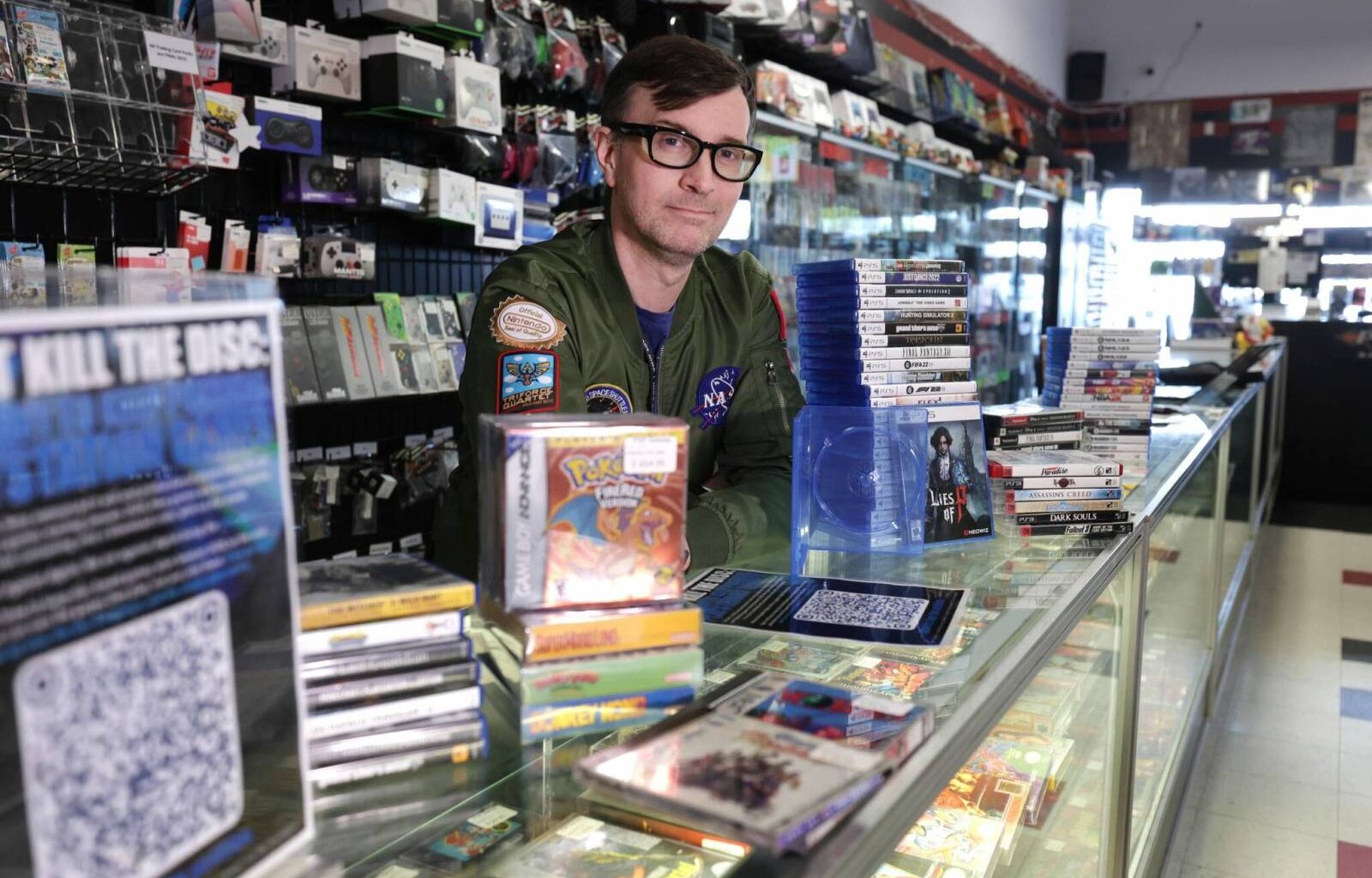
Atop a counter displaying vintage video games, a sign urges passersby to petition Sony Group Corp.
The Japanese multinational company’s PlayStation system discs aren’t retro — yet. But they will be in 2028, when Sony plans to stop producing the physical products.
Its games will be sold online or in “digital formats” at shops, including as codes.
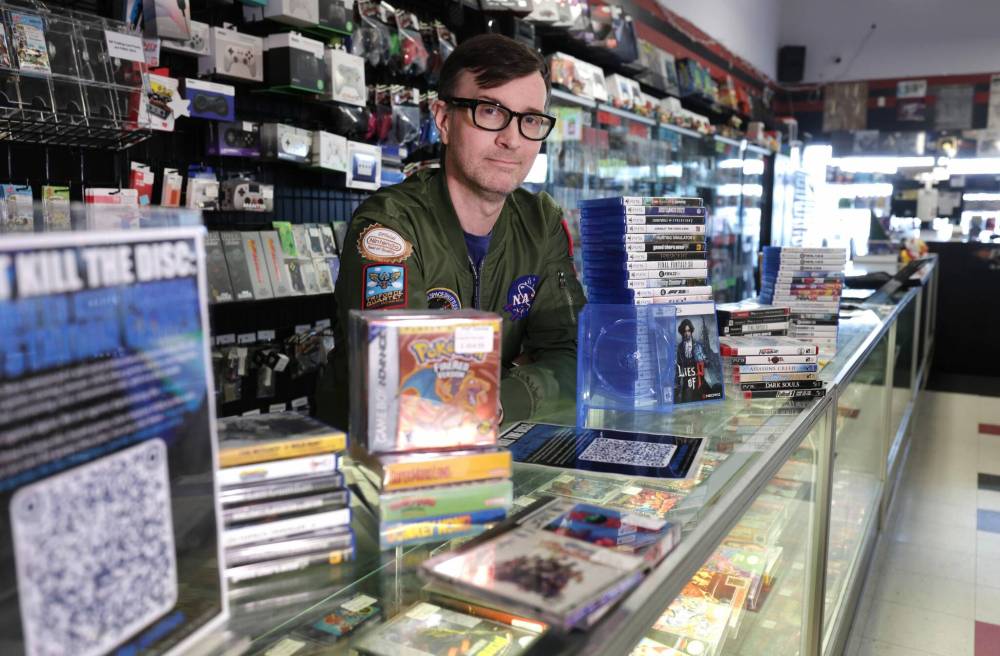
Ruth Bonneville / Free Press biz – PNP Games Photo of Dan Boissoneault, business and community development representative of PNP Games. PNP Games has started a petition calling on Sony to reverse its decision to stop making physical discs for PlayStation 5. The decision takes effect in 2028; the petition has gotten more than 200,000 signatures. PNP Games, 160 Meadowood Dr See story by Gabby July 8th, 2026
Winnipeg-based independent chain PNP Games has outfitted its St. Vital area store with signs of protest. It’s also launched an online petition — one garnering more than 231,000 signatures in roughly a week.
Its leadership worries the change will hurt business.
“Sony is … taking away the option for people,” said Dan Boissoneault, PNP Games business and community development representative.
“The biggest component — especially for our customers — is being able to own (a game) and keep it and have it as part of their collection for years.”
He walked through the shop, which sells new PlayStation, Nintendo and Xbox games behind its counters. Sony petition signs covered Atari 2600 cartridges; Super Nintendo wares were nearby.
PNP Games’s petition argues using a download code isn’t the same as buying a physical game.
Those options are already available, Boissoneault noted — and they’re less popular to purchase.
The petition raises fears of future job loss in the video game industry, from retailers to distributors and manufacturers. It calls on Sony to reverse its decision, which the mammoth company publicized July 1.
Sony cited a shift in “consumer preferences and the broader entertainment industry” from physical discs to digital in its Canada Day statement.
Digital sales accounted for a majority of the brand’s gaming revenue last year. Globally, just one-fifth of gamers favour consoles, a 2025 report from the Entertainment Software Association states.
More than half of gamers prefer to play on their smartphones; 21 per cent choose computers.
“I think the retail landscape is … becoming very niche,” said Jeffrey Pidsadny, a game level design professor at Sheridan College in Ontario. “It’s going to be very different to compete, because what is the value that you’re offering the consumer?”
Boissoneault has already clocked a shrinking video game retail space. Big-box chains are pulling back on their offerings, he said.
EB Games has shops in Winnipeg; Entertainment Exchange in Grant Park Shopping Centre has a corner devoted to the hobby.
PNP Games runs three Winnipeg locations. It’s been stocking more game-related merchandise — Mario mugs, Pikachu plushies — over the past five years to accommodate shifting demand, Boissoneault said.
Sony’s lack of physical games could lead to fewer customers in the long-term, he added.
“It will definitely affect our business, but we’re going to be working to … fill that hole,” Boissoneault said, adding the company will “find opportunities” as a niche shop while bigger chains cut their video game aisles.
Nintendo Co., Ltd., still leans into physical games, Boissoneault noted.
Pidsadny considers Sony’s move “a numbers game.” When physical games are sold in store, the money is split between the game developer, retailer and console maker.
Involving fewer parties generally means the companies keep more cash.
Sony didn’t respond to questions by end of day Wednesday.
The video game giant’s decision comes amid uncertainty in the industry, with consolidation and layoffs. However, the sector is still widely popular, Pidsadny said.
Brick-and-mortar video game sellers’ situations will worsen if companies such as Microsoft Corp’s Xbox follow suit, said Andrei Zanescu, a Concordia University professor who researches large-scale game distribution.
It’s unlikely Sony will reverse course on its decision, Zanescu said.
A European plant that manufactures PlayStation game discs is restructuring to make optical microlenses, according to media reports citing ORF Salzburg, an Austrian publication.
Price and other factors can make Sony’s biggest competitors — PC and Xbox — inaccessible, Zanescu added: “Sony is basically making a gamble that people will not leave, no matter how much this annoys them.”
Trading old games and lending are ways gamers keep costs down. Those will be lost as games move fully digital, Zanescu said.
Daniel Voth, executive director of Winnipeg Game Collective, opts to play games online, in part because of the costs of console-based games.
“Even if I’m not directly affected by it, there’s people that are,” Voth said, adding he’s against Sony’s change.
“I think it would be important to have some more control of what we buy. Terms of services can change, and then we’re at the mercy of the company.”
Fabio Hofnik, who’s co-creating the Manitoba Computer and Gaming Museum, signed PNP Games’s petition.
Winnipeg Free Press | Newsletter

The customer experience has morphed. There are few collectibles, such as world maps and detailed instructions, that come with physical discs, Hofnik said.
“This experience was very unique to these kinds of games,” Hofnik said, adding there’s demand for third-party companies who make such collectibles.
Boissoneault called games a “community thing” — something to share with family and friends, and to pass down to children.
The petition is being sent to Sony, he said.
gabrielle.piche@winnipegfreepress.com

Gabrielle Piché reports on business for the Free Press. She interned at the Free Press and worked for its sister outlet, Canstar Community News, before entering the business beat in 2021. Read more about Gabrielle.
Every piece of reporting Gabrielle produces is reviewed by an editing team before it is posted online or published in print — part of the Free Press‘s tradition, since 1872, of producing reliable independent journalism. Read more about Free Press’s history and mandate, and learn how our newsroom operates.
Our newsroom depends on a growing audience of readers to power our journalism. If you are not a paid reader, please consider becoming a subscriber.
Our newsroom depends on its audience of readers to power our journalism. Thank you for your support.