
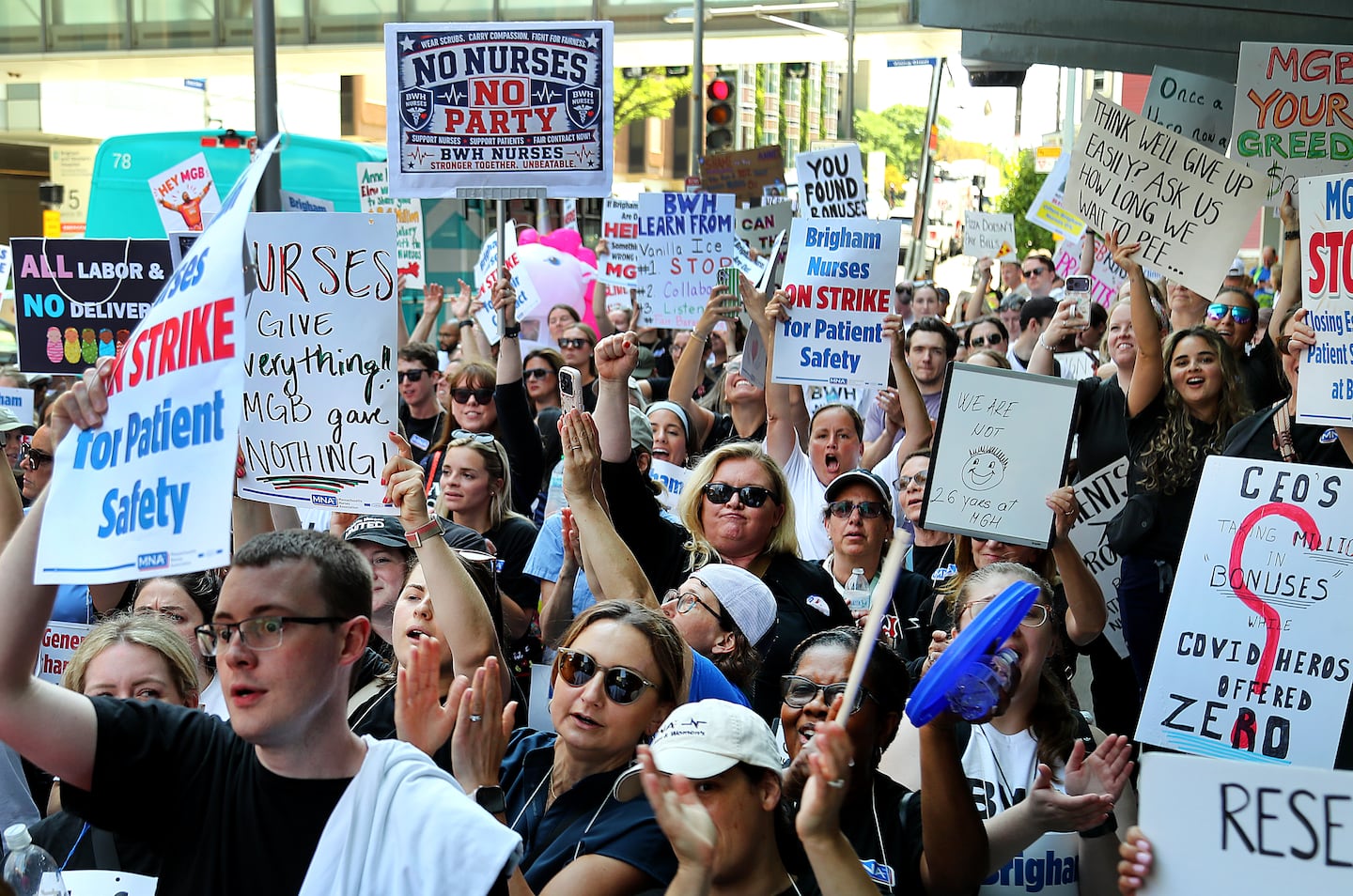
The strike has disrupted one of the nation’s top-ranked hospitals and prompted division within the state’s largest health care system and the broader public over whether the nurses or management should budge.
Late Wednesday, parent company Mass General Brigham and the nurses union met at the State House in a meeting convened by Governor Maura Healey and Mayor Michelle Wu, but those talks ended without an agreement.
Massachusetts Nurses Association spokesperson Joe Markman said in a statement the union reiterated its interest in negotiating with the health system.
“The Governor urged both sides to return to bargaining,” Markman said. ”We are waiting for MGB to respond.”
The strike began at 7 a.m., with thousands of Brigham nurses and supporters gathering on Francis Street outside the hospital, ringing cowbells, banging on plastic buckets, and cheering when drivers of passing cars pealed off a chorus of supportive honks. The nurses, sporting “Union Strong” and “Brigham Nurses United” shirts, waved signs calling out management. “Value Nurses Like You Value Your Bonu$e$,” one sign read.
A separate group of 450 clinicians who visit patients at their homes under MGB Home Care also went on strike Wednesday, for seven days.
 Yaeko Karatonis, wearing a starfish suit, marched during the first day of the nurses walkout outside Brigham and Women’s Hospital on Wednesday.Christian Kantosky for The Boston Globe
The sides are particularly far apart on wages. The union wants a 3 percent raise for the first six months and a 4 percent raise for the next 12 months of the contract. The hospital isn’t offering any new across-the-board raise, but notes nurses already receive a 5 percent step increase on the yearly anniversary of their hiring until they reach two decades of service.
Brigham nurses start at $86,700 annually, and those with two decades of service earn at least $220,000, according to documents shared by MGB. Nearly one-third of the union, or 1,322 nurses, earn that maximum amount, MGB said, making them among the highest paid in the state.
MGB has said the nurses’ demands are not “financially sustainable and not supported by the current labor market.”
MGB representatives said they have hired nearly 1,300 temporary nurses to keep the hospital running as normal. Picketers called those replacements “scabs,” and said the transition inside the hospital Wednesday morning was not smooth.
Kelly Morgan, a Brigham nurse and head of the union chapter, said hospital management kept union nurses working on several units beyond the scheduled end of their shifts as the strike began, including the neonatal intensive care unit and the cardiac catheterization lab, because they didn’t immediately have enough replacements.
MGB disputed reports that temporary nurses weren’t ready in time for shift change.
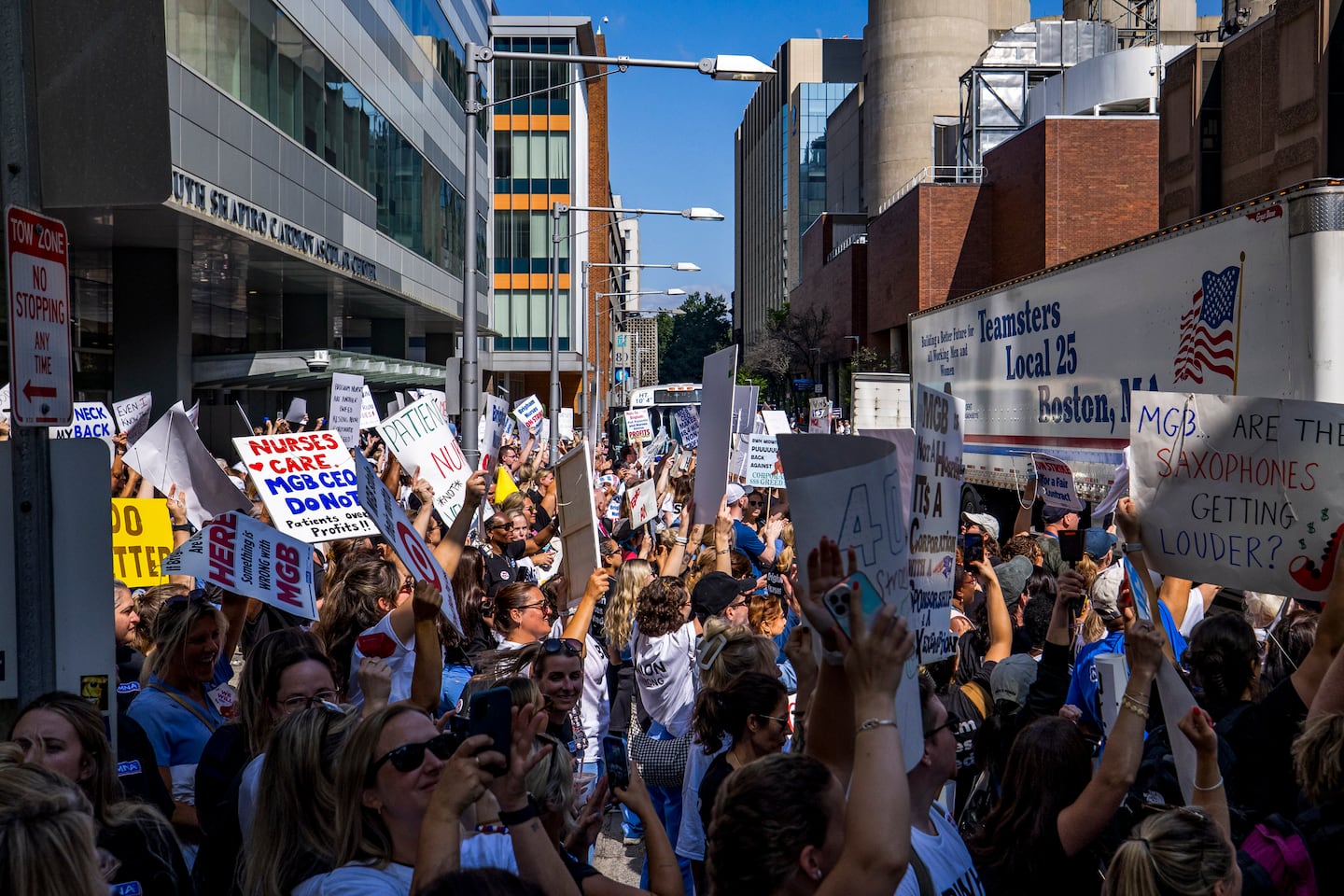 Nurses cheered as a Teamsters truck honked after the nurses strike began outside Brigham and Women’s Hospital on Wednesday.Christian Kantosky for The Boston Globe
Inside the Brigham Wednesday afternoon, medical and nurse leadership said they had aggressively prepared for the potential pitfalls of staffing every unit with temporary nurses.
The labor and delivery unit had 32 nurses, up from the unit’s usual 25 or 26, they said, and the cardiac surgery intensive care unit had three additional nurses on board. In the emergency department, nurse leaders wore neon vests so that the temporary staff could recognize them more easily.
The number of patients in each unit was typical despite the strike, management said. While the emergency room saw a slight dip in the number of walk-ins compared to other days, the department was still at full capacity.
One doctor, who requested not to be named, said she had been at the hospital since before 5 a.m. preparing for worst-case scenarios: “I’m just so proud of our team.”
Several patients, however, said they were disappointed MGB didn’t tell them sooner about the strike and what to expect.
Destiny Cosby, a 23-year-old who has been with her son at the Brigham for 70 days since he was born prematurely, said hospital leaders didn’t speak with her about the strike until Tuesday.
“I had to learn from the news,” Cosby said.
Ben Mays, 38, whose wife just gave birth and is recovering at the Brigham, said he was shocked at how little information they received before the strike.
“If I ran an organization, the number one thing I would be thinking about … is you would do very clear communication in advance,” Mays said. “It seems like the leadership here is almost embarrassed to talk to patients and communicate what’s going on.”
MGB said it had notified patients about the strike through flyers on meal trays, messages on TVs, and signs.
“We understand how stressful this moment is for patients,” MGB said, adding it has activated plans for emergencies “to ensure that patients continue to receive high-quality, safe care.”
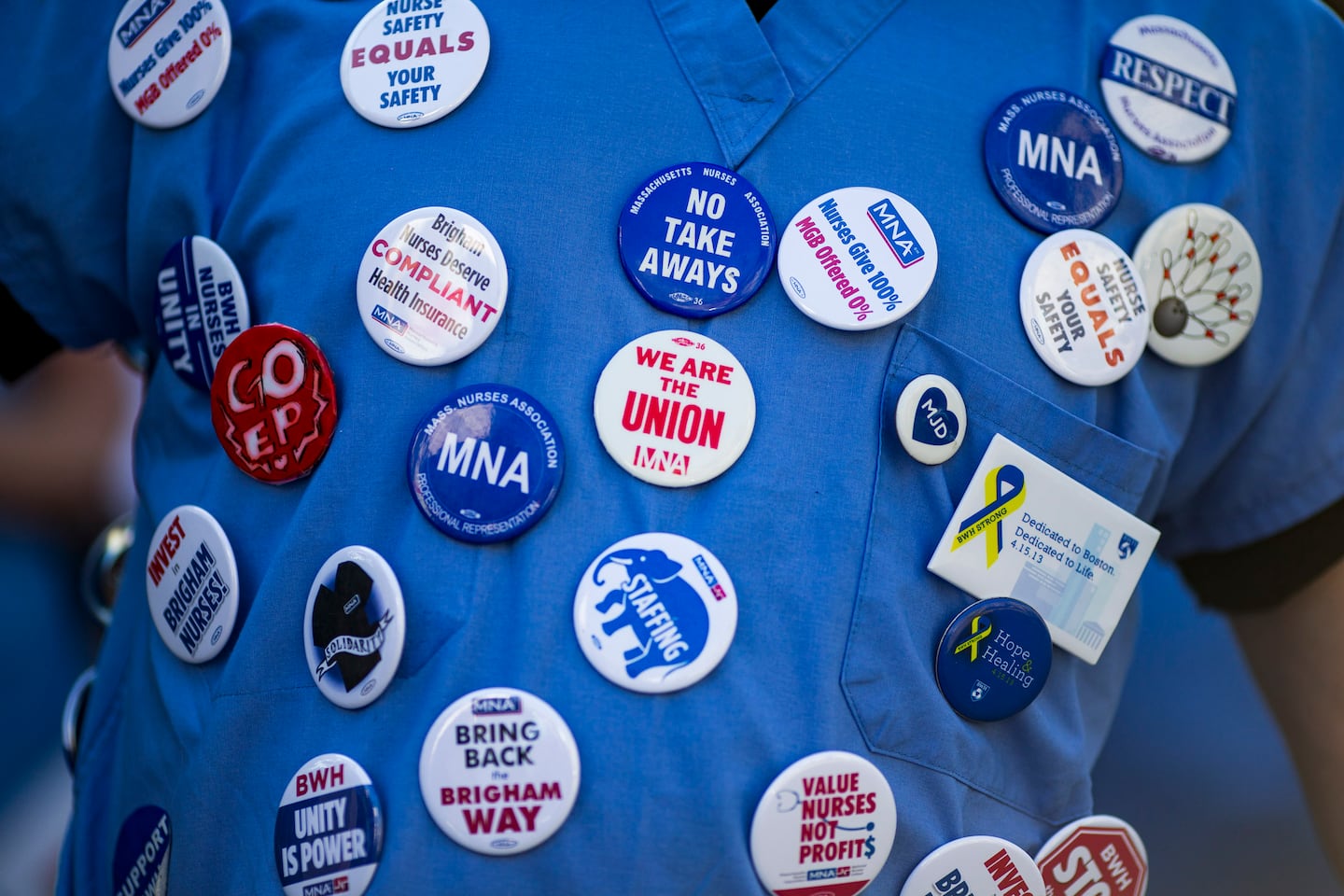 Protest buttons were pinned to the scrubs of a nurse during the first day of the nurses strike outside Brigham and Women’s Hospital on Wednesday.Christian Kantosky for The Boston Globe
At the picket line, Senator Elizabeth Warren joined the nurses and handed out doughnuts.
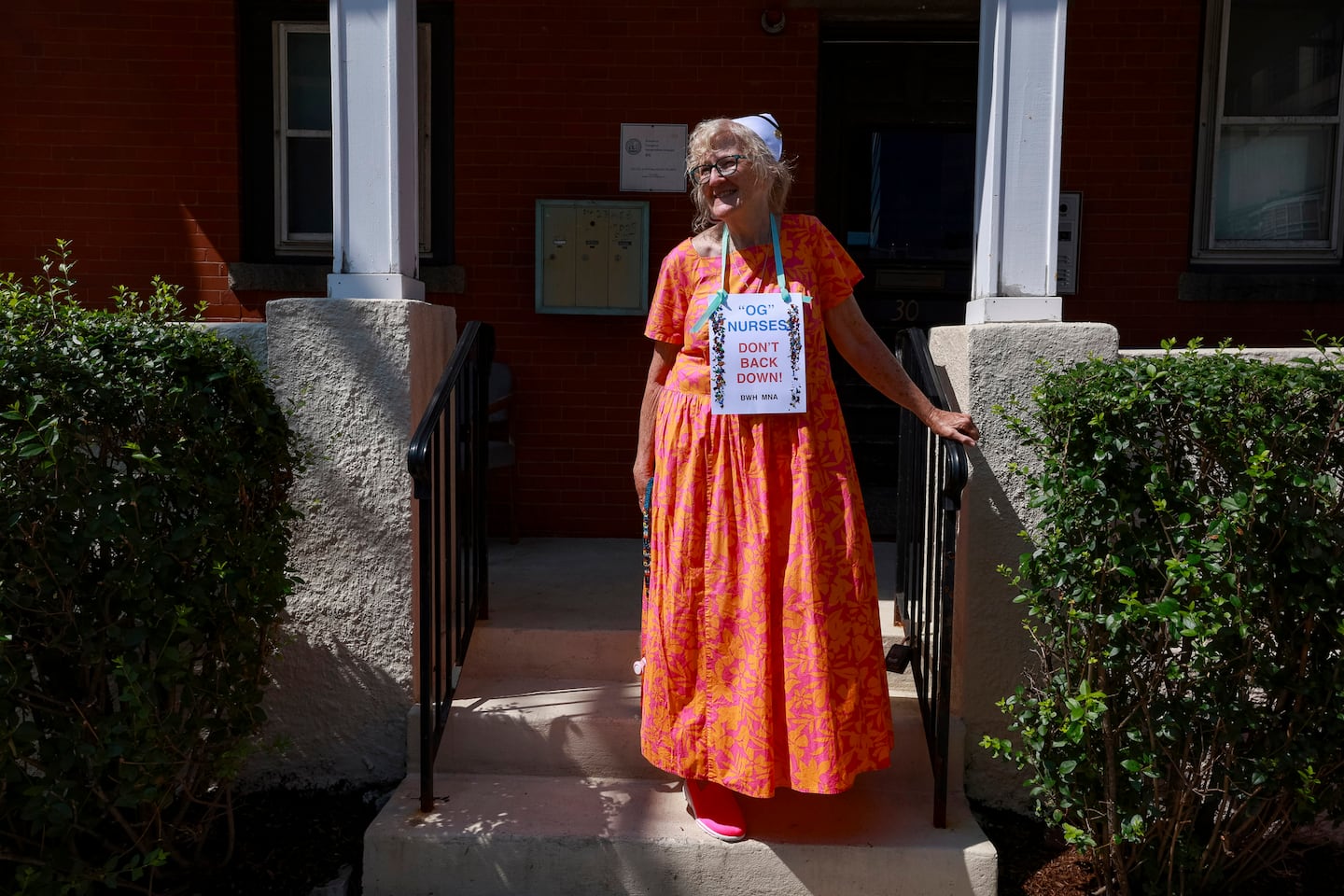 Mary Allendorf-Burns, a retired registered nurse, joined the picket line during the first day of the nurses strike outside Brigham and Women’s Hospital on Wednesday.Christian Kantosky for The Boston Globe
The two sides are arguing mostly over pay and health care costs. For health insurance, management wants nurses who are enrolled in Harvard Pilgrim Health Plan, which is more than half of the membership, to pay 2.5 percentage points more of their monthly premium.
Outside the hospital, several non-unionized physician assistants cheered the striking nurses.
“To not be given any cost-of-living increase is insulting for all of the work that they do,” said Elyse Doherty, 35, chief neurology physician assistant, who has been a PA at Brigham for 10 years. “They come in, day in and day out, and literally deal with patients and their families on the worst day of their lives, more so than even the providers do.”
She added that it’s true that some veteran nurses might earn more than new doctors, but that makes sense to her.
“Someone that has been here 30 years, dedicating their entire life to this profession, should be making that much money,” she said of nurses who make over $200,000 a year.
Although the union has said the cost of living increase and health insurance contributions are the sticking points, several nurses said money isn’t the big issue.
“We don’t have adequate staffing and we have difficulty on a good day retaining staffing,” said Kathryn Julien, who works in the Center for Women and Newborns. “It’s also respect. We’re not respected. I personally don’t do my job for the paycheck.”
The Globe is interested in speaking with people impacted by the strike. Please email Marin Wolf at marin.wolf@globe.com and/or Jonathan Saltzman at jonathan.saltzman@globe.com.
Marin Wolf can be reached at marin.wolf@globe.com. Jonathan Saltzman can be reached at jonathan.saltzman@globe.com.