
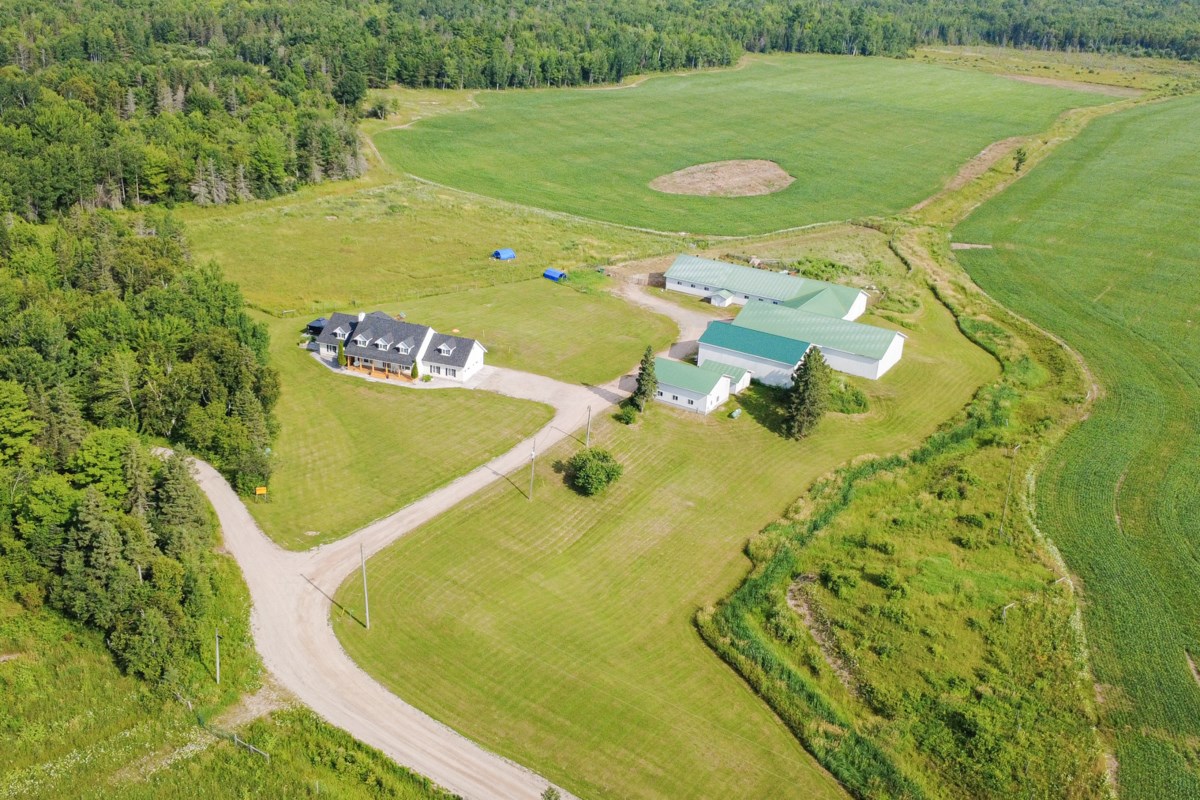
Originally from Desbarats, Dalton MacFarlane recently added to his massive land holdings with the purchase of 1,691 acres for a cattle farming operation
One of the largest land purchases in Algoma history will not stay idle for long.
A 1,691 acre stretch of farmland near the St. Joseph Island turnoff will soon turn into a farming operation that could raise over 3,000 heads of cattle annually.
Work is already underway to build an 85,000-square-foot barn after the deal closed earlier this week, said the new owner, Dalton MacFarlane.
“We’re actually finalizing the designing and engineering,” MacFarlane said.
“We have some of the local contractors right now, like dump truck drivers, aggregate drivers – I mean they’re hauling around the clock.”
The purchase is just the latest in a series of moves the 37-year-old has made over the past 10 years, during which he has amassed roughly 4,000 acres of land in an effort to bolster food sovereignty in the Algoma region and with numerous First Nations throughout northern Ontario.
“Working with First Nation communities across northern Ontario, and some of their food security and food sovereignty initiatives, there’s a lot of talk of how to do it but nobody actually has developed an actual viable farm or large scale operation that can support that,” he said.
“If we can take care of 3,000 head of cattle annually and start sending to some of these northern and remote First Nation communities, I think it’s going to be a big help.”
MacFarlane has already built dozens of these connections through his private equity firm, MacFarlane Capital Limited, which works with First Nations communities to help generate the capital required to complete projects.
Listed as one of Canada’s 40 Under 40 in the 2024 Business Elite Awards, MacFarlane’s foray into farming marks a turn from his business ventures into an effort he describes as more tangible and “real.”
“I stepped away from the administrative side of my company in 2025, so I’m just going to focus more and more on my roots,” he said.
“I grew up here with my grandparents, and that was one of the first farms I bought back – the old family farm in Desbarats.”
With MacFarlane’s return to his roots, he hopes to see his farming venture benefit northern people and the northern economy through the entire cattle-raising process.
While cattle might typically be raised in one area, processed in another, and shipped yet again to somewhere new, MacFarlane said the cows in his operation will be raised and butchered right here in Algoma.
“Everything’s going to be done right here. The animal will never leave Algoma,” he said.
“Raise local, finish local, and process local, then you can sell local so that the value chain, right from calf to plate, is all going to be done right here in Algoma.”
Beyond northern First Nations, MacFarlane hopes to see his venture benefit other northern Ontario communities as well.
“When you start looking at food sustainability in the north, it doesn’t take many Google searches to look and see that it’s a massive problem – not only with northern First Nation communities, but even northern municipalities in general,” he said.
“If this is something we can do, still maintain some level of profitability, but offer bulk cuts at, say, $8 a pound instead of $35 a pound for ribeyes and T-bones, that’s going to make a big difference in some of these smaller communities.”
MacFarlane’s new land is composed of 18 individual properties, listed together at a $6.5 million price tag,
For realtor Meagan Vance, it’s one of the biggest land sales she can remember in the Algoma region.
“I’ve been selling real estate for 18 years. I’ve never seen anything like this,” she said.
“He is the biggest landowner in our region.”