
With years of experience observing the abundance of wildlife in Greater Victoria waters, it takes something truly extraordinary to surprise the region’s most seasoned naturalists.
The rare sight of the second-largest animal on the planet cruising through the Salish Sea most certainly fits that description.
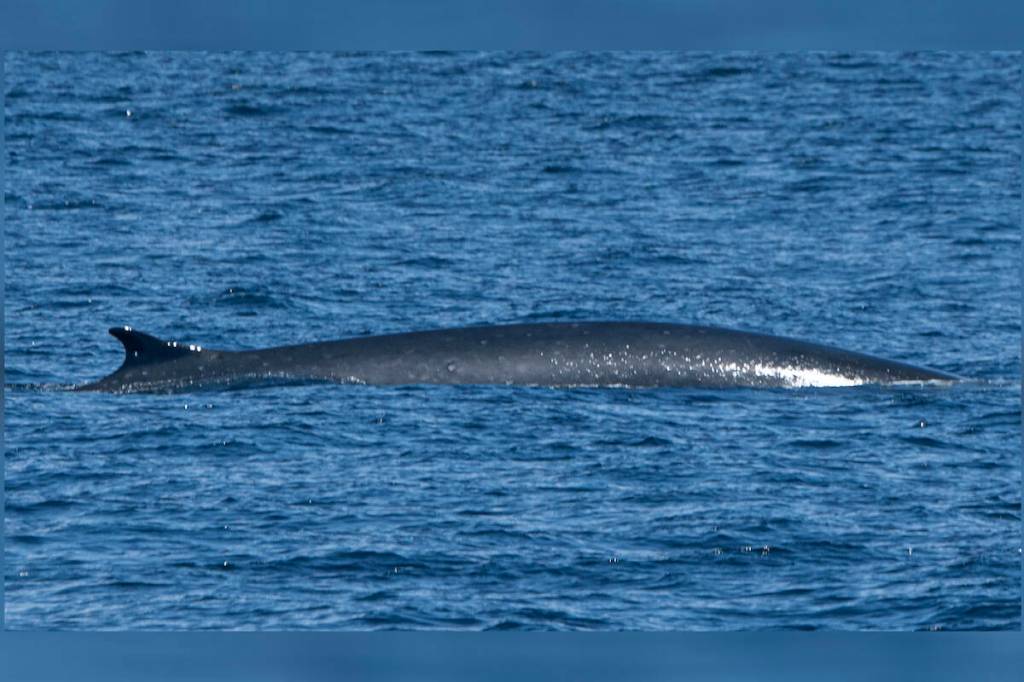
Estimated to be around 70 feet long – which is as long as a seven-storey building is high – a fin whale was spotted in waters west of Race Rocks June 28.
The encounter was a first for Sooke Coastal Explorations’ Mollie Cameron.
“I’ve been going out on the water now for 10 years, so to see anything that you’ve never seen before is always a special experience,” she said. “When it takes that big breath, you can hear the size of that animal in the exhale – it’s just a moment that takes your breath away.”
The excitement extended well beyond the crew. While whale-watchers in the region regularly encounter orcas and humpbacks, Cameron often tells guests that spotting a gray or minke whale is lucky enough to warrant buying a lottery ticket once they’re back on shore.
A fin whale, however, is in a league of its own.
“I told my guests they definitely need to go buy a lottery ticket today, because this is the first for even myself and the other captain on board, and we’ve been doing this for a very long time,” says Cameron.
The fin whale is only the sixth to be documented in the Salish Sea since 2015. Nicknamed the ‘greyhound of the sea’ for its ability to reach speeds up to 40 kilometres per hour, the species is listed as ‘threatened’ under Canada’s Species at Risk Act.
Most recently in the spring, a 61-foot emaciated fin whale was tracked in Admiralty Inlet in Washington, before it became stranded and died on Samish Island. A necropsy found evidence the whale had suffered a recent net entanglement and attacks from killer whales.
For the behemoth creature spotted near Race Rocks, the outlook appears much brighter, says Valerie Shore, a senior naturalist at Eagle Wing Tours.
“From what we can see, this one looks quite healthy,” she said, adding that fin whales can live up to 90 years, growing up to 80 feet long.
While it wasn’t Shore’s first fin whale sighting, the experience was no less memorable.
“It’s always exciting to see something that you don’t see every day,” she says. “I get excited about any whale, but when you see an unusual one like that, you get really, really, really excited.”
While they typically inhabit deep offshore waters, fin whales can be seen during the summer months along B.C.’s north coast, feeding on small schooling fish and krill – a similar diet to humpbacks.
Shore says the Race Rocks whale was observed feeding, indicating there could be an abundance of food in the area. Even so, Shore says she is unsure why fin whale sightings in the Salish Sea remain rare.
“If I was to guess, I’d say that it’s a younger whale that is exploring different parts of the coast to see if they can find new food supplies,” she adds.
“The humpbacks are showing that the Strait of Juan de Fuca in particular, is a really good place to find food in the summer and fall … so it’ll be interesting to see if we see a few more fin whales come in.”
Shore plans to send photos of the whale to researchers for identification. She suspects this individual may be relatively easy to identify because of a small hole in its dorsal fin, which she believes was likely caused by a large parasite.
“It’s called pennella and it burrows into the skin tissue and blubber, feeding on their blood,” she explains. “Sounds awful, but it doesn’t harm them, other than being irritating. It hangs off the whale like a tag, and when it falls off, it often leaves a hole.”
Other culprits could be a cookiecutter shark or a Pacific lamprey, adds Shore. While another theory is simply the whale was born with the hole.
More concerning for Shore was the cruise ship traffic moving through the Strait of Juan de Fuca.
“When we were watching the fin whale, a couple of cruise ships blasted by – one of them going quite fast,” she says.
Ship strikes are one of the biggest threats to fin whales, says Shore, who notes that globally, they are the most common whale species struck.
In June, a cruise ship that left Vancouver arrived in Alaska with a dead pregnant fin whale draped across its bow. Shore recalls three similar incidents in Vancouver harbour in 1999, 2009 and 2015; cruise ships arriving carrying fin whale corpses.
“The increasing volume of commercial ship traffic in the Strait of Juan de Fuca is concerning, given that it is an important feeding area for hundreds of humpback whales during the summer and fall, and now occasional fin whales,” she says.
“There are voluntary vessel slowdowns and route alterations in certain areas, but are these enough?”