
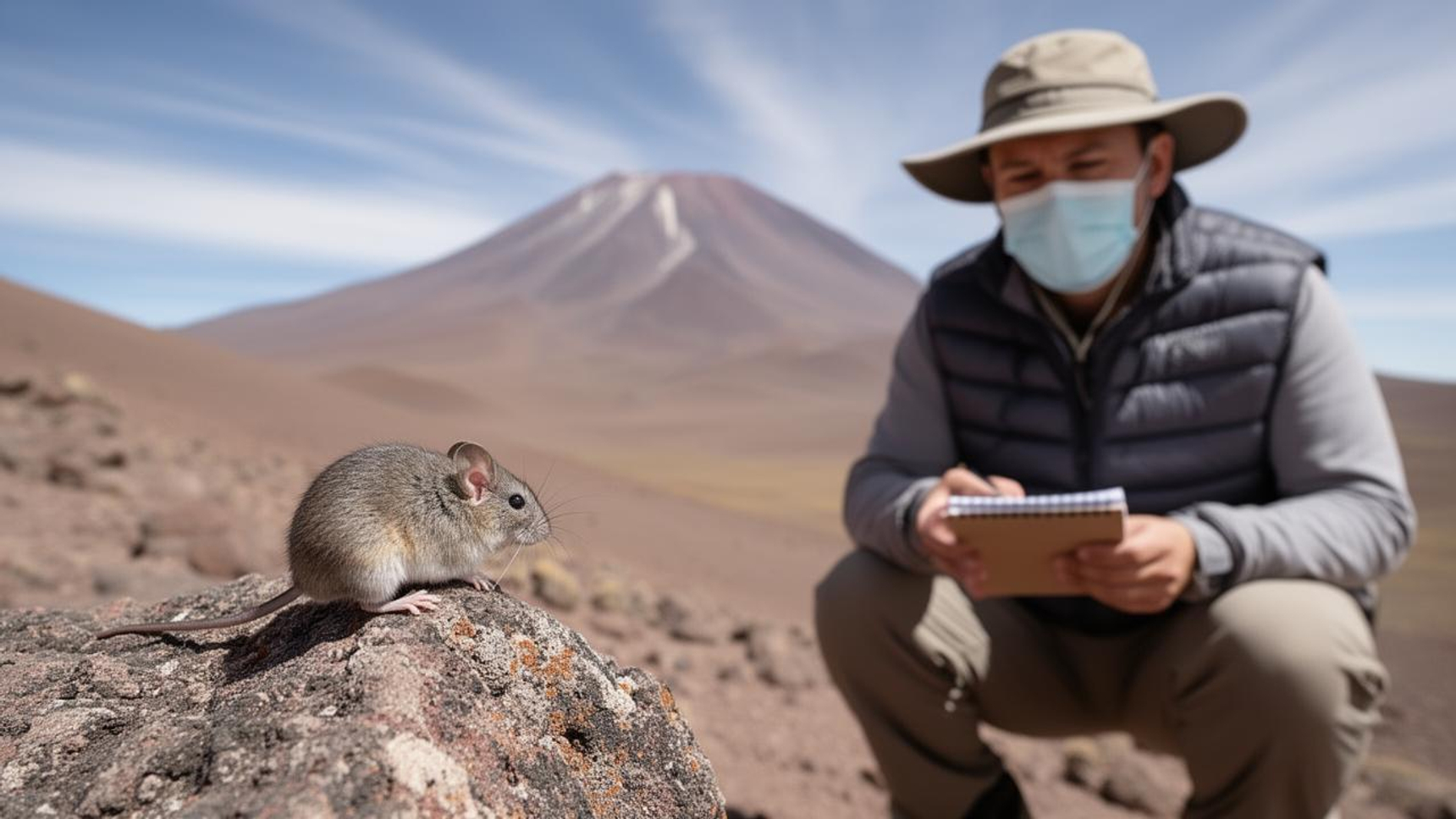
If the tiny superhero “Mighty Mouse” from 1990s television existed in reality, this might be what it looks like. On the summit of a volcano in the Andes Mountains, at an altitude exceeding 22,000 feet, a mouse has been discovered that endures an extreme environment where oxygen levels are less than half of those at sea level and temperatures are perpetually below freezing. Even more astonishing is that this small mammal’s staple diet consists of highly toxic grasses, while it burns fat as its primary energy source.
In a paper published on the 10th in the international journal Science, a research team led by Professor Jay Storz of the University of Nebraska’s School of Biological Sciences revealed that the Puna de Atacama leaf-eared mouse (scientific name Phyllotis vaccarum), living at altitudes over 22,000 feet in South America’s Andes, has evolved to simultaneously cope with oxygen scarcity, cold, and the toxicity of its food.
Professor Storz captured a living leaf-eared mouse in 2020 at an elevation of 22,113 feet on the Llullaillaco volcano, which straddles the border between Chile and Argentina. This is the highest-altitude habitat ever recorded for a mammal. The previous record was held by pikas, a rabbit-like animal, discovered a century ago at 20,341 feet on Mount Everest.
The environment where this mouse lives is so harsh that scientists call it “Mars on Earth.” The oxygen concentration is only 44% of that at sea level, and NASA has tested Mars exploration equipment at this location. Scientists long believed that mammals could not survive above 19,685 feet.
The research team decoded and compared the genes of 167 leaf-eared mice captured at low and high altitudes, along with a closely related species (Phyllotis darwini) that lives only at lower elevations. The results showed that the high-altitude mice did not experience a significant drop in heat production even when oxygen levels were reduced to simulate conditions at 14,107 feet and 22,965 feet. They withstand sub-zero cold by shivering their hind leg muscles to generate heat.
Interestingly, the high oxygen affinity of hemoglobin typically found in high-altitude animals was not present in the leaf-eared mouse. Instead, the mouse adopted a strategy of forcing an increased oxygen supply by putting the mitochondria in its hind leg muscle cells into a state of “hyperventilation.” This can cause excessive carbon dioxide expulsion, leading to a side effect where the blood becomes alkaline. To prevent this, the mouse demonstrated a sophisticated regulatory ability, suppressing the activity of carbonic anhydrase (CA) in its red blood cells to slow the rate at which carbon dioxide leaves the body.
Its choice of energy source also reflects a unique evolutionary path. Typically, animals in low-oxygen environments primarily burn carbohydrates, which yield more energy for the same amount of oxygen. However, because the leaf-eared mouse evolved to forcibly inhale more oxygen, it could use fat—which has a much higher energy density—as its main fuel. The researchers likened this to “burning logs instead of thin kindling.”
The problem lay in those logs—that is, its food. Plants from the Amaryllidaceae and Malvaceae families that grow in the high alpine zone contain potent toxins to protect themselves from predators. To eat these poisonous plants, the mouse’s liver powerfully evolved specific detoxification enzyme genes. But here, a new dilemma arises.
In a commentary published the same day in Science, Professor Denise Dearing of the University of Utah’s School of Biological Sciences summarized the study’s core finding under the title, “To eat or to breathe?” Professor Dearing pointed out that the low-oxygen response and the toxic substance detoxification response can conflict because they share the same protein, ARNT2. This creates a trade-off: using ARNT2 to respond to oxygen deprivation reduces detoxification capacity, and focusing on detoxification weakens low-oxygen adaptation.
Professor Dearing assessed that “the leaf-eared mouse is not simply an animal that endures a lack of oxygen; it has adapted under complex evolutionary pressure to also process the toxic substances in food plants that vary with altitude.” She explained that this is the product of an exquisite balance, akin to two critical programs constantly sharing limited computer memory resources.
This study is being evaluated as a significant case demonstrating how life in extreme environments has finely coordinated the two critical tasks of respiration and detoxification for survival.