
SASKATOON — Canola growers in Saskatchewan and Manitoba may have some anxious moments this weekend.
Environment Canada issued a special weather statement on July 8 for the two provinces warning about a “long duration heat event” beginning Friday afternoon and lasting well into next week.
“The timing of this could be pretty unfortunate,” said Ian Epp, an agronomist with SaskOilseeds.
“A lot of the crop is just getting into that flowering window.”
Canola is a cool-weather crop that starts to experience yield loss when temperatures reach 28 C.
Environment Canada is forecasting temperatures will reach 30 C on July 10, climbing to the mid-30s by July 12.
“Conditions will be particularly muggy this weekend, especially in regions along and south of the Trans-Canada Highway, with humidex values approaching 45 on Sunday,” the forecaster said in its statement.
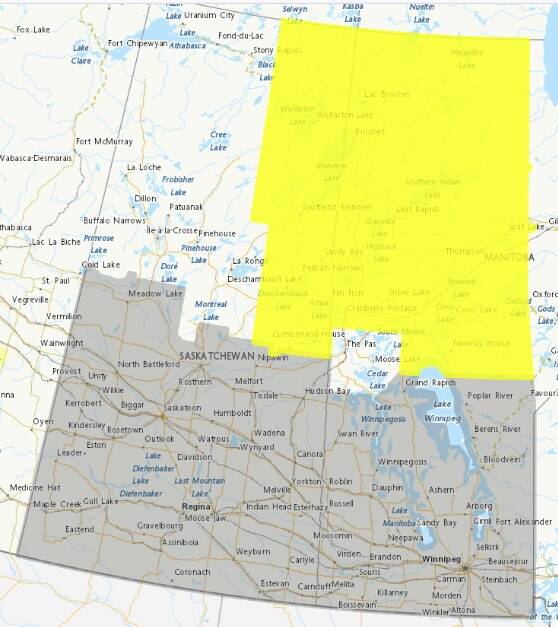
Environment Canada is forecasting a heat wave for much of Saskatchewan and Manitoba this weekend, which could hurt canola yields. The affected region (in grey) is anything south of a line from Meadow Lake, Sask., to the top of Lake Winnipeg in Manitoba.
Photo:
Environment Canada
The affected region includes most of the grain growing regions of Saskatchewan and Manitoba, anything south of a line running from Meadow Lake, Sask., across to the top of Lake Winnipeg.
Read Also

It will be particularly hot in southwestern Saskatchewan and southern Manitoba.
WHY IT MATTERS: Delayed seeding means much of the crop will be flowering at the time of the high temperatures.
The original forecast called for temperatures to remain in the high 20s to low 30s C next week.
However, the latest forecast calls for a cooling off to more normal temperatures in the mid- to high-20s next week.
Epp said that is a big difference because crops can probably withstand temperatures in the high 20s, but if the mercury remains in the 30s, that would be problematic.
Adequate to surplus soil moisture levels will help minimize any potential yield loss this year.
It is not like 2021 when high July temperatures combined with dry conditions to slash yields, said Epp.
But it is still not ideal timing for a heat wave.
“It’s definitely not a good thing,” he said.
The extent of the damage will also depend on nighttime temperatures. Plants can recover from extreme daytime heat if nighttime temperatures are 16 C or cooler.
Environment Canada meteorologist Terri Lang said overnight lows on July 12 are expected to be 18 C in Saskatoon and 19 C in Moose Jaw.
Extreme humidity will keep the temperatures high.
Epp does not know of any scientific data on what impact high humidex values have on canola yields.
But the muggy conditions could result in disease development in the crop canopy. He encouraged growers to stay on top of their sclerotinia risk assessment programs.
He also encouraged growers to be vigilant about scouting for cabbage seedpod weevil. He has been receiving calls from all over the province about that insect, including areas that don’t traditionally see it.
But when it comes to the looming heatwave, there is nothing growers can do but wait and see what happens.