
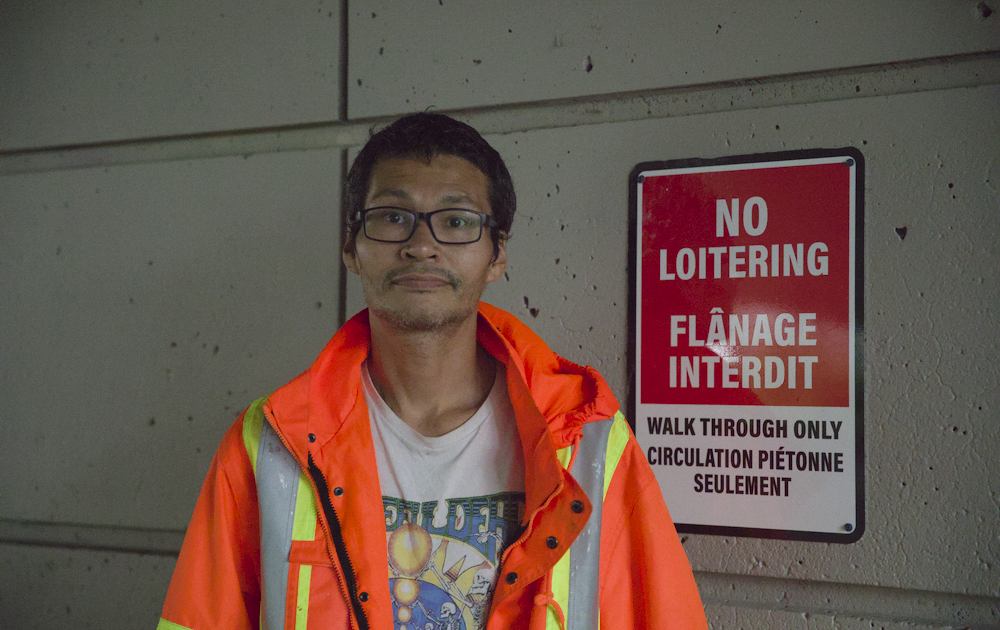
Dedicated facility needed to help most vulnerable community members says group co-founder Nick Illauq
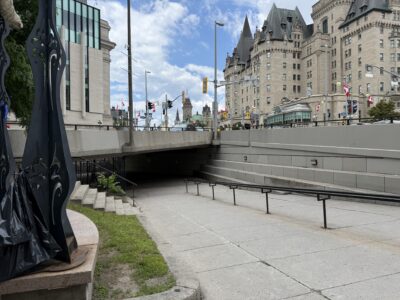
For many in Ottawa, the Rideau-Sussex pedestrian underpass is a sidewalk. For a group of Inuit without homes, it’s the Circle — a place where they have gathered, supported each other and slept for more than 30 years.
Ottawa Inuit Circle co-founder Nick Illauq says Inuit are no longer welcome at the Rideau-Sussex pedestrian underpass, known to many Inuit as the Circle. (Photo by Jorge Antunes)
“This place has history with us,” said Nick Illauq, co-founder of Ottawa Inuit Circle, in an interview. “It’s a mausoleum.”
The group met at the Circle June 30 to remember and share stories about their past members over plates of bannock and Arctic char.
In a way, the gathering was also a protest because, Illauq says, Inuit are no longer welcome in the area. During the last two months, police have increased patrols, issued tickets, erected a “no loitering” sign and removed unhoused Inuit from the underpass, he said.
The effect: Illauq says Inuit are less safe, as those who would typically be together at the underpass are scattered across the city. They now frequent locations such as Dundonald Park, a bus stop near the Odawa Native Friendship Centre and Rideau Street.
For example, Illauq recalls a recent incident outside the friendship centre where one man in a group of six yelled “drunk native” before punching an Inuk in the face.

The Ottawa Police Service says that it is not asking people to leave simply for gathering: they are enforcing laws regarding open alcohol consumption, drug use, threatening behaviour, public urination and other public safety concerns.
“Officers have been conducting proactive patrols in the area, with a focus on education, outreach, and public safety,” OPS spokesperson Julie Kavanagh wrote in an email, adding that the increase in policing is due to the “city’s broader revitalization and beautification work” under its Downtown Core Safety Strategy.
She also said that while sleeping in parks is prohibited, OPS recognizes there is a safety concern that comes with displacement and that police work to connect people with social services.
When asked if people are removed from the underpass for sleeping there, she did not clarify.
“Our focus is on working with municipal and community partners to offer safer alternatives where possible, while recognizing that the broader issues of homelessness, housing instability, and access to culturally appropriate supports cannot be solved by police enforcement,” Kavanagh wrote.
Illauq said that police have begun issuing tickets for public drinking. Some Inuit can’t pay them, and fear their inability to pay could result in jail time.

Four people in the city have received tickets since May 1, as part of the police service’s Downtown Core Safety Strategy — one ticket for trespassing, one for smoking and three for drinking in public, according to Kavanagh.
Three people who have received tickets were classified by the department as “white,” while one other was “Indigenous.”
Repeat offences, even with unpaid tickets, do not automatically result in jail time, Kavanagh said.
Meanwhile, Illauq says the underpass is a stop-gap measure. What he’d like to see is a permanent facility in Ottawa for Inuit in need to get cleaned up and have a safe place to sleep when necessary.
Some existing social services have turned Inuit away, Illauq said, deeming them “too dangerous.”

“These people are our friends, they are our family,” he said. “We are not afraid of them; they are humans just like everybody else and they’re Inuit. Everybody has forgotten them.”