
For seven of its eight episodes, Star City didn’t feel like it quite belonged in the same alternate-history universe as For All Mankind. More often, it seemed, Star City was trying to mimic Chernobyl, and the result was a forensic accounting of all the ways in which the Soviet Union was bad. Gone was FAM’s galvanizing portrait of how space exploration brings out our best ideas and unites us despite divisive political and economic ideologies; Star City was more intent on arguing the practical impossibility of communism than depicting how collaboration feeds our human potential. Until, that is, season finale “The Wolves,” an operatic episode that finally balances Star City’s paranoid vibes with the frissons of romantic longing and sacrifice that are the series’ strongest connection to its astute and adventurous predecessor.
FAM has demonstrated with each of its five season finales that series co-creators Ben Nedivi, Matt Wolpert, and Ronald D. Moore know how to shake up established world-building to reveal new facets of character and plot, and they do so again with the invigorating, moving, wonderfully melodramatic conclusion of Star City’s first season. A character crash-lands out of space to save her husband! He then refuses to flee the Soviet government because he won’t seek asylum without her! Another cosmonaut successfully makes it to Venus — where his final thought, as he’s being squeezed to death by the atmosphere, is how much he misses his wife back on Earth! These are hugely sentimental moments that demonstrate how much these characters are willing to risk to protect each other, and if they can’t protect each other, they might as well suffer together. This is Gordo and Tracy sacrificing themselves by running onto the moon’s surface with only duct-tape suits to stop a nuclear reactor from melting down. This is Ellen Wilson walking away from the American presidency to be with the woman she loves. This is North Korean ujunaut Lee defecting from Earth and being overwhelmed with emotion when he reunites with his wife on Mars. Star City earns its FAM bonafides by remembering that gigantic expressions of yearning and gumption are what this franchise does best. Mission accomplished.
I’ll admit, I was dubious Star City would pull it off. I found much of the season leading up to “The Wolves” to be shaky and imbalanced, focusing too heavily on the Soviet government as violent and duplicitous. Much of the season’s forward momentum is dictated by the KGB’s Colonel Lyudmilla Raskova (Anna Maxwell Martin), responsible for surveilling all employees at Star City, and her monstrous fealty to the state felt pretty one-note. Raskova butts heads with the space program’s chief designer (Rhys Ifans), with surveillance trainee Irina Morozova (Agnes O’Casey), with cosmonaut Valya Mironov (Adam Nagaitis), and with engineer Sergei Nikulov (Josef Davies), who is loyal to the chief designer. All of these interactions play out the same way: One of these characters dares to do something that the Soviet government doesn’t approve of, Raskova finds out and punishes the responsible party with violence, threats, or blackmail. Raskova’s characterization doesn’t expand past “zealot,” and the characters she targets are defined almost exclusively via constraint. It was as if the series’ writers heard that line from Doctor Zhivago about how “the personal life is dead in Russia, history killed it” and took it as a “Yes, and” prompt.
But Star City countered Raskova’s one-dimensionality and shook up its established rigidity when its characters fell in love — a part of their lives that the Soviet government also tried to control, but young hearts, they run free. These subplots were the best part of the season and laid the groundwork for the soaring heights of the finale. When Star City showed Valya worrying about his wife Tanya’s (Ruby Ashbourne Serkis) rule-breaking activities because of how much he cared for her, or provided another glimpse at former enemies Sasha Polivanov (Solly McLeod) and Anastasia Belikova (Alice Englert) actually falling for each other after being forced by the KGB into an arranged marriage, the series was building out their interior passions and concerns. That first frenzied kiss between Sasha and Anastasia in fourth episode “Dark Forest” was the series at its most exciting; Valya weeping in fifth episode “Bite Your Elbow,” when Tanya realized that he turned spy for the Americans because they threatened to reveal Tanya’s dissident past, was the series at its most heartbreaking. Star City was most wrenching when it explained who these characters are through who they adore rather than who they fear. Spending so much time with Raskova’s frown was a miscalculation, when Sasha and Anastasia falling for each other, and Valya worrying about how Tanya’s past would haunt them forever, were so much more compelling.
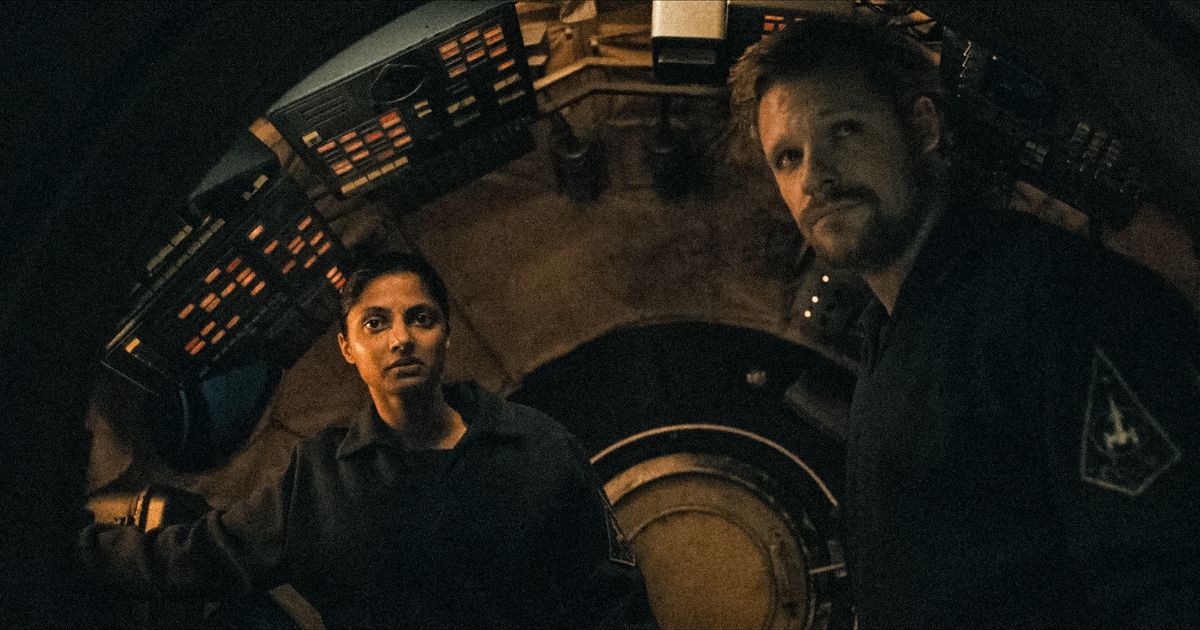
Those two story lines make “The Wolves” a tense, absurd, fantastic episode of television. After Valya realized his cover was blown, he fled into space on Venera 7, accompanying fellow cosmonauts Sasha and Lakshmi Chadha (Priya Kansara) on a nine-month journey to Venus. When Raskova found out, she told Sasha and Lakshmi about Valya’s betrayal and deemed them traitors for being on Venera 7 with him, and ordered Star City’s engineers to depressurize the ship, seemingly killing everyone onboard. Nine months later, the three have been valorized as heroes by a government-issued cover story. In reality, they’re alive, and still sending out signals on a rarely used frequency — one which Sergei intercepts and sends to Anastasia, who has been sent by the Soviets to their space station Salyut 1 to legitimize their secret surveillance of American sites on Earth. Meanwhile, back on Venera 7, Valya realizes that Raskova’s forced depressurization changed their trajectory; they’re going to miss Venus and get pulled toward the Sun.
“The Wolves” then follows three ludicrously gripping situations. Valya volunteers to detach Venera 7’s bathysphere, knowing that he’ll be pulled toward Venus, and will certainly die there. After he does that, Sasha and Lakshmi can take the now-lighter Venera 7 back to Earth, land outside of the Soviet Union, and secure asylum for themselves. Meanwhile, on the space station, Anastasia learns that the Soviet Union tortured the Venera 7 coordinates out of Sergei, and that they plan on killing Sasha and Lakshmi when they land; she needs to somehow make it back to Earth to help them evade Raskova. These two emergencies provide the circumstances for what FAM does best, and what Star City finally does, too: show how life-or-death problem-solving reveals people’s purest selves.
Englert and McLeod are agonizingly shocked when Anastasia and Sasha, on separate ships, hear each others’ voices for the first time in months, and realize the depths of their longing. When Anastasia bails on her space-station comrades, commandeers their evacuation capsule, and crash-lands on Earth, Englert sells Anastasia’s fucked-by-zero-gravity physicality as she lurches her way toward a pickup truck to speed toward the Venera 7 coordinates. McLeod had until now made Sasha a louche, a guy who pretended not to take anything seriously so he didn’t get hurt; as he sees Englert’s Anastasia trying to stop Raskova from murdering him, his face clears of tension and stress and settles on a look of surprising-to-himself love. Anastasia hurtled herself out of space so that Sasha could get asylum, but he can’t imagine a life without her. He’d rather get taken into custody with Raskova, on the slight chance that he and Anastasia might be together in prison, then start a new life in a country she’s not in. Martin’s most poignant moment all season is her inscrutable look as Raskova gazes between Anastasia and Sasha; two people sacrificing themselves for love is unfathomable to her. She’d certainly be confused by Valya’s last moments, too, as he looks out on Venus’s mountainous landscape and clutches Tanya’s picture. He’s achieved something incredible by reaching Venus, but as the planet’s pressure crushes the bathysphere around him and blinks Valya out of existence, he’s thinking of Tanya. He was a man squeezed between the Soviet Union and the U.S., yet in the end, his loyalties belonged to his wife across the galaxy.
In the final act of “The Wolves,” Star City landed on a message that finally merged the personal with the political: The heroes of Star City, just like the heroes at NASA’s Mission Control Center, love space. They also love each other, and when it comes down to it, they’ll give up their dreams to safeguard those relationships — definitive humanity instead of theoretical discovery. The focus on these scenes isn’t another ad nauseam repetition of the Soviet government’s menace, but how each individual choice made by Sasha, Anastasia, and Valya is fed by feelings they can’t deny, that they allow themselves to fully experience. That’s a lovely, melancholy sentiment Star City uses to deliver a season-best episode full of character moments that feel properly FAM. Let’s hope that, should Star City get renewed, its second season has more of them.
Sign up for the Vulture Daily
An entertainment newsletter for the pop-culture obsessed.
Vox Media, LLC Terms and Privacy Notice