
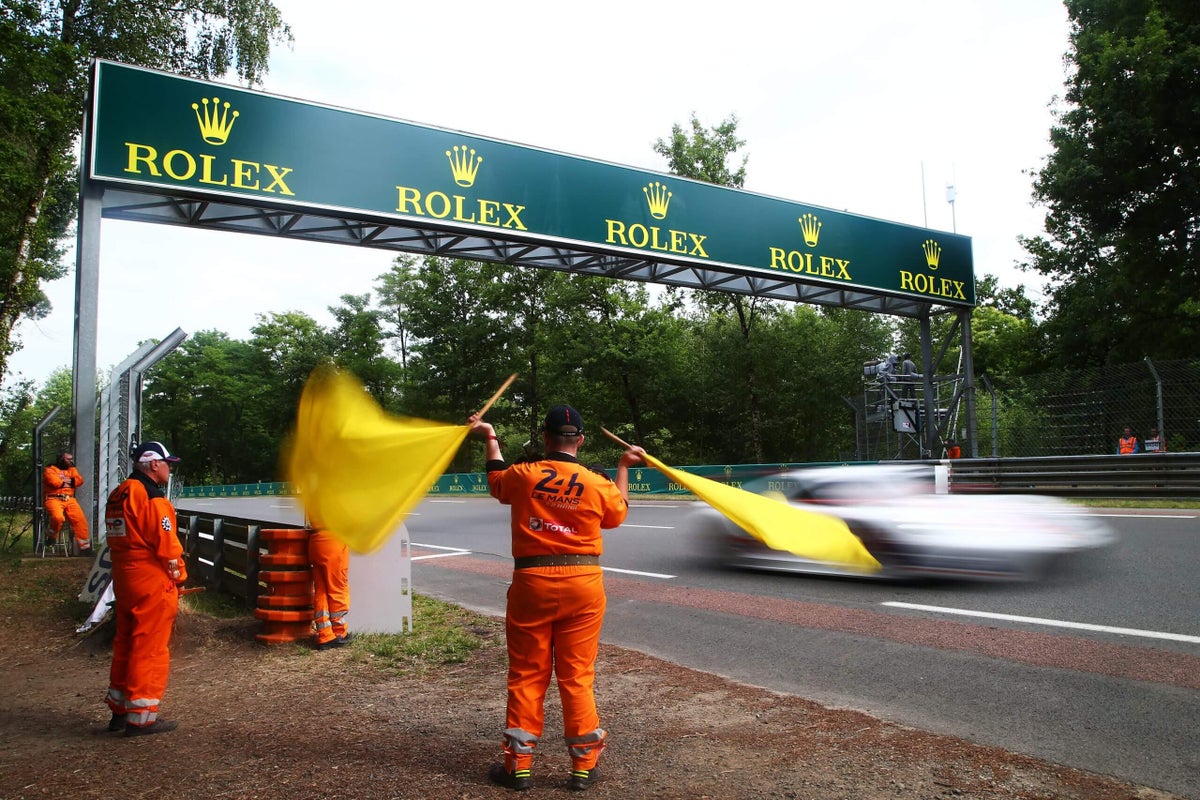
What unites the World Endurance Championship, Formula E and Formula 1? All three categories are regulated by the governing body of global motorsport, the FIA, and all use intricate safety systems the organization has developed to keep drivers, fans and track officials out of as much danger as possible.
Racing is always dangerous. But it is especially when cars can reach 200 mph, as the Hypercars in the WEC’s top class can, rivaling F1 machines for speed in certain circumstances, and they’re required to race through the night.
The WEC differs from the FIA’s other two circuit-based world championships in two critical areas that make safety even more complex: race length and the number of cars on track. There can be three categories of cars — Hypercar, LMP2 and GT3 — competing at the same time.
“You’re always doing something,” Cadillac Hypercar driver Jack Aitken told The Athletic of his experience of WEC endurance racing.
At this weekend’s Six Hours of São Paulo — the fourth of eight rounds making up the 2026 WEC season — 35 cars are expected to start. At the 24 Hours of Le Mans, the championship’s premiere race, the entry list swelled to 62.
Every F1 race, by comparison, will have a maximum of 22 cars on track and will never exceed a two-hour race limit. WEC race distances stretch from five six-hour events (in Italy, Belgium, Brazil, Texas, and Japan) to the Eight Hours of Bahrain, 10 Hours of Qatar, and the ultimate endurance test over an entire day at Le Mans.
For the FIA, the WEC’s blue-riband and longest event is where the championship’s safety systems must be bespoke. These are then adapted and redeployed for the shorter events.
“Le Mans is more than eight miles long, which is double the average track (length),” Benoit Dupont, the FIA’s WEC head of sporting, told The Athletic. “So, just for that, we have more people working, and more local people too, who link with the marshals around the track.
“It also means more marshals around the track. They work in three shifts. We are talking about 2,000 marshals, and we are also working two shifts of race control personnel.”
Race control is a critical area of every motorsport event. For the FIA’s circuit racing world championships, the format is similar for all three: a multitude of screens show every angle of each track, with more on the periphery, so officials can keep live sessions running or neutralize them in the event of an incident.
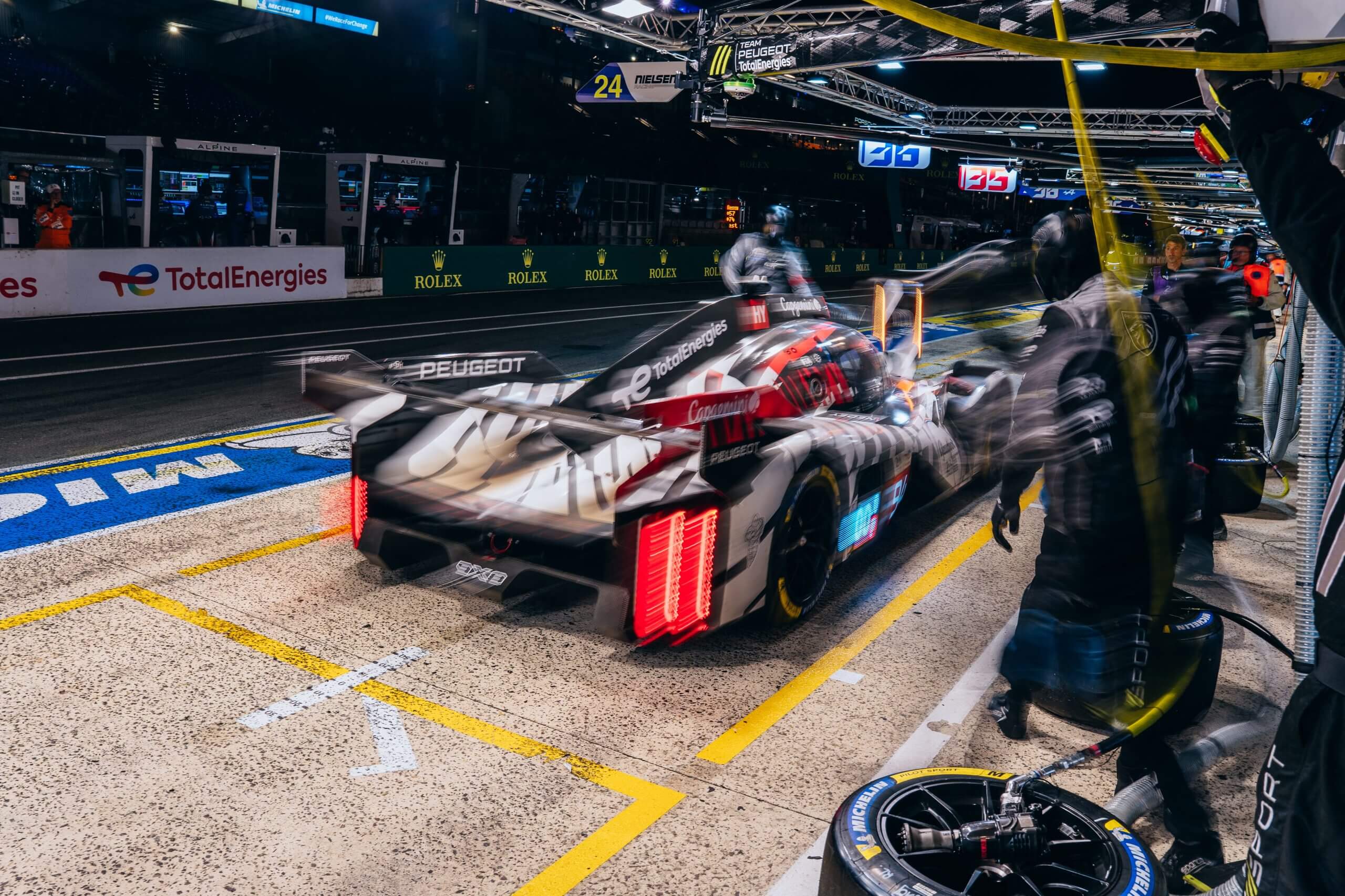
A Peugeot pit stop during the 2026 Le Mans 24 Hours. (Ivan Couturier / Hans Lucas / AFP / Getty Images)
Each race control is commanded by a race director, who in the WEC is Eduardo Freitas.
Around Freitas are approximately 20 other FIA officials, but for Le Mans, the number swells to between 35 and 40. They also work shift patterns throughout the race, leaving and reporting back to race control as required.
“Three quarters of the group are locals from Le Mans, they know the circuit by heart, they know exactly how it works, who we are, the different marshal posts, the different access points to recover cars and everything,” Dupont said.
“They have a very important knowledge of the facilities. And we, the international team, rely on their knowledge to make things as efficient as possible.”
That international team also attends the rest of the WEC season. But the Le Mans staff still has a hand in the other seven races, because of the specific safety rules mandated for pit stops in the top flight of global sports car racing.
These require mechanics (bar a signal mechanic holding a direction board to guide a car into a pit box) to wait behind a safety line in the pit lane until their car has stopped, and only then can refueling take place.
Car cleaning and driver swaps can begin at this point (the latter with the help of another mechanic), but only after refueling is complete can two teams of two mechanics start changing tires.
This is all monitored for strict compliance via camera feeds placed above each pit gantry — up to the 62-field maximum at Le Mans — with the feed transmitted back to the WEC’s Le Mans remote operations center for monitoring.
“Each pit stop is analyzed,” Dupont said. “There are lots of rules to be followed, mainly safety rules, but also sporting rules, and we need somebody to watch that. So, we have four people working in Le Mans to help us with that at every WEC race and especially (during the 24-hour race).
“Even though they are just across the racetrack (at Le Mans), they are still remote. And we also have a team in Geneva, mainly working on the track limits.”
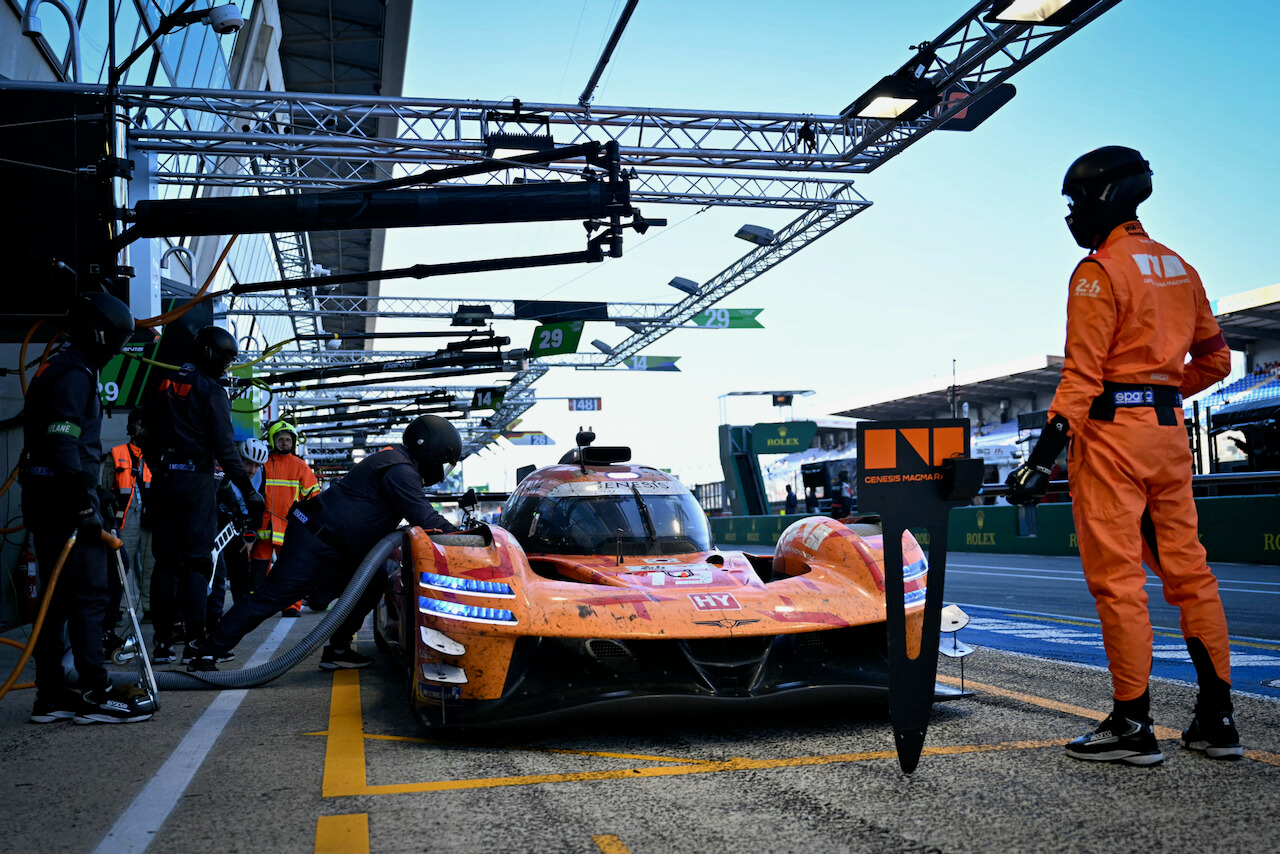
Tire changes in a WEC race can only take place once refueling has been completed. (Lou Benoist / AFP / Getty Images)
This is part of the same digital safety ecosystem the FIA developed in 2022, in the aftermath of the 2021 Abu Dhabi Grand Prix saga, where the then F1 safety director incorrectly applied safety car restart rules late in the contest between Max Verstappen and Lewis Hamilton.
The FIA calls it the Remote Operations Center (ROC), although Dupont said what applies for WEC is “not exactly the same system, but it’s the same principle (as used in F1).”
“We are working on our technical solutions for F1, Formula E and WEC. Each championship’s specifics are taken into account, but we are working more or less with the same parameters,” Dupont said.
Another area where WEC has specific safety rules concerns the operation of the safety car system at Le Mans.
As the championship’s longest track, there are always three safety cars deployed to cover a major incident, with a fourth ready to go in case one of the others requires refueling. At the 2024 Le Mans, a nighttime safety car period lasted four hours, and tanks began to run dry.
Deploying three safety cars instead of one — as is the case in F1 and FE — is done so that intervention after a big crash can take place as quickly as possible on the long Le Mans lap, rather than cars taking time to form up behind one safety car, and so marshals are delayed in intervening in an incident until this has happened.
Once an incident has been cleared, the pack forms up behind one safety ahead of a restart.
“The safety cars need to be fully synchronized to make sure that one group will not get an advantage from another,” Dupont said.
“So it’s all managed by the local officials at Le Mans. They are all French-speaking. It all happens in French, so that’s why we are not using our usual safety car driver (Pedro Couceiro), who is Portuguese.”
“They synchronize themselves to make sure that they always cross the same part of the track at the same time from one lap to another. It’s quite impressive in terms of training.”
The other safety systems the WEC race control team uses to neutralize racing are known as the full course yellow — the equivalent of the Virtual Safety Car system in F1 — which requires each car to drop to a 50mph limit for an entire lap, and slow zones.
“This is where we neutralize just a sector,” said Dupont. “We have nine slow zones around Le Mans. Entering one sector with all the signals and all the information there is in the car, the driver will have to be at 50mph all along this sector, and then start racing again.
“This is to give us the possibility to remove a car, for example, or bring it back on the track if it’s in the gravel, without being too intrusive in the sporting development of the race.”
This weekend’s race in São Paulo will take place on the 2.7-mile Interlagos track that also hosts F1’s São Paulo GP. Other than continuing to use the remote pit stop monitoring team, the FIA’s WEC safety systems contract is “more or less the same as you can see in F1,” Dupont said, because of the shorter lap duration.
“There are less people in race control and just one safety car with a standard safety car procedure,” he added.