
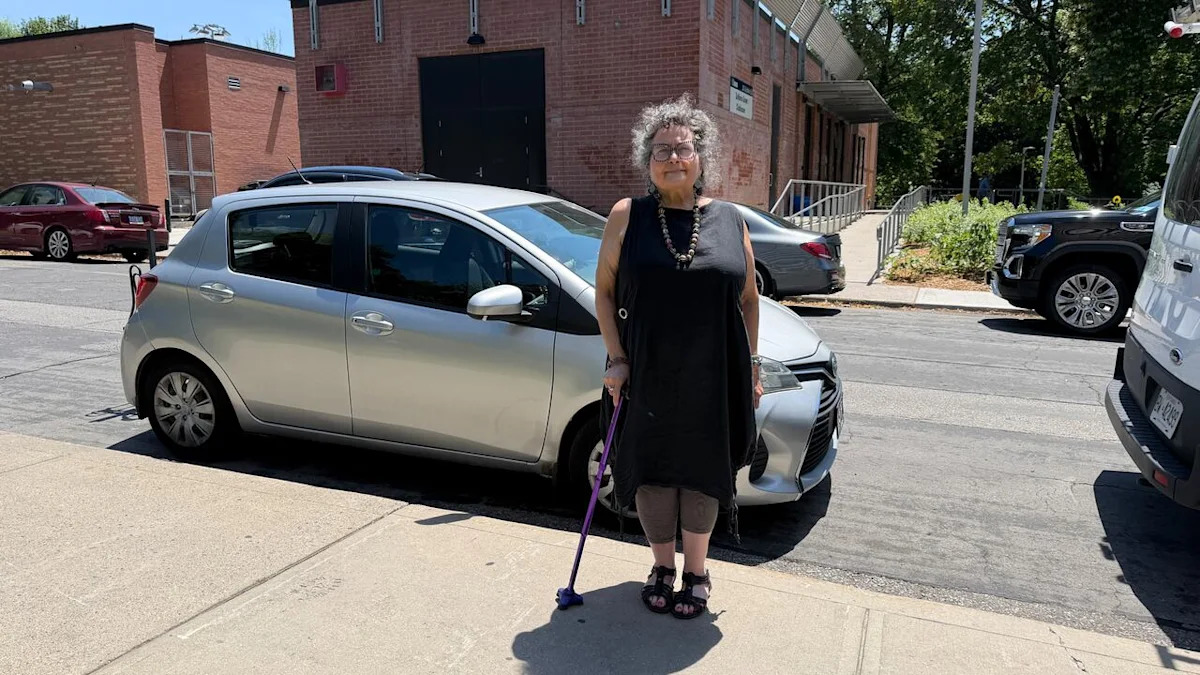
A small change to parking rules on a tiny stub of street adjacent to Dufferin Grove Park has led to a large controversy over parking and accessibility.
The roughly 20-metre length of Dufferin Park Avenue runs east off Dufferin Street and has long been a no-parking zone — except for those with accessible parking permits, which includes volunteers who help keep the park operating.
But the city recently changed the parking rules on the street, which removes the right of accessible parking permit holders to park there, including long-time park volunteer Erella Ganon.
“It means everything to me, all my friends are somehow involved with the park,” she said. “We meet here, we have dinner here every Friday (at weekly pot lucks she helps organize), the farmers’ market. It’s all around the park.”
Ganon says that without nearby parking, her mobility issues mean she’ll have to give up the work she’s been doing with the community group Friends of Dufferin Grove for the past 25 years. The group is made up of local residents who, along with the city, help coordinate activities for the public, both in the park and the surrounding neighbourhood.
Ganon’s work includes looking after social media posts for the group, organizing events like the weekly pot luck, and representing the park neighbourhood on the Toronto Community Police Liaison Committee.
“I can’t continue representing the park if I can’t come to the park,” she says.

Councillor Alejandra Bravo moved to restore some of the parking rights that disabled drivers had enjoyed at the July 8 meeting of the Toronto and East York Community Council. She says she was trying to increase the number of public parking spots near the park. (Michael Wilson/CBC)
Changes were made to improve the street: councillor
In February, local councillor Alejandra Bravo proposed changes to the parking regulations on both the north and south sides of Dufferin Park Avenue, where it intersects with Dufferin Street.
In an email to CBC Toronto, Bravo said earlier this year her team City of Toronto staff and residents worked together to address parking rules on the road.
“One of the main requests we received was to increase the number of available parking spaces for residents, staff bringing equipment to the Park Clubhouse, and event organizers needing to load and unload,” she wrote.
At the time, both the north and south sides of the small strip of Dufferin Park Avenue were designated no parking zones, but since an accessible permit trumps most parking restrictions, those with mobility issues regularly parked there.
Bravo’s motion, approved by staff from the city’s transportation department and passed by councillors at the end of April, called for the city to open up the south side of the street to limited public parking. The north side of the street became a no stopping zone — a designation that the accessible parking permit cannot override.
The changes apparently came into effect earlier this month. Ganon said on July 2, she arrived at the park to find the “No Parking” signs had changed to “No Stopping” signs.
“It was heartbreaking,” she says.
Staff considered pedestrians, park staff: report
An April 15 staff report on the impending changes to the parking regulations on Dufferin Park Avenue shows staff considered the need of pedestrians, cyclists and parks staff before approving Bravo’s changes. No mention is made of the impact they could have on disabled drivers.
That’s not a surprise to Wendy Porch, executive director of the Centre for Independent Living Toronto, who says she sees government decisions being made without input from disability advocates “a lot.”

(Zoom)
“There’s a tendency for the city to make decisions about who goes where and who can access what, but they don’t often include disabled people in those decisions,” she said.
One solution, according to University of Toronto associate professor Aparna Nair, who heads the Centre for Global Disability Studies, is to include a disability advocate in all government decision-making, to ensure their concerns aren’t overlooked.
But beyond that, Nair says governments need a fresh mindset, one that takes into account the needs of disabled people.
“There has to be a shift in how governments at all levels think about their decision-making, and that’s going to take a lot of work,” she says.
Issue has been re-opened, says councillor
Bravo says that as soon as she realized the change had frozen out disabled drivers, she moved to re-open the issue and reinstate the no parking zone on the street’s north side.
“As soon as my team was notified on this impact by one of the Park’s dedicated, long-term volunteers, I began drafting a motion to re-open the item and remove the no stopping rule while keep the new additional spaces,” she wrote in an email to CBC News.
The latest changes were approved by the Toronto and East York Community Council at its July 8 meeting, meaning some parking will still be allowed on the south side of the street.
Ganon says she is not satisfied. She says she wants the parking regulations on the street to be returned to how it was, in which both the north and south sides were no parking zones, usable only by people who are disabled and have special permits.
She also says she’s not the only disabled volunteer who works for the Friends of Dufferin Grove. Plus, she says vendors at the weekly farmers’ market also need that space to unload and load their goods.

Wendy Porch is executive director of the Centre for Independent Living in Toronto. She says it’s not uncommon for policy-makers to develop new municipal rules without taking into account the needs of those with disabilities. (Sinisa Jolic/CBC)
Besides, she says, parents dropping off their children to use the skating rink, park or clubhouse could do so in a non-parking zone if they were quick.
Ganon also maintains the changes were made without any warning or community consultation, an assertion that’s challenged by Bravo, who said in a statement to CBC Toronto that she recommended the changes only after speaking with residents.
A meeting between Ganon and Bravo’s staff is being planned, she said, but no date has been set.