
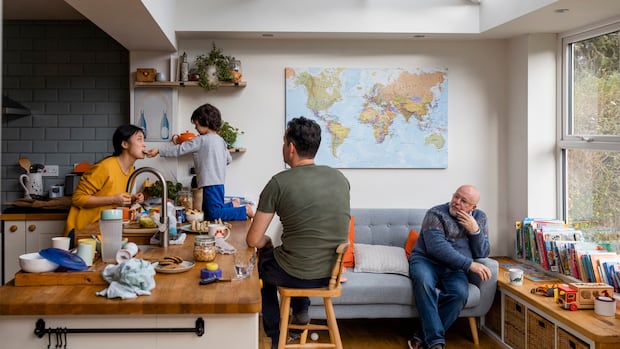
A home shared by multiple generations has to accommodate many needs at once. Aging parents with mobility issues and young children alike might require things within closer reach, while teens and adults working from home may crave quiet and privacy. Addressing all those needs can sometimes leave a home feeling more practical than personal.
But creating a multi-generational space that’s comfortable, accessible and stylish is possible — and can be the difference between a home that merely functions and one that’s enjoyable to live in.
Camille Farrag, a housing researcher with Canada Mortgage and Housing Corporation, said builders and designers are increasingly gravitating toward universal design, which ensures spaces work for everyone, regardless of age, abilities, or needs. “It’s easier to do this in the initial design of the home,” she said, “but there are ways of accommodating after the fact too.”
Universal design specialists say there’s a growing interest in decor and furnishings that quietly make daily life easier, blending seamlessly into modern interiors. It should be “almost invisible,” said Farrag. “You don’t really notice it until somebody points it out.”
Sleek closet rods that do the reaching for you
Margot McWhirter, an occupational therapist and founder of Inclusive Aging, said one of the biggest challenges in multi-generational homes is accommodating different reach ranges. What a growing teenager can safely access can be a very different story than what’s accessible for aging grandparents.
The universal reach range “falls between shoulder-height and knee-height,” said McWhirter, who recommends her clients use storage solutions that meet family members where they’re at.
In the closet, an adjustable pull-down rod brings clothes down to eye level with minimal strain, which is especially helpful for seniors and young children, and safer than using a stepstool. This also helps to make the most of vertical storage, keeping items off the floor and making it easier to keep closets organized.
Pull-down closet rods come in a range of styles. Some, like this Häfele model, are designed as straightforward, out-of-the-box solutions that can be added to an existing closet with minimal fuss. Others, like this premium model from Richelieu Hardware, feature a sleeker design and 360-degree rotation, making them well suited to custom closets where maximizing storage is a priority.
Pretty visual labels for cupboards
In a multi-generational home, closed storage is key to controlling visual clutter, but these systems can make it tricky for everyone to find what they need.
McWhirter suggests labelling cupboards and drawers with visual icons to teach younger children where to locate and store items. Illustrated tags can also help individuals with memory issues maintain their independence. “Pictures are better than words for older adults who may experience aphasia,” she noted.
Decorative options range from minimalist black-and-white icons that blend into contemporary kitchens to chalkboard-style labels that can be updated as storage needs change. Some Etsy makers even offer custom wooden or acrylic labels that feel more like decor than organizational tools.
Light switch plates that really stand out
Fumbling for a light switch in low light can be both frustrating and dangerous. “Being able to see those clearly can be really helpful,” said McWhirter. “[The solution] does not have to be ugly — contrast can be beautiful and part of the design esthetic.”
Some covers utilize colour-blocking to make switches easier to spot, while others are designed to blend seamlessly with existing hardware. Pottery Barn, for example,offers metal switch plates in three finishes that can be coordinated with cabinet pulls, faucets and door hardware throughout the home, even as they stand out against a white wall.
If you want to take it one step further, Melody Grant, an interior designer who co-runs Living By Design, suggests a cover with a built-in night light. Many models, like this one from SnapPower, can simply be snapped onto an existing panel without any additional wiring required. What you get is a consistent source of light that helps guide household members at night without adding visual clutter to the space.
“It’s on all the time, so when you walk through the space at night, it directs you to the light switch,” Grant said.
Artful acoustic panels
Between rest times, work-from-home arrangements and kids who need to study, noise can quickly become a point of contention in multi-generational households. But there are ways to reduce how sound travels through the home.
“You need to create buffers. An example of that would be putting a large storage cabinet against a wall,” said Grant. “You can also buy acoustic panels.”
Traditionally, acoustic panels haven’t exactly been stylish, but these days, they come in a variety of decorative formats. Fluted wood panels — like these panels from Home Depot — add warmth and texture to a space just as they help to absorb sound, while patterned panels, like these from Vevor, double as artwork.
Streamlined laundry pedestals
When people think about making a home more accessible, bathrooms and kitchens tend to get most of the attention. Tom Grant, an occupational therapist who runs Living By Design alongside Melody Grant, said the laundry room is often overlooked.
“Older people really struggle to bend down to do the laundry,” he said. “A simple solution is just having a basic block that the machines can go on.” Ideally, he noted, you want to have the washer and dryer at waist-height.
Another way to achieve this is with a laundry machine pedestal, which can come with built-in storage. You can get pedestals that are designed for your washer and dryer models, like these models designed for LG systems, or something in a contrasting style, like this pedestal from Yodolla.
Lever-style door handles
Some of the most effective universal design features are hiding in plain sight. Lever-style door handles, for example, are easier to operate than traditional round knobs for everyone from young children to adults with arthritis or reduced grip strength.
“[If] you’ve hurt your ankle and you suddenly need crutches, you quickly realize how important a lever door is, because you can use your elbow,” Farrag said. “It’s one of those things that’s a cheap fix.”
Door hardware also comes completely customizable, making it easy to find an option that complements your home. For example, this St. Tropez model from Explore Hardware has a knurled grip and a boutique-hotel feel, while this Emtek model offers a more textured, handcrafted look. The handles don’t call attention to themselves, but they do make the home easier to use for everyone who lives there.