
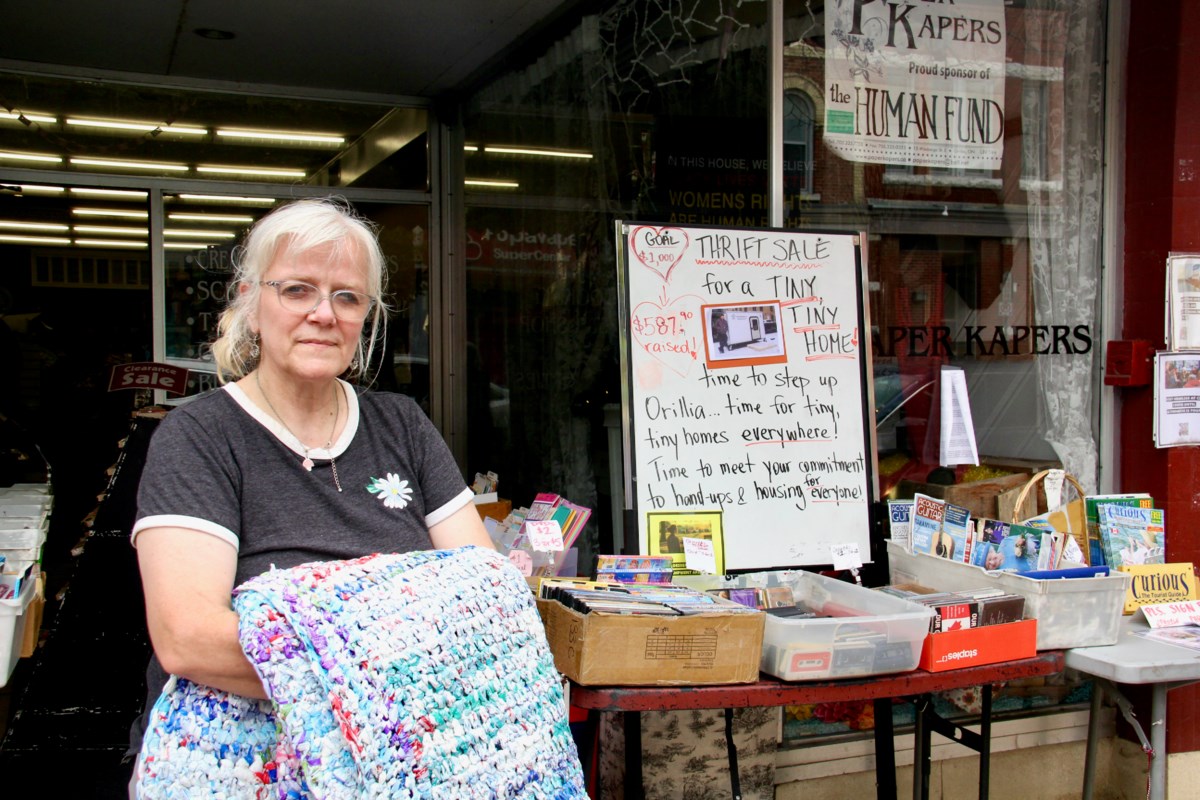
‘There is legally nowhere to exist in Orillia. If you sleep on the sidewalk you get moved … If you sleep under a tent, you get your tent removed,’ laments business owner
Downtown Orillia business owner Ellen Wolper says she tries to do her part to help the homeless because she says the city isn’t doing enough.
Wolper allows homeless people to sleep in the outdoor vestibule area of her store, Paper Kapers on Mississaga Street, nightly, especially since the warming centre closed April 30. But she knows that decision this is causing friction with other downtown business owners.
“I have been letting people sleep on my private property because there is nowhere else to go,” Wolper said. “There is legally nowhere to exist in Orillia. If you sleep on the sidewalk you get moved because you are on city property. If you sleep under a tent, you get your tent removed.”
She notes The Lighthouse shelter is regularly at capacity, while others simply don’t want to be at a shelter.
Several business owners have taken their complaints — including people leaving waste, including human waste, in the downtown — to the Downtown Orillia Business Improvement Area (DOBIA).
Doug Cooper, chair of the DOBIA board, recently wrote a letter to mayor and council that was discussed at the June 29 council meeting.
“On behalf of the Downtown Orillia BIA Board, we would like to request a review of all local bylaws pertaining to allowing businesses to provide shelter in public-facing commercial properties in the BIA,” reads the letter.
“We by no means condone this behaviour, but we believe that if this activity occurs, the property owner should be required to provide basic services and be responsible for cleaning up any resulting damage to surrounding properties. We are happy to work with city staff on this matter or to answer any questions you may have.”
Council and staff were confused by what they deemed an “ambigious” request.
“This is cross purposes,” Clerk Dan Kirby said at the council meeting. “On the one hand they don’t support temporary shelter but they want that temporary shelter to be provided?”
Coun. David Campbell, who sits on the DOBIA board, offered an explanation.
“I think what they are looking for is the potential of regulation,” said Campbell.
A motion to review related city bylaws was voted down. Then, a motion to receive the letter for information was carried. That, essentially, means no action will be taken.
“I will provide the information to them that makes this not necessary,” said Campbell.
Following the meeting, Campbell referenced Wolper’s actions.
“I’m sure you are aware, a business owner in the BIA continues to allow people to sleep (live) in the outside foyer of their business,” Campbell told OrilliaMatters. “The BIA understood that this was not permitted under existing city bylaws.
“All the BIA letter was requesting was clarification of the bylaw. Once council was assured by staff that they would follow up with the BIA and clarify, no further action was required by council. I hope that clears it up,” Campbell said via an email.
Deron Johnston, executive director of the DOBIA, said the letter was looking for two things. He said they were seeking clarification of what’s in the bylaws, if there is anything allowing or disallowing homeless people to sleep on business property.
The second, he said, was to discern rules around providing basic services.

The City of Orillia remove an encampment from Bay Street in 2023 after receiving numerous safety-related complaints. Tyler Evans/OrilliaMatters File Photo
“Part of our inquiry was to find out if there is something around providing proper facilities. If you are going to temporarily house someone, you should logically have access to bathroom facilities,” said Johnston.
“We wanted to know if there was a bylaw like that in place and if not then that is something that should be considered because, unfortunately, sometimes if someone spends time overnight on private property, that sometimes they leave a mess and sometimes that involves human waste and sometimes it’s done on neighbouring private property and those folks aren’t usually happy about that,” Johnston said.
“We are thinking that maybe there is an option that the folks that are going through some tough times can actually have access to somewhere they can do the basic human things,” he said.
Johnston didn’t say he wants downtown public washroom facilities or that homeless people sleeping at businesses should be outlawed, but said if businesses are going to allow people to sleep on their property, they should also be providing a washroom.
“So if people who are struggling need a bathroom or place to wash up, they are not doing it in someone else’s private property where they don’t have permission to be,” Johnston said.
Wolper said she does allow people to use her store washroom when the business is open.
“In 2024, there was a petition. I asked for a supervised encampment with toileting facilities,” she said.
Wolper said two Ontario legal decisions outline that people are to be allowed to camp on city property and be provided with toileting and garbage facilities.
In 2023, an encampment was allowed in Kitchener Waterloo in order to have garbage pickup and toilet access, otherwise it would be a violation of the Canadian Charter of Rights and Freedoms.
This May, Superior Court Justice Michael Gibson ruled that the region could not remove people living at the encampment unless if offered an alternative site or created a tenting protocol.
“This has been ongoing in Orillia,” said Wolper, who referenced the city removing people from an encampment behind Giant Tiger in 2023.
“People were moved off of Peter Street, which is also city property, in the fall of 2023. In the the following year, people were moved off Bay Street, which is also city property.
“So it’s the city that has been violating this provincial decision by not providing a site for people to live and have garbage services and toileting services,” she said.
Wolper said portable toilets and garbage cans are provided for boaters who use the Collins Street boat launch.
“So it’s provided for some people but not others,” she said.