
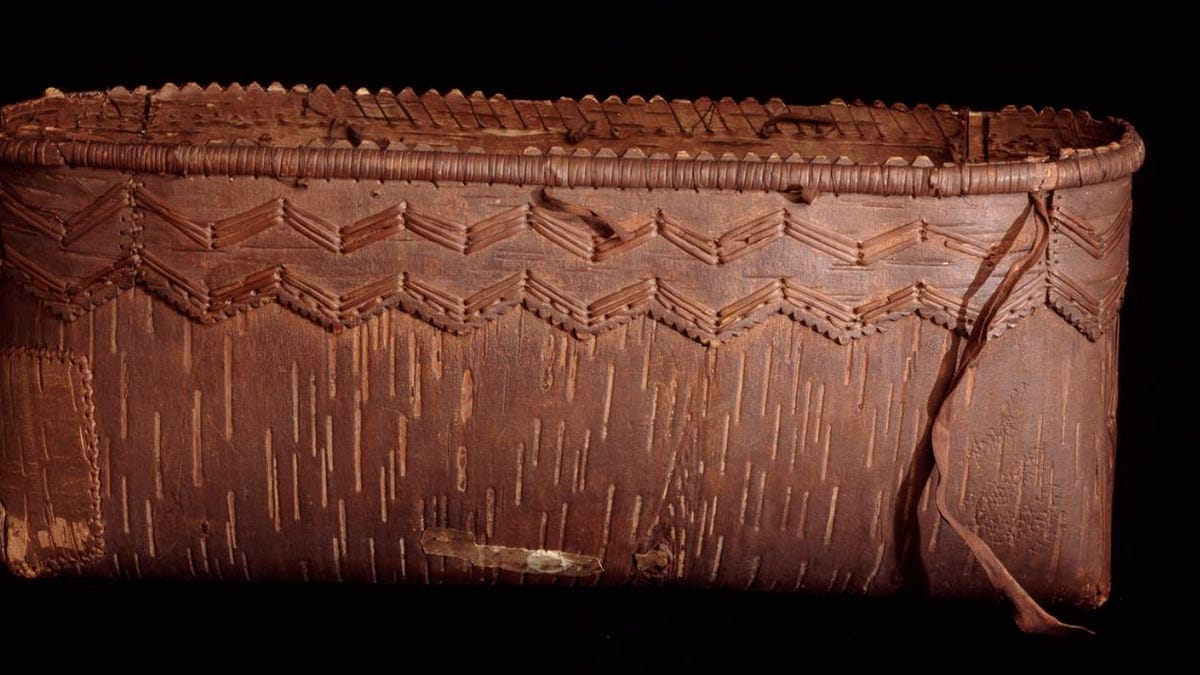
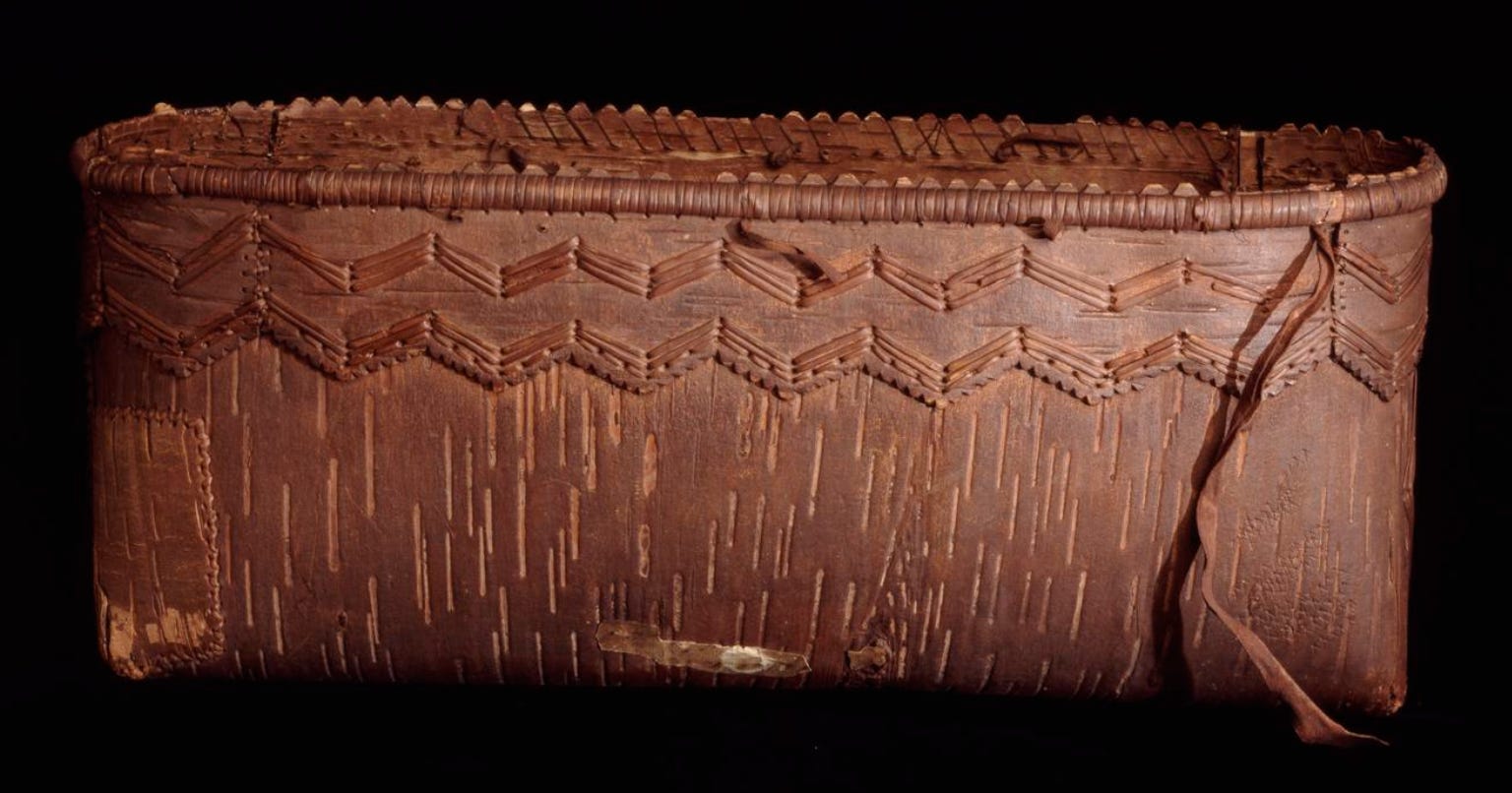
 A Beothuk chief’s bowl, 1820s or earlier, made of sewn birch bark and wood strips. Looted by William Epps Cormack from graves at Beothuk Lake, N.L. (British Museum, Am.6975)
An Indigenous couple’s remains, repatriated to Canada six years ago, have yet to find a final resting place because their “spiritual belongings” are being held by museums in the United Kingdom.
Six objects associated with Demasduit and Nonosabasut, among the last of the Beothuks of Newfoundland, are being retained by the National Museums Scotland and by the British Museum.
“Repatriating their spiritual belongings is a critical step towards peacefully laying Demasduit and Nonosabasut to rest in their final resting place,” Tony Wakeham, premier of Newfoundland and Labrador, wrote earlier this year.
Wakeham’s comment is from a March 27 letter to federal Heritage Minister Marc Miller, asking for Ottawa’s help in returning the six objects to Canada, including a container made of birch bark, spruce root and seal fat.
A copy of the letter and related documents, heavily redacted, were obtained under the Access to Information Act. They can be downloaded here:
The couple’s remains were looted from a central Newfoundland gravesite in the late 1820s, shortly before the Beothuks were declared extinct – a case of genocide by European colonizers, according to some historians.
The couple’s skulls and burial objects were removed by explorer William Epps Cormack from graves at Beothuk Lake (previously Red Indian Lake), most of which wound up in a Scottish museum.
In 2017, the Canadian government formally requested the return of the skulls and associated objects. The National Museums Scotland partially acceded, and the remains were transferred in 2020 to the Canadian Museum of History in Ottawa, and later to the care of The Rooms, a museum, archives and art gallery, in St. John’s, N.L.
But the “spiritual belongings” were held back in the absence of a clear repatriation policy for artefacts held by the Scottish institution. An updated policy was created in 2025, “which may now make it possible for the associated objects to be repatriated to Canada,” says a memorandum to Miller.
Miller wrote to Wakeham in April that the federal government “would be pleased to assist again in facilitating the return of these spiritual belongings,” and that his officials would begin discussions. The U.K. institutions require national governments to make formal requests in repatriation cases.
The process this time will be more complicated because the sought-after artefacts are held in two places, the Scottish facility in Edinburgh and the British Museum in London. Three birch-bark containers of similar manufacture and a small model canoe are in Scotland, while a birch-bark bowl and vessel are held in London.
Miller was cautioned not to expect quick results.
“There are no binding international treaties that require the repatriation of Indigenous cultural belongings and ancestral remains,” says the memo. “Repatriation of artefacts from abroad is often a lengthy process. … There can be significant costs associated with repatriation, including travel and transportation.”
Five Indigenous groups in Newfoundland and Labrador jointly represent the interests of the extinct Beothuk people, and all are members of the Final Resting Place Circle, created in 2023 to recommend a final interment of the remains. The group is also pressing for the return of the spiritual objects.
CBC reported in 2022 that the provincial government is considering creating a $250,000 cultural centre at Beothuk Lake to eventually hold the remains.
Demasduit, called Mary March by European settlers, was kidnapped by a fur trapper in March 1819. Nonosabasut was killed later that year as he attempted to free his wife. Demasduit died in 1820 and was buried on her ancestral lands at Beothuk Lake alongside her husband.
The couple were aunt and uncle to Shanawdithit, a Beothuk woman who was captured by Europeans in 1823 and died in 1829 in St. John’s, N.L. She is regarded as the last of the Beothuks.