

Listen to this article
Estimated 3 minutes
The audio version of this article is generated by AI-based technology. Mispronunciations can occur. We are working with our partners to continually review and improve the results.
Much of southern and western Quebec remains under a weather watch for this afternoon.
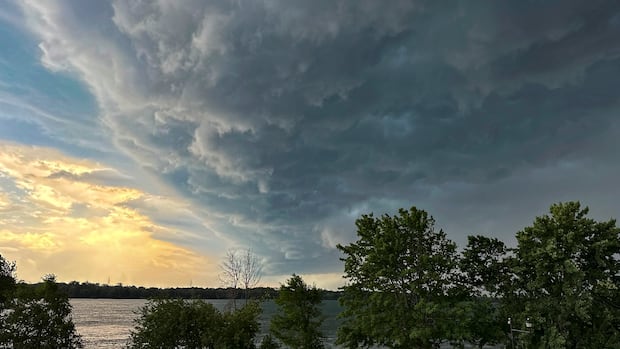
A morning thunderstorm brought almost 30 millimetres of rain to Sherbrooke in the Eastern Townships in less than an hour this morning. Environment and Climate Change Canada (ECCC)’s yellow watch for the region is still in place.
Dany Robitaille, assistant co-ordinator of Sherbrooke’s municipal civil security office, told CBC damage to the city was limited, but advised residents to bring in umbrellas or anything else that could be carried away by strong winds.
ECCC has also issued a yellow watch for a severe thunderstorm for the island of Montreal, with conditions considered to be “favourable for the development of severe thunderstorms capable of producing strong wind gusts, large hail and heavy rain.”
“We are in the middle of summer. This is not totally unexpected,” said ECCC metereologist Jim Prime.
“But it is something that is more of a precaution today just because, with those higher temperatures and the higher humidity … there’s just a lot of fuel for these thunderstorms to get going.”
With the humidex, the temperature in Montreal on Tuesday is expected to feel like 42 C. That’s still not as hot as July 1, when it felt like 44.
There is also risk of a tornado developing, which Prime explained any severe thunderstorm can produce. The weather agency put a section of south-central Quebec on an orange watch for a possible tornado.
The difference between a yellow and orange watch is the anticipated level of severity and subsequent cleanup or damage, with orange being more severe than yellow.
A tornado watch or warning would come if the possibility of a tornado increases.
“If [a tornado] does happen, seek shelter,” said Prime. “Make sure that you are in the safest place possible — a secure basement — and wait until everything has passed.
“Don’t go outside and start videotaping or try to get the best shot. It’s better for you to take cover and make sure you’re protected.”
Why the yellowish sky?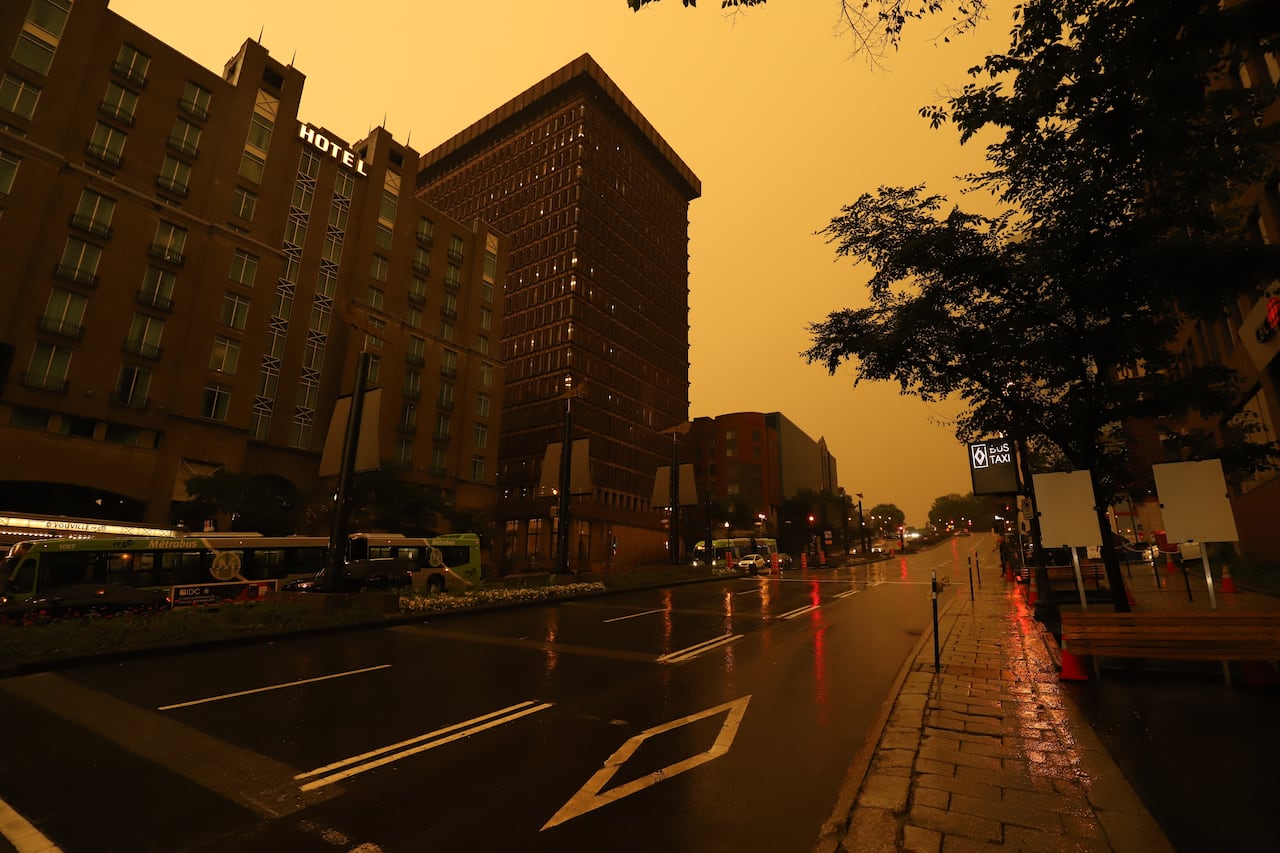 In addition to thunderstorm watches, some areas, such as Quebec City, also got hazy yellow skies caused by smoke from forest fires earlier in the day. (Sébastien Vachon/Radio-Canada)
Montrealers may have also noticed the sky had a yellowish hue Tuesday morning, thanks to smoke particles wafting over from forest fires in northern Ontario. Prime said that forest fire smoke can start to accumulate as two air masses push together.
“When they sweep over a region, we start to see this accumulation of smoke move over us,” Prime said.
The air quality across the province was generally moderate on Tuesday morning.
Meanwhile, heat warnings and advisories are in effect across other parts of Quebec, Ontario, Manitoba, Saskatchewan and the Northwest Territories.
Officials are urging people to stay hydrated, to avoid strenuous outdoor activity, and to check on older people, or anyone else who might be vulnerable to the heat.
WATCH | The yellow sky, explained: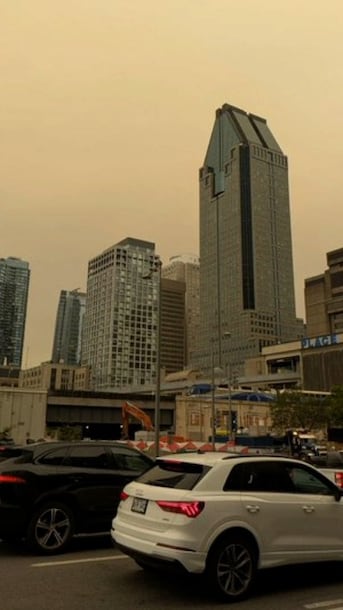
What’s behind Montreal’s hazy yellow sky this morning?
The particular hue is a telltale sign that wildfire smoke is in the air. The fires are mostly in northern Quebec and other parts of the country. Much of southern and western parts of the province are under weather warnings for severe thunderstorms and the risk of tornadoes.