
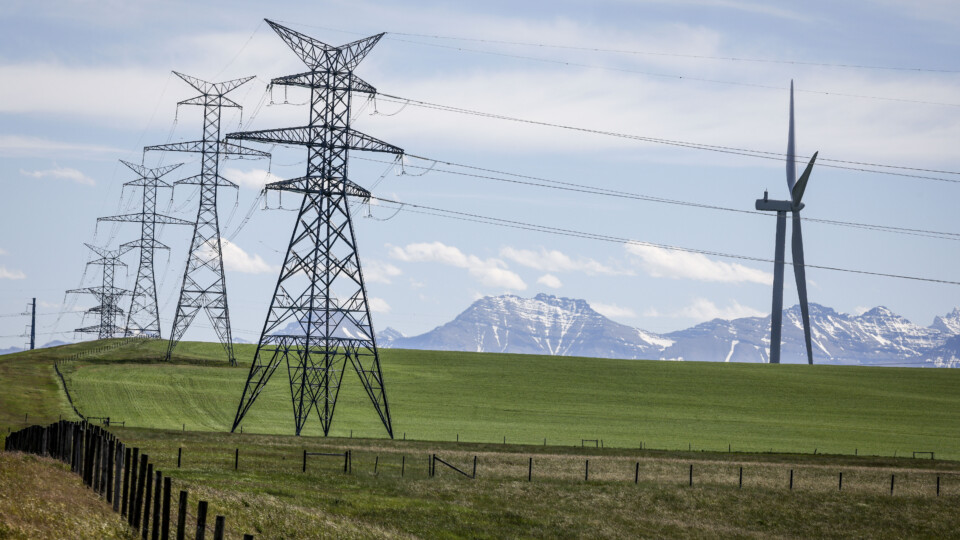
In the race to electrify the economy, Canada has one big problem. The country is not always great at moving power to where it’s actually needed.
From AI data centres and critical mineral mines to factories, homes and electric vehicles, Canada’s future increasingly depends on cheap and reliable electricity.
Governments understand this and are scrambling to build more generation. What they’re only beginning to confront is that Canada’s electricity system remains a patchwork of provincial grids, stitched together only loosely by a handful of interprovincial transmission lines.
In many ways, this is a familiar story.
A vast geography, unevenly distributed resources, and competing regional interests have long made it easier to talk about national infrastructure than to build it.
But something is shifting in the West, and it might be the first real test of whether we’re ready to turn decades of ambition into action.
Last week, a new initiative called Western Transmission Catalysts quietly launched in Calgary. It lacked the headline-grabbing scale of pipeline proposals or Meta’s $13-billion data centre. Yet the transmission projects it hopes to advance could ultimately rival those megaprojects in both economic impact and national importance.
Some may eventually land on the federal Major Projects Office list.
“We’re clearing the landscape for what’s possible” said Blake Shaffer, a University of Calgary professor and former energy trader who’s directing the initiative. “We’re calling it pre-pre-development.”
The coalition behind the $4.2-million effort includes an unusual mix of economists, engineers, Indigenous leaders, and industry experts. Funded by the federal government and working alongside provincial governments and utilities, the group hopes to spend the next three years turning promising interties into shovel-ready projects.
“It’s well and good to have ambition,” said Shaffer. “What we’re trying to do is lay the foundations for projects to occur.”
The three interties that matter
At its simplest, an intertie is a high-voltage transmission line connecting two electricity grids. Think of it as a highway for electricity. Most provinces have plenty of “roads” within their own borders.
Between borders—not so much.
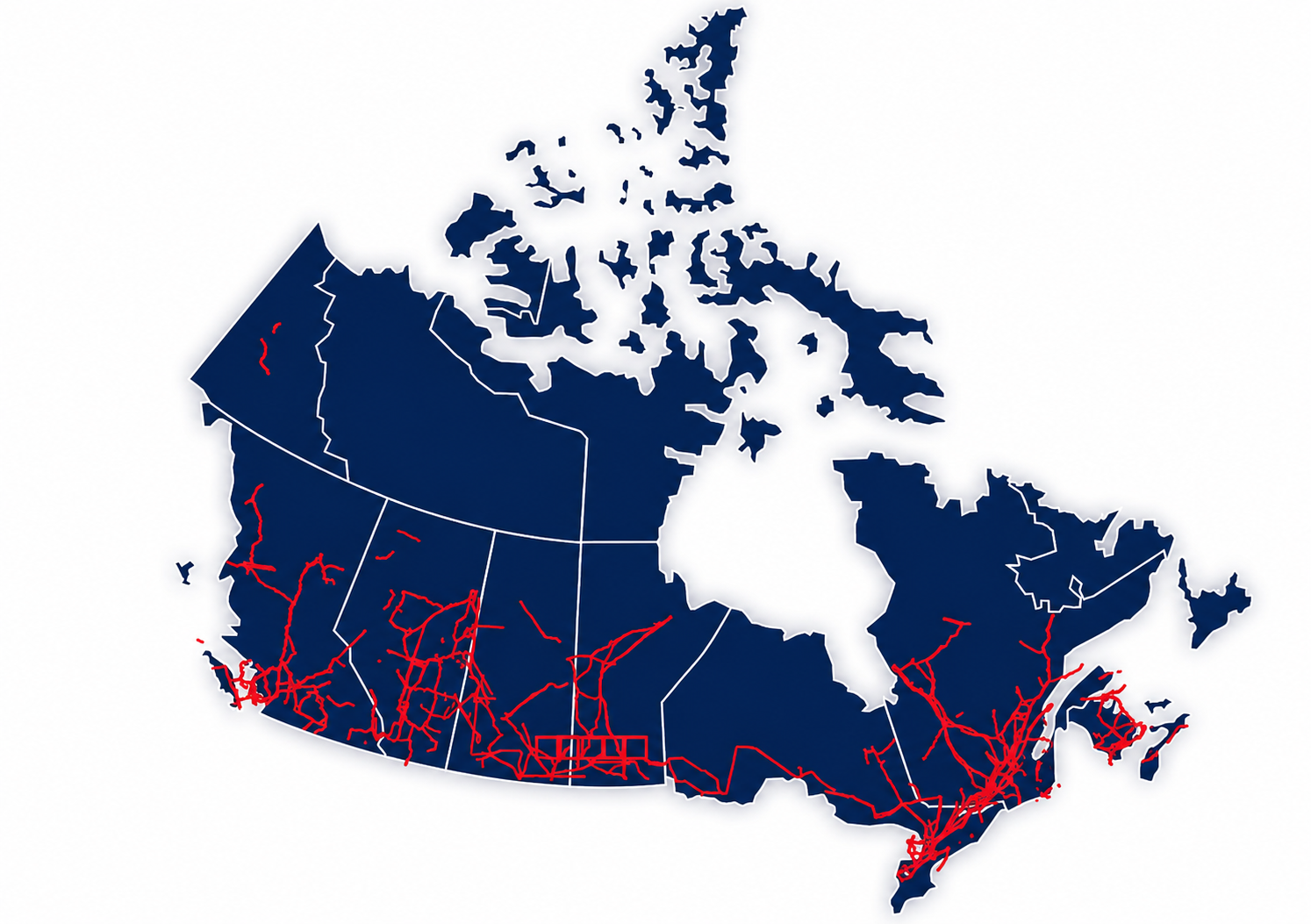
Snapshot of Canada’s current transmission network. Credit: Indigenous Power Coalition.
That gap means one province can be sitting on surplus power while its neighbour is spending billions to build new generation. Construct stronger interties, the argument goes, and provinces could treat electricity more like a shared resource—buying and selling wherever it’s cheapest, instead of leaning so heavily on U.S. markets.
Right now, Alberta connects to B.C., Saskatchewan, and Montana. B.C. also trades with Washington state. Manitoba links to Saskatchewan, Ontario, and several U.S. states.
In fact, more than 80 percent of Canada’s electricity trade still moves north-south. It’s simply been cheaper and easier to hook up with a nearby American grid than to bolster the lines across the provinces.
Thus the three principal interties linking Western Canada remain relatively weak. The B.C.-Alberta, Alberta-Saskatchewan, and Saskatchewan-Manitoba connections were largely designed decades ago to provide emergency backup rather than serious day-to-day trading.
The biggest gains would come where neighbouring provinces have complementary systems.
B.C.’s hydro reservoirs provide flexible, dispatchable power that can quickly ramp generation up or down, while Alberta’s grid is powered by natural gas alongside an expanding fleet of wind and solar projects. A stronger tie would let Alberta lean on B.C. hydro when it needs firm, reliable power, while B.C. saves water behind its dams whenever Alberta’s wind and solar are running strong.
Saskatchewan and Manitoba offer a different, but equally compelling, case.
Both have smaller grids, which makes them more exposed when a single power plant goes down. A bigger intertie would give them a safety net. It would also support Saskatchewan’s plans to add nuclear power, allowing the province to export surplus electricity when demand is low and import hydro power when reactors are offline.
“They absolutely need to have outlets for it,” Shaffer said.
i
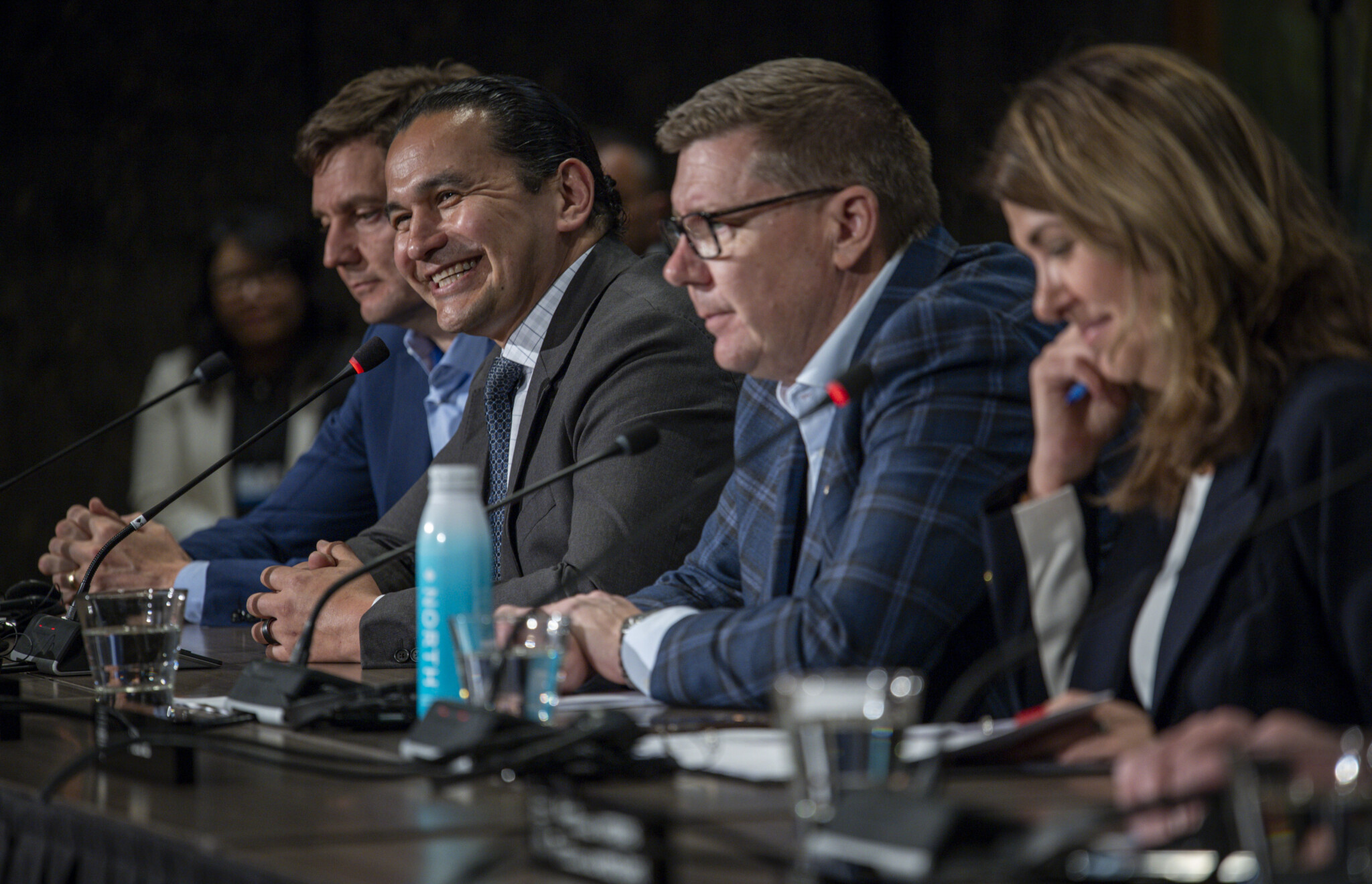
Manitoba Premier Wab Kinew, second left, speaks a closing news conference of a meeting of western premiers as B.C. Premier David Eby, left, and Saskatchewan Premier Scott Moe, centre, and Alberta Premier Danielle Smith listen in Kananaskis, Alta., Tuesday, May 26, 2026. Jeff McIntosh/The Canadian Press.
Earlier this year, Manitoba Premier Wab Kinew turned down a proposed hyperscale AI data centre southeast of Winnipeg, in part questioning whether it was worth the electricity it would consume. Alberta took the opposite approach, welcoming AI investment on the condition that developers bring their own power generation, while bracing for a big jump in demand.
Stronger interties won’t change all that.
But supporters say they’d give provinces more options—and more room to lean on each other—instead of each one having to solve its energy problems alone.
How to actually get started
In March, Ontario initiated a National Energy Corridor Agreement with nine other provinces and territories—including all four Western provinces—to advance new transmission projects and strategic interties across Canada. Ottawa has since followed up with its National Strategy for an Electrified Canadian Economy, which names stronger regional electricity ties as key to both energy security and economic growth.
The hard part is figuring out how to get there.
“We’re really positioning ourselves as ‘the how,’”Shaffer said. “How this will get done.”
Rather than pushing one specific line, Western Transmission Catalysts is trying to clear away the obstacles that have killed these projects before construction ever starts—commissioning independent economic studies, working out financing, bringing utilities and provincial governments to the table, and helping First Nations organize early.
Right now, most of the group’s energy is going into the B.C.-Alberta corridor, where talks are furthest along. The provinces are already linked by Western Canada’s largest intertie, crossing the southern Rockies near Cranbrook, with a nominal transfer capacity of roughly 1,200 megawatts.

Earlier this year, Nathan Neudorf, Alberta’s then-minister of affordability and utilities, told The Hub that the province was studying a second, $2- to $3-billion intertie farther north.
“We would love to have another intertie with northern British Columbia,” Neudorf said in March. “It would help their economy. It would help our economy.”
That corridor could support growing industrial demand on both sides of the border, including natural gas development, mining, LNG terminals, and other heavy energy users.
Flipping the script on Indigenous involvement
One of the more striking parts of this initiative has almost nothing to do with engineering.
“We’d like to take the next step in the evolution of Indigenous equity participation by focusing on leadership,” said Kwatuuma Cole Sayers, executive director of the Indigenous Power Coalition, which advocates for Indigenous communities to become project proponents.
Usually, First Nations get brought in only after a route is picked and a project is already designed. Western Transmission Catalysts wants to flip that order, so that nations can lead these projects from day one rather than react to them.
“It’s still very early stage but there’s been a lot of excitement—a lot of interest—in the Nations,” Sayers told The Hub. “We’ve been engaging for well over a year, so we have put a lot of effort into those relationships with the nations and hopefully over the next year, those Nations will be able to announce themselves.”
The concept reflects the next evolution of a model already emerging in northern B.C.
BC Hydro’s proposed North Coast Transmission Line—a 445-kilometre, 500-kilovolt transmission corridor capable of carrying up to 2,200 megawatts of electricity between Prince George and Terrace—is already giving participating First Nations the option to acquire up to a 50-percent ownership stake.
i
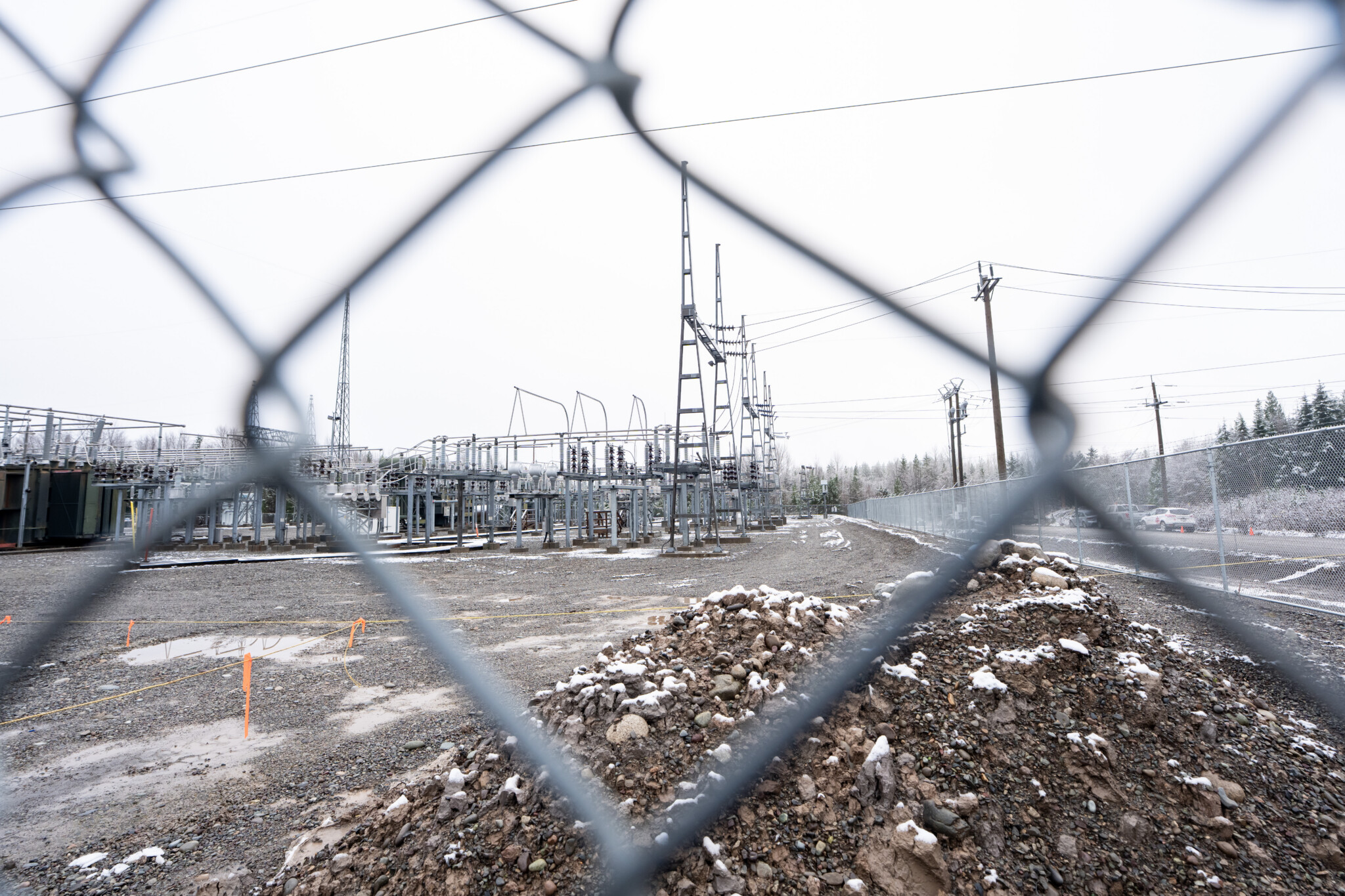
The BC Hydro Skeena Substation is pictured while under construction in Terrace, B.C., on Thursday, November 13, 2025. Ethan Cairns/The Canadian Press.
Sayers calls that “the minimum standard” going forward. His view is that Indigenous Nations should be the ones identifying and pushing for new transmission projects in the first place.
Shaffer thinks First Nations may actually be better suited than private companies to own assets like these, simply because of how differently they evaluate time horizons.
“When I talk with private companies, when they’re looking for returns… anything beyond 10, certainly 15, certainly 20 years is so heavily discounted that it’s less meaningful,” Shaffer said. “Whereas Nations are looking at this with a longer-term vision. They really do talk about—for generations.”
Sayers also argues that Indigenous leadership could make these projects easier to build. By involving Nations before a route is selected, many land-use, cultural, and community concerns can be resolved before the project hits the formal regulatory process, where delays get expensive.
The North Coast Transmission Line is already before the Major Projects Office. Sayers believes future Indigenous-led interties could fit naturally into Ottawa’s broader nation-building push.
“I mean it definitely checks all the boxes,” Sayers said.
Ottawa hasn’t committed to funding future interties, but federal Natural Resources and Energy Minister Tim Hodgson showed up at the launch to share the stage with Sayers and others.
Nation-building agenda
None of this is simple. Transmission projects are expensive and technically complicated, and splitting costs between provinces with different utility markets and structures adds another layer of difficulty.
Even the people behind Western Transmission Catalysts admit most of these projects are still years from breaking ground.
But the conditions that kept interties stalled for decades have genuinely changed.
After roughly 25 years of flat electricity demand, AI growth, industrial electrification, critical mineral development, and energy security concerns have elevated robust interprovincial transmission from a nice-to-have to what increasingly looks like an economic necessity.
Ottawa is once again talking seriously about nation-building—not just roads, ports, and pipelines, but the wires that power Canada’s next industrial buildout.
And in that race, moving electricity may end up mattering just as much as generating it.

Falice Chin is The Hub’s Alberta Bureau Chief. She has worked as a reporter, editor, podcast producer, and newsroom leader across Canada…
Read more
Canada’s push to electrify its economy depends not only on generating more electricity but on moving it across provincial borders. This article examines how a new Western Canadian initiative hopes to transform decades of talk about interprovincial transmission into buildable projects. Central to its approach is a belief that First Nations should move beyond equity ownership to help lead and shape transmission projects from the outset, potentially making them easier to build while strengthening Canada’s energy security and economic competitiveness.