
Prime Tire Newsletter | This is The Athletic’s F1 newsletter. Sign up here to receive Prime Tire directly in your inbox twice a week during the season and weekly in the offseason.
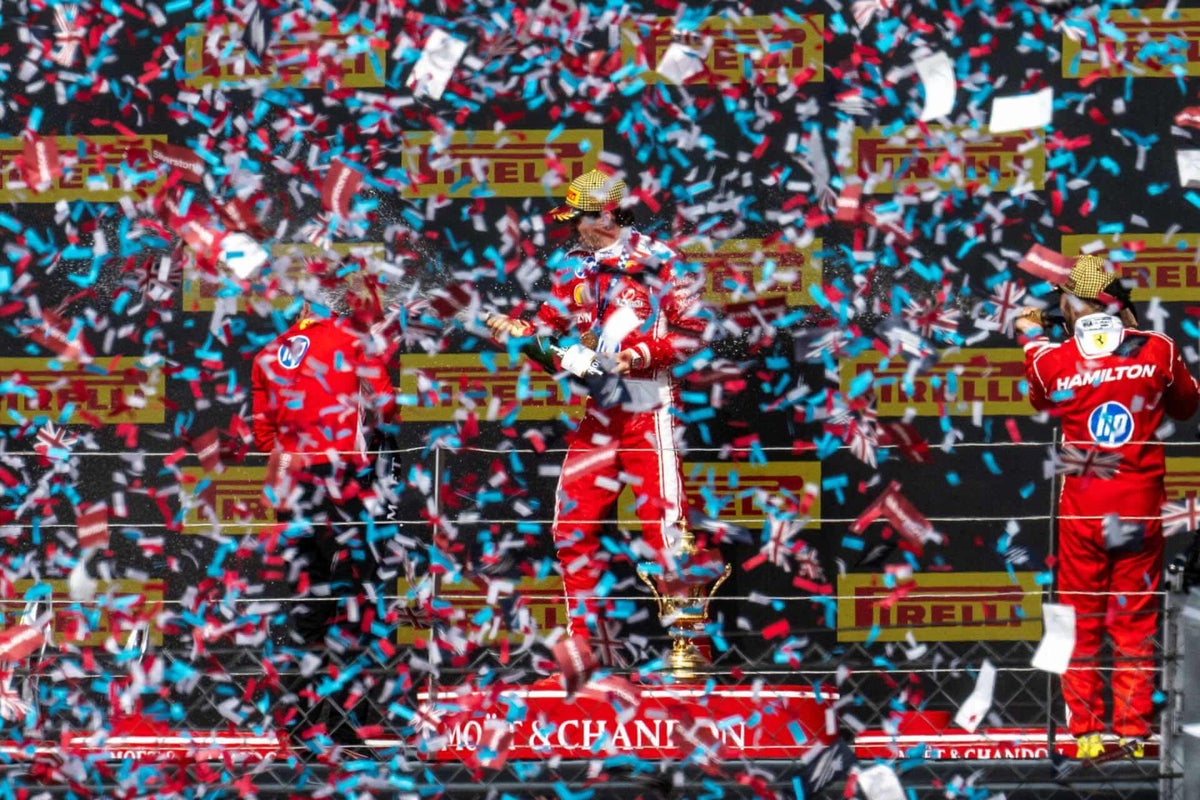
Welcome back to Prime Tire, where today I’m looking forward to Formula 1’s Belgian Grand Prix this weekend and considering the curious, fluctuating form of Ferrari, the British GP winner.
I’m Alex, and Luke Smith will be along later.
Flummoxing Ferrari: What next in a long title drought?
Later this week, Luke and Madeline Coleman are going to explain their predictions for the upcoming race at Spa. But as Madeline covered in our last PT edition, the drivers are heading there fearing it could be another strange weekend, with the new engines continuing to behave counterintuitively at a fast and fearsome track.
At Silverstone, things ultimately weren’t as bad as the drivers feared. But Spa, with its undulating layout and fickle Ardennes weather, is arguably more special in the minds and hearts of both drivers and F1 fans. So it will be strange to hear the depressing sound of super-clipping limiting top speeds on the long run up the Kemmel straight when watching driver onboards this weekend. But the yo-yo racing style of the 2026 cars could make it interesting.
Although if F1 in 2026 has taught me anything, it’s that predictions are harder than ever.
Enter Ferrari.
The Italian team arrived at Silverstone after a chastening Austria weekend, one race removed from Lewis Hamilton’s sensational win in Spain.
Ferrari’s poor Red Bull Ring outing came down to its engine struggling at the Austrian GP track’s relatively higher altitude. But it still shone at Silverstone when a Mercedes walkover appeared likely.
OK, sure, Charles Leclerc needed Mercedes driver Kimi Antonelli to break his left-side wheel shield against the Copse exit curbs to win the main Silverstone race, after the Italian dashed Hamilton’s hopes of a home win in the sprint event the day before. But that was still some turnaround from Ferrari.
Ferrari’s car upgrades so far this season have made an impressive impact. And both Hamilton and Leclerc have put in impressive performances — albeit after a lot of brake-related frustration for Leclerc.
So, now the question is: Can Ferrari win the 2026 world title?
The team won’t entertain such talk. But Hamilton is just 32 points behind Antonelli — who has 179 points after the championship leader ended up scoreless in Silverstone’s main contest — and seven points behind George Russell (154 points, second place).
Antonelli’s once-commanding standings lead is suddenly looking vulnerable, especially with 13 races remaining this year (more on the fluctuating 2026 calendar below).
And for Ferrari fans, it’s the hope that keeps them going.
OK, now bear with me … I’m going to make one final football (aka soccer, for our American readers) analogy this summer (mainly because I can’t be sure of the outcome of the FIFA World Cup semifinals and, if England lose to Argentina tomorrow, I just might not want to mention the tournament ever again).
The Italian football team is enduring a World Cup title drought that will last at least 22 years after its failure to qualify for the current tournament. But Ferrari isn’t most like Italy; it’s most similar to England’s football team.
Hear me out, with some help from the “Three Lions” song by David Baddiel, Frank Skinner and the Lightning Seeds. Let’s apply those lyrics, about what it’s like to be an English football fan, to the F1 Ferrari team, and what those fans endure:
🎶 “Everyone seems to know the score” = see my point above about F1 predictions
🎶 “They’ve seen it all before” = so many botched Ferrari strategy calls
🎶 “But I know they can play” = that run of five world title doubles I watched Michael Schumacher scoop up for Ferrari at the turn of the millennium
🎶 “Thirty years of hurt” = 19 years since Kimi Räikkönen (pictured above) last won Ferrari an F1 drivers’ title, and 18 since its 2008 constructors’ triumph
🎶 “So many jokes, so many sneers” = every “we are checking” meme
🎶 “But all those ‘oh so nears’” = Fernando Alonso coming agonizingly in second for Ferrari in 2010 and 2012, plus Sebastian Vettel’s near-miss in 2018
🎶 “Three Lions on a shirt!” = the Prancing Horse logo on its field on Modena yellow, obviously
🎶 “I know that was then, but it could be again” = whatever Hamilton and Leclerc can now do with the upgraded SF-26
I guess what I’m getting at is, much like that song implies for England, Ferrari also has what it takes to succeed at the top level. Yet with plenty of historical pedigree, Ferrari remains painfully stuck in a cycle of defeat largely of its own making.
Supporting Ferrari can feel very frustrating, as big hopes give way to big disappointment. And I know this can apply to many worthy footballing countries and F1 teams, but that song is just stuck in my mind during these sunny days in London, while Team England is still alive this World Cup.
Going back to Ferrari, it has lost more than it has won in its long F1 history, which goes back further than any other team, to the second race of the inaugural world championship season in 1950. (Ferrari’s mercurial eponymous founder Enzo Ferrari refused to enter the first race at Silverstone, as he deemed the race appearance and prize fees too low.)
But it has also been so good over certain stretches the past 76 years, it always feels like Ferrari is on the cusp of rediscovering the old Alberto Ascari, Niki Lauda or Schumacher magic. Let alone that of the six other drivers to have won the title in red.
There’s two races to go until F1’s August break. If Ferrari can add to its 2026 win tally against the mighty Mercedes in that time, it’s game on for a multi-team title battle this year.
And, if not, put this analogy down to some hot summer fever dreams.
Over to Luke to return this newsletter to more serious territory.
Inside the Paddock with Madeline Coleman: F1 needs to make a rescheduling decision
F1 wants to get at least one of its canceled races in Bahrain or Saudi Arabia back onto the 2026 calendar, having called off both events that were slated for April following the conflict in the Middle East.
The ceasefire agreement made last month has unravelled in the last couple of weeks, with the number of attacks in the region increasing. F1 has continued to closely follow events, staying in close contact with not only the race organizers in Bahrain and Saudi Arabia, but also local governments and authorities.
Whenever F1 makes a call, it will be well-informed.
But time is ticking on a decision, especially as the conflict is appearing to re-escalate. The mooted spot for Bahrain to be reinstated was Oct. 4, between races in Azerbaijan and Singapore. The next couple of weeks are likely to be vital to judge what is viable for rescheduling the race in that slot.
F1 still has Middle East races scheduled in Qatar (Nov. 30) and Abu Dhabi (Dec. 6) to close out the season, but the deadline for any decision on these is months away. It wouldn’t be until early October that teams would need to know how the end of the season may look.
Back to you, Alex.
Magnussen Magic: Dane gets first post-F1 win in WEC race
We’ve been rather Kevin Magnussen-heavy in PT of late, but the Dane created such a legacy across nine full F1 seasons and 185 grands prix that we can’t help but keep track of what he’s up to. Especially in a race we covered on our site.
Our latest round of World Endurance Championship stories culminated in my report of the series’ 6 Hours of São Paulo race last Sunday, when Magnussen and his co-drivers Raffaele Marciello and Dries Vanthoor won for BMW WRT. Ferrari took second place with its No. 51 car, and Cadillac’s No. 12 car placed third, despite showing the race’s strongest pace.
Although there was plenty that could disrupt the race over the four hours that followed Magnussen’s opening two-hour stint in the lead BMW, his key work set up the victory.
Unlike his poor start at Le Mans last month, Magnussen gained spots quickly and early on at Interlagos — the same venue that hosts F1’s Brazilian race each year — including a feisty pass on Earl Bamber in the No. 38 Cadillac car.
There was plenty of rubbing and bumping on what was a cold, damp track, but Magnussen pulled off the ultra-aggressive move with aplomb — exactly what you’d expect from his time in F1.
Magnussen then paired speed with good fuel efficiency to keep the lead on what emerged as the “orthodox” race strategy, while both Cadillacs hit trouble at their first pitstops.
You can read my full report here — including Vanthoor overcoming sickness in the BMW cockpit to hold on for the win — but Magnussen was certainly pleased with the result.
After all, it marks his first win after 1 1/2 WEC seasons, and his first win post-F1. It’s also his first win in any category since the Detroit IMSA race in 2021, and it came on the same track where he took a popular F1 pole in 2022.
“The strategy was perfect, the pit stops too – everything just worked,” Magnussen said in BMW’s post-race news release. “My two teammates did an excellent job. That’s why I’m overjoyed to have finally achieved this victory. It took a long time, but now, we’ve finally done it.”
Congrats, K-Mag.
Outside the Points
❗ Sticking with WEC updates, I explained how safety systems work in endurance racing, with events and fields much bigger and therefore more complex than in F1.
🏎 Lando Norris drove the McLaren Hypercar at the Goodwood Festival of Speed in the UK.
‼️ And a report from dailysportscar.com suggests the rescheduled WEC races in Bahrain and Qatar could be canceled again.
📫 Love Prime Tire? Check out The Athletic’s other newsletters.