
Assembly of First Nations chiefs on Wednesday unanimously resolved to oppose the Carney government’s sweeping proposed reforms aimed at streamlining major project approvals, if those reforms weaken environmental protections or sidestep Indigenous rights.
The federal Liberals in May released a plan for an extensive legislative overhaul to get projects like pipelines approved within a year, including by creating a new Crown Consultation Hub to co-ordinate engagement with Indigenous Peoples.
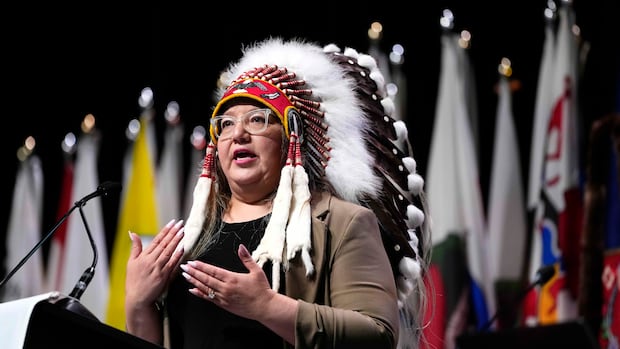
The AFN’s national chief denounced the plan in no uncertain terms on Tuesday as the advocacy organization, which represents chiefs countrywide, opened its annual summer political assembly in Ottawa.
“A one-year timeline, principally designed to attract investment, subordinates the honour of the Crown to commercial imperatives. Instead, it will give rise to questions about the legitimacy of approvals,” Cindy Woodhouse Nepinak told delegates at the Rogers Convention Centre.
“The federal government can try and set up all the timelines that they want for project approvals, but they can’t put a deadline on First Nations rights.”
The delegates punctuated that point Wednesday morning by carrying resolutions to, in part, oppose any federal reforms that “weaken environmental protections, undermine oversight, limit meaningful consultation, compress review timelines or circumvent First Nations’ free, prior and informed consent.”
 The AFN logo is seen with Parliament Hill amid a smoky sky in the background, at the 2026 Annual General Assembly in Ottawa on Tuesday. (Justin Tang/Canadian Press)
“This cannot proceed without upholding First Nations rights,” said the resolution’s mover Judy Wilson, proxy delegate for the Shuswap Band in B.C.
In an emailed statement, Internal Trade and One Canadian Economy Minister Dominic LeBlanc’s office said the federal government agrees partnership with Indigenous Peoples is critical to the success of nation-building projects.
“The government intends to strike a deliberate balance — faster decisions and more co-ordinated Crown consultations, without weakening oversight, standards, or Indigenous rights,” the statement reads.
The resolution helps set the stage for what’s shaping up to be a high-stakes first ministers’ meeting between First Nations leaders, provincial premiers and the prime minister this fall.
Woodhouse Nepinak told the group the prime minister’s office confirmed the meeting will be held on Oct. 26. In the meantime, Woodhouse Nepinak said, “Our message is simple and practical: that our rights are our rights and this land is our land.”
The delegates discussed the meeting at length on Wednesday, emphasizing the need to come prepared, disciplined, united and focused given the rare chance to hold these direct talks.
They eventually adopted a resolution calling for the agenda items to include establishing a table on Confederation and constitutional change, federal fast-tracking legislation, the Canada-Alberta pipeline agreement, environmental oversight, and upholding First Nations’ rights.
“We are not asking for permission to participate. We are asserting our rightful place as partners in decisions that affect our peoples and our territories,” said Ogimaa (Chief) Shelly Moore-Frappier, of Temagami First Nation in Ontario.
Later on Wednesday, chiefs representing the Blackfoot Confederacy in Alberta and Iroquois Caucus in Quebec signed an economic alliance, highlighting the importance of solidarity in the face of separatist movements in those provinces.
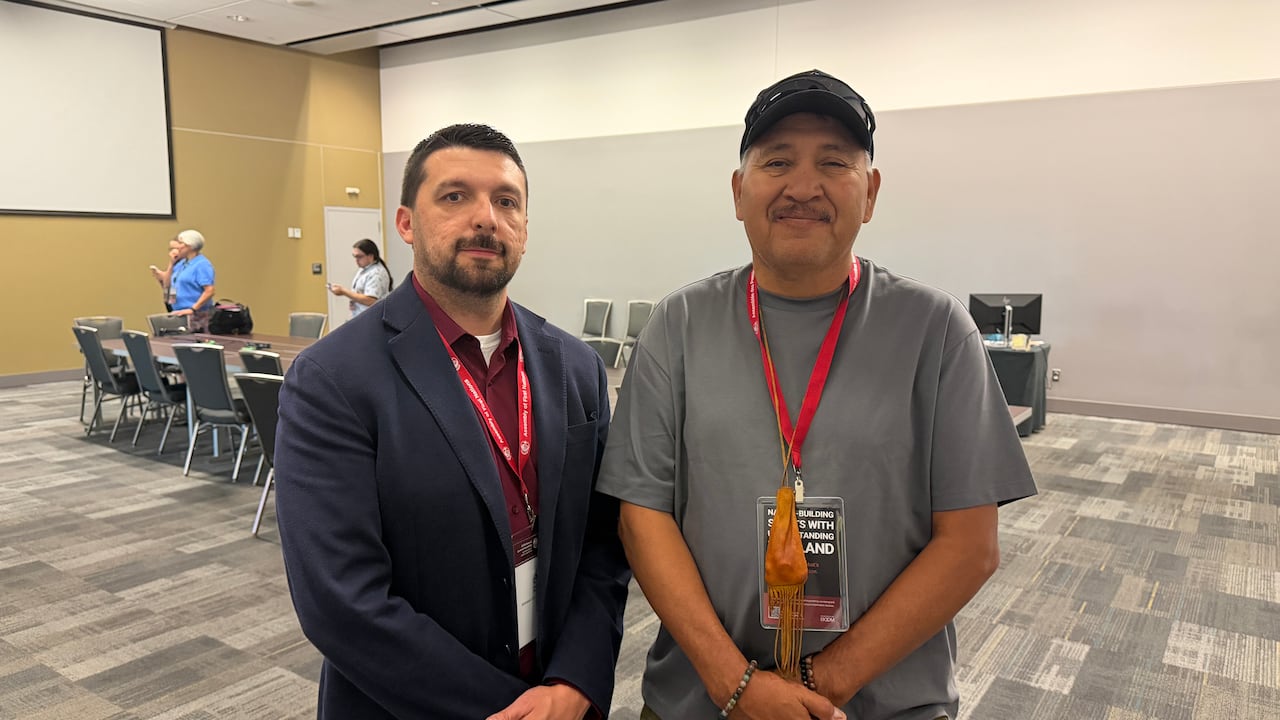 Mohawk Council of Kahnawà:ke Grand Chief Cody Diabo (left) stands with Chief Troy “Bossman” Knowlton of the Piikani Nation in Alberta after signing an economic alliance at the Assembly of First Nations in Ottawa on July 15. (Brett Forester/CBC)
“We’re dealing with separation right now in Alberta, and Quebec and has gone through that so we want to learn from the experiences they’ve went through,” said Troy “Bossman” Knowlton, chief of Piikani Nation and president of the Blackfoot Confederacy, in an interview.
“Right now the unification of all First Nations across Canada is paramount, and we’re seeing it.”
Mohawk Council of Kahnawà:ke Grand Chief Cody Diabo called it “history repeating itself,” and added that alliances with other nations in Alberta are in the works.
Another central concern was the federal government’s tabling of new on-reserve drinking water legislation, Bill C-37.
Alberta and Ontario last summer wrote the federal government urging it not to reintroduce this bill at all after a predecessor died on the order paper earlier in 2025. An out-of-court settlement, however, forces the Carney Liberals to reintroduce it.
But in doing so, the Liberals removed direct recognition of First Nations’ human right to safe drinking water and rolled back protection for water sources off reserve, prompting accusations Canada weakened the bill to appease provinces and shield itself from legal liability.
“We’ve seen the government of Canada fall in line with Alberta’s agenda and it’s very troubling,” said Chief Sheldon Sunshine of Sturgeon Lake Cree Nation in Alberta.
He told CBC Indigenous outside the AFN meeting that his community will be among those opposing the bill because of the changes.
“When they try to limit jurisdiction onto reserve … First Nations never gave up jurisdiction over water. It was non-negotiable, and it’s still non-negotiable today,” he said.
Indigenous Services Minister Mandy Gull-Masty has previously told CBC Indigenous the changes in the bill were there to make it harder to challenge, particularly by provinces.
The assembly continues Wednesday afternoon and Thursday.