
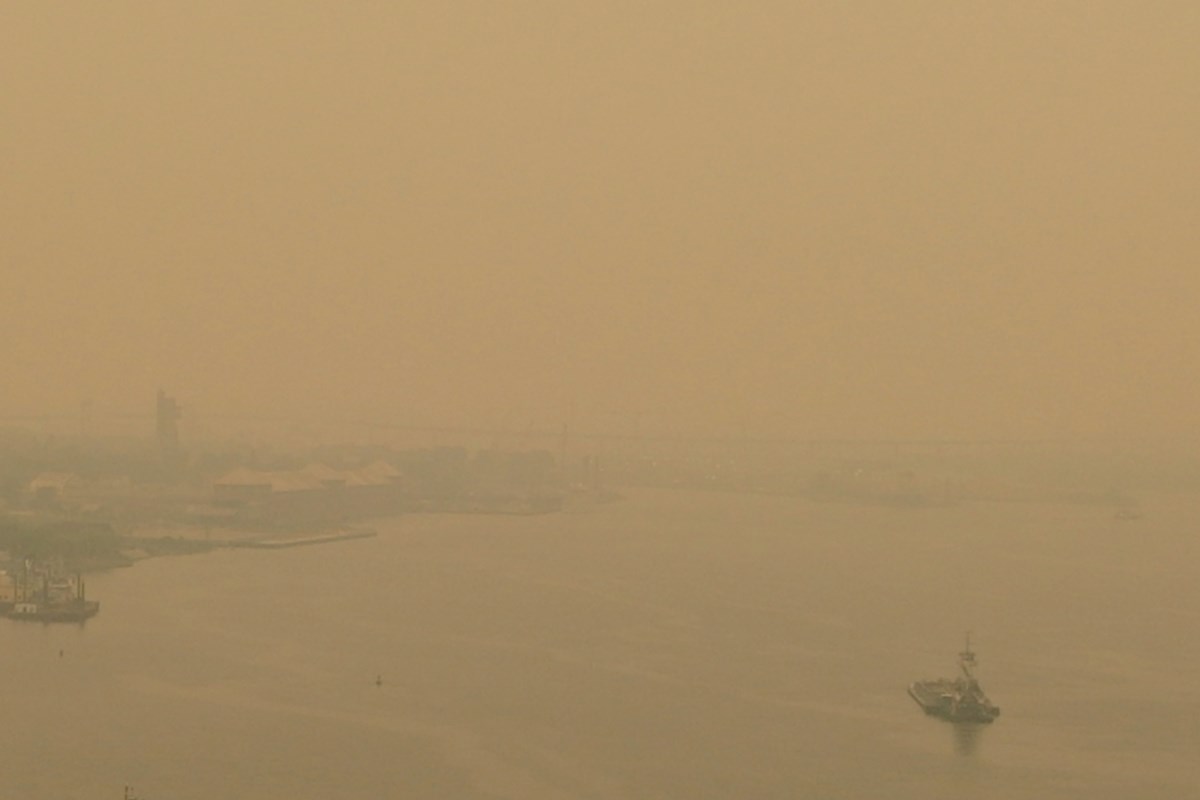
The Sault is currently among the hardest-hit Ontario municipalities for wildfire smoke, but relief could be on the way with shifting winds and rain
It may seem really bad in the Sault right now, but a spokesperson for the province said the air quality was worse a few years ago.
Lindsay Davidson, media relations advisor for Ontario’s Ministry of the Environment, Conservation and Parks, said it was worse here in 2023.
“Current fine particulate matter concentrations are lower than those observed in 2023 during the unprecedented wildfire season. Current concentrations are still considered very high and are having a substantial impact on air quality,” said Davidson in an email.
A graph using hourly readings from Air Quality Ontario shows the air quality health index levels were off the chart between midnight and 2 p.m. today, before lowering slightly.

Graph courtesy Air Quality Ontario
Relief from poor air quality due to wildfire smoke may be coming with shifting winds, although a spokesperson for Environment Canada says that could only be temporary.
Simon Legault, a meteorologist at Environment and Climate Change Canada, said the poor air quality due to wildfire activity is widespread throughout Ontario, with Sault Ste. Marie among the population centres most affected.
“It’s very bad right now. For Sault Ste. Marie, it could improve by tomorrow afternoon or evening, when we could see some of that smoke being pushed to the south,” Legault said.
He said, for today, the current conditions will remain.
“It’s going to stay probably very bad all through the day and into the evening,” Legault said.
That predicted improvement may only be temporary, with winds expected to shift again in a few days.
Legault said a rain prediction on Saturday may bring some relief to the hazardous air quality.
Nicole Lindahl, Algoma Public Health’s manager of emergency preparedness and response, said the current poor air quality is mostly being driven from wildfires happening in northwestern Ontario and Manitoba.
“We know they’re not nearby. We can experience poor air quality from forest fires that are hundreds or thousands of kilometres away and it can definitely be concerning,” said Lindahl.
While the poor air quality impacts everyone, Lindahl said some people are more affected by it, such as “people with breathing conditions, asthma, chronic obstructive pulmonary disease and congestive heart failure.
“But it can also more adversely impact people who spend more time outside. So people who work outside or people who are playing outside, sports, things like that,” she said.
Asked about people experiencing homelessness, she said they should find a place to go inside.
“Especially when it’s hot and the air quality is bad, because I know it’s not as hot today, but it’s still in the high 20s with the humidex,” Lindahl said.
If anyone in any of those groups has to be outdoors, said Lindahl, people are recommended to wear N95 certified face masks.
“If those are available to organizations to pass out, that’s good as well,” she said.
During air quality events, Lindahl works with municipalities and community partner agencies to provide information on hazards that can impact health.
“We send information out to partners who connect with workplaces to share about how to keep indoor air quality safe when the air quality outside is bad,” Lindahl said.
Information is shared with Indigenous partners, child care centres, school boards and other partners.
“That’s what we’ve spent a lot of time doing over the last couple days,” Lindahl said.
Algoma Public Health maintains a page on its website devoted to safety during wildfire smoke events.