
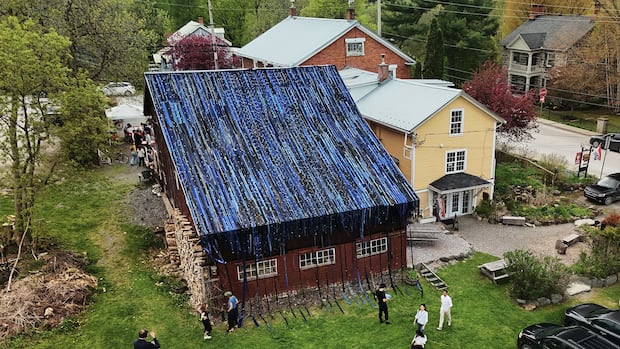
When Montreal artist Stina Baudin looked at the roof of a 19th-century barn in Quebec’s Eastern Townships, she saw a potential canvas that could reflect the region’s nearly forgotten Black history.
For her artwork, titled The Sky Still Carries the Stories, she sewed together pieces of black and indigo fabric and tarps atop the roof to resemble a night sky with 2,000 hand-stitched mirrors as “stars.”
“I thought about mirrors immediately as something that would twinkle in the sky on a sunny day, but also how mirrors itself reflect our society back to us,” said Baudin in an interview for CBC Montreal’s All in a Weekend.
The project took her eight months, which involved dip-dying and waxing pieces of cotton fabric.
LISTEN | Stina Baudin reflects on her artwork:
All in a Weekend10:14“The Sky Still Carries the Stories” installation in Frelighsburg honours historical Black community
We speak with artist Stina Baudin about her art installation on the roof of the Adélard Arts Centre in Frelighsburg in the Eastern Townships. Stina talks about how she made the quilted panels with more than 2,000 little mirrors to reflect Black ancestors who have been erased from history.
The mirrors also hold another meaning for Baudin.
“When we think about the stars in the sky, we think about the ancestors,” said Baudin, who is a Haitian Canadian artist and scholar.
While looking up at the barn prior to making her art piece, Baudin thought about the history of the Black migratory population from America to Canada, including people fleeing slavery on the Underground Railroad.
“I thought about the sky immediately and how they followed the drinking gourd north,” said Baudin.
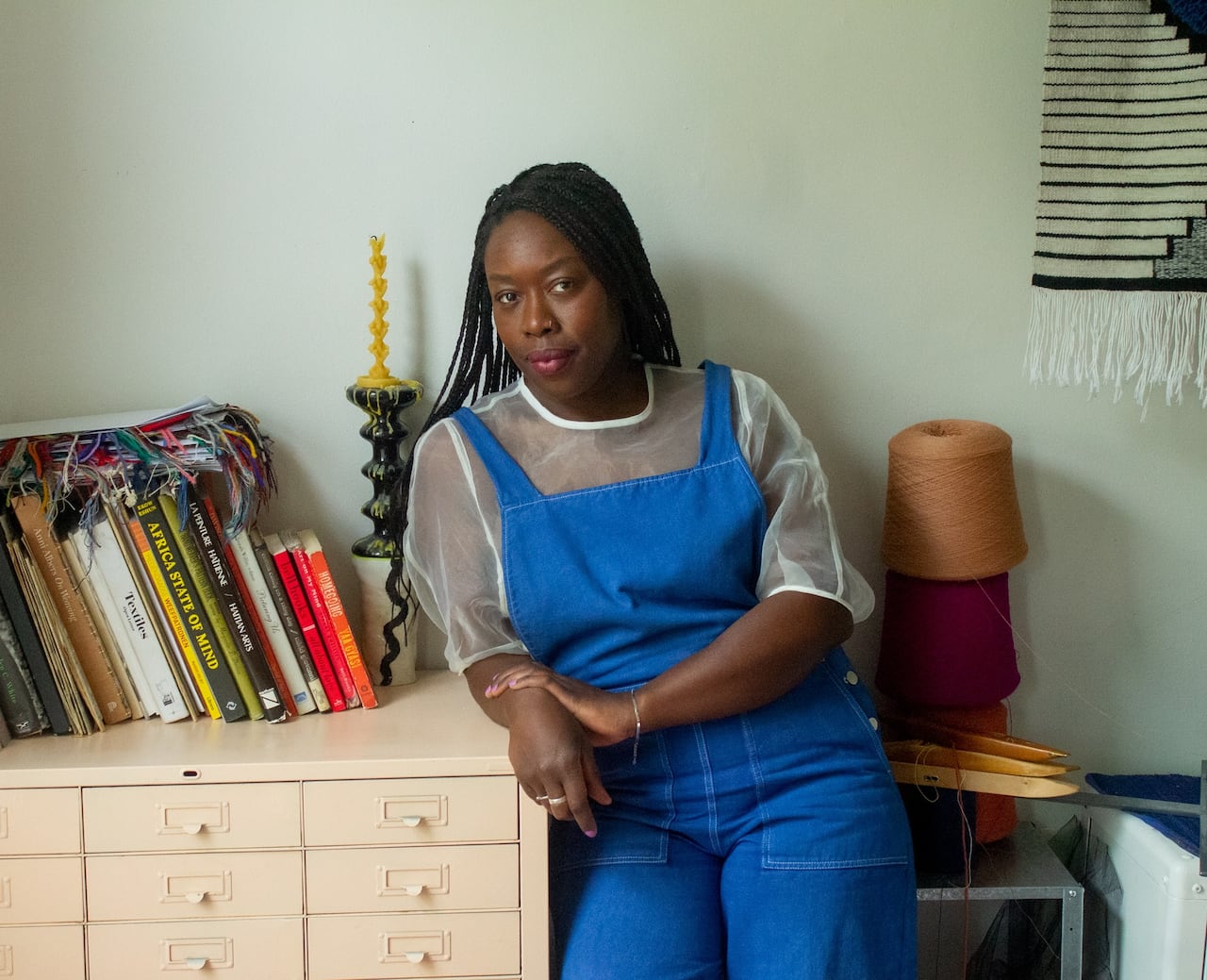 Stina Baudin is an interdisciplinary textile artist based in Montreal. (Submitted by Stina Baudin)
The work is displayed atop the barn at Adélard, a contemporary art centre in Frelighsburg, Que., until Nov. 2, 2026. Visitors can get a better view of the work by climbing the observation tower set up beside the barn.
A soundscape accompanies the rooftop piece, which includes a musical composition by Markus Floats, that visitors can listen to on headphones.
The installation aims to shed light on a period that is little discussed in Quebec history, serving as a monument to early Black residents in the Eastern Townships, about which little is known.
Slavery in the Brome-Missisquoi region
The barn at Adélard was built between 1830 and 1845, and Baudin thought about how Black people could have possibly lived or worked there, as well as in the village of Frelighsburg in the Brome-Missisquoi regional county municipality.
Adélard, founded in 2019, hosts residencies and offers educational programming.
Baudin’s work is part of an ongoing project to acknowledge Black history in the area that began in 2021.
The lack of said recorded history is a subject that Baudin engages with in her work. She located 15 names of Black residents from the area by going through ledgers and other historical records, and from research by other artists who had done residencies at Adélard.
These names are read aloud as part of the soundscape, alongside numbers and excerpts from Jesse Jackson’s poem I am Somebody. The numbers represent the many names that were not found.
“All of the numbers that are played at random represent the potential or the possibility of people who have lived or had lived and worked there,” said Baudin.
Missing histories
Heather Darch, a local historian and former curator of the Missisquoi museum, has studied many of the people named in The Sky Still Carries the Stories.
Cato Gilles was a slave who first appeared in the will of a Loyalist named Jacob Best, dated 1794, in St. Armand, says Darch.
Later, his name can be seen in the records of Philip Ruiter, a Loyalist who was also an abolitionist.
Gilles is the only person on Baudin’s list that historians, including Darch, can confirm was a slave, and later a freed Black man.
There are missing histories for other free Black men and women who are on the list, so it’s not possible to know if they were previously slaves, said Darch.
“It’s very, very hard to see Black people in the records,” said Darch. “There’s definitely unidentified people, you know, and … we’ll never know their names.”
Dorothy Williams, a retired Concordia adjunct professor and author of numerous books on Black history in Montreal, said under chattel slavery, enslaved people were viewed as objects and therefore slave owners did not write about them.
“If they didn’t keep records of them, that says something about the way they didn’t keep records of their cows other than as numbers. This was just property and it may not have had any other value to them other than as an asset, which they were,” said Williams.
She says Quebec was “not immune” to slavery. “It practiced it like every other white settler on the continent …. In fact, most of the slaves in the area called New France were not even Black.”
There were 4,185 Indigenous and Black slaves in Quebec from the 17th to the 19th century, with two-thirds of these slaves being Indigenous, called “panis,” according to Marcel Trudel’s landmark study. Trudel was a prominent Quebec historian and pioneer in the study of slavery in the province.
‘The work needs to keep going’
Darch says talking about the history of slavery in the region can be touchy.
“The work needs to keep on going. The community has been sort of divided about the history, that people don’t want to think that slaves were there,” said Darch.
She says the community is coming to terms with the fact that some Loyalists who are idealized owned slaves.
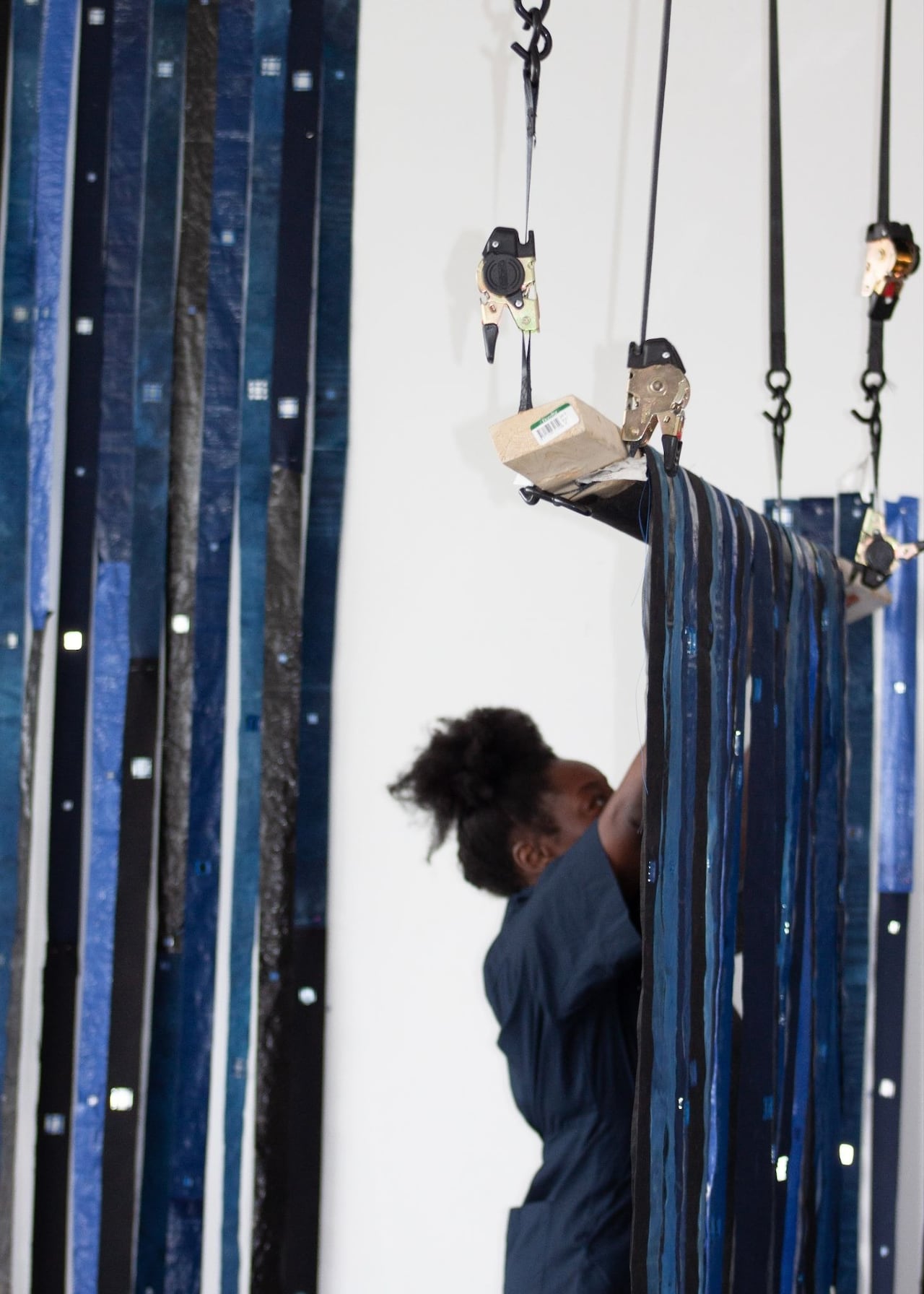 Stina Baudin works in her studio at Adélard. (Alice Hebert/ Adélard)
Baudin hopes her artwork will have additional meaning for Black visitors.
“I want Black people to look at the work and see reflections of themselves back up at them,” she said, “because we are here because somebody was here before us.”