
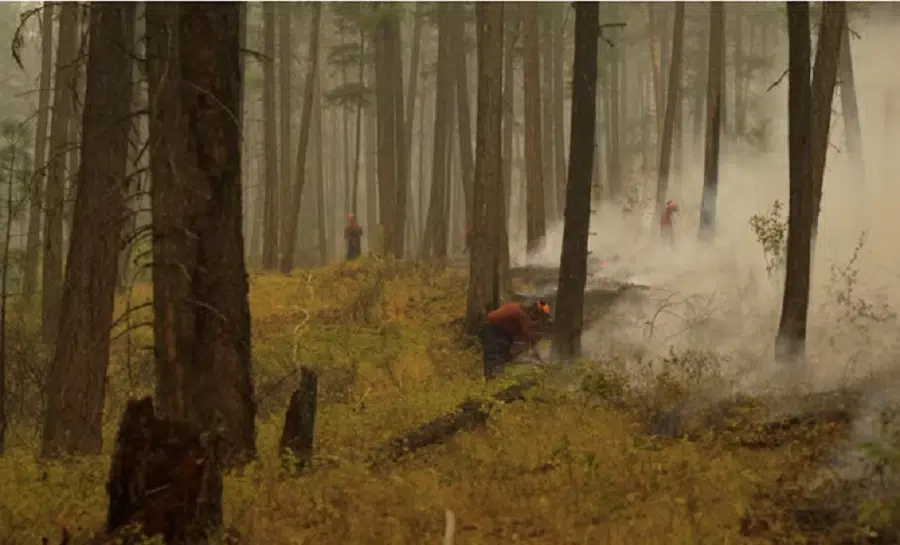
The federal government says wildfire activity across Canada remains below the recent five-year average, but officials are warning fire danger is expected to increase through the rest of the summer as hot, dry conditions persist in several regions.
Emergency Management and Community Resilience Minister Eleanor Olszewski, joined by Parliamentary Secretaries Corey Hogan and Ginette Lavack, provided an update Thursday on the 2026 wildfire season and announced $1.25 million in new funding to strengthen wildfire preparedness and response.
Nearly 800 active fires
As of Thursday, Canada had 796 active wildfires, including 60 out-of-control fires receiving a full suppression response.
So far this year, 3,137 wildfires have burned approximately 1.4 million hectares nationwide.
At the same point last year, Canada had recorded 2,913 fires, but more than 4.6 million hectares had burned.
Environment and Climate Change Canada forecasts above-average temperatures across much of the country through July and August, with drier-than-normal conditions expected in parts of Manitoba and northwestern Ontario.
Fire danger is expected to remain highest across the Northwest Territories, Nunavut, northern Manitoba and areas surrounding Hudson Bay, while elevated wildfire potential is also forecast for northern Ontario and Quebec.
Recent widespread rainfall has lowered the fire danger across much of Western Canada, although localized areas of higher risk remain in British Columbia’s interior.
Related Stories:
Funding supports Indigenous preparedness
Natural Resources Canada also announced $1.25 million for six projects aimed at improving wildfire preparedness and response capacity.
Funding will support projects with the Métis Nation British Columbia, Métis Nation of Alberta, Métis Nation–Saskatchewan and Métis Nation of Ontario to improve wildfire risk mapping, emergency planning, evacuation coordination and the integration of Indigenous knowledge into wildfire management.
Additional funding will help train up to 38 Indigenous wildland firefighters through projects with the Délı̨nę Got’ı̨nę Government and Chipewyan Prairie First Nation.
Manitoba flooding also a concern
While responding to wildfires, the federal government is also assisting Manitoba as it recovers from severe flooding following recent heavy rainfall.
Olszewski approved Manitoba’s request for federal assistance on July 3 after discussions with Premier Wab Kinew and provincial officials.
Ottawa said it also stands ready to provide additional financial assistance through the Disaster Financial Assistance Arrangements program if requested.
Canadians urged to prepare
Olszewski said the federal government will continue working alongside provinces, territories and Indigenous communities throughout the wildfire season.
“Building a more resilient country means strengthening collaboration and coordination before, during and after emergencies,” she said in a statement.
The government is encouraging Canadians to monitor wildfire conditions, weather alerts and emergency information throughout the summer and to have emergency preparedness plans in place.
Emergency management in Canada is shared among federal, provincial and territorial governments, with provinces able to request federal assistance when emergencies exceed local response capacity.