
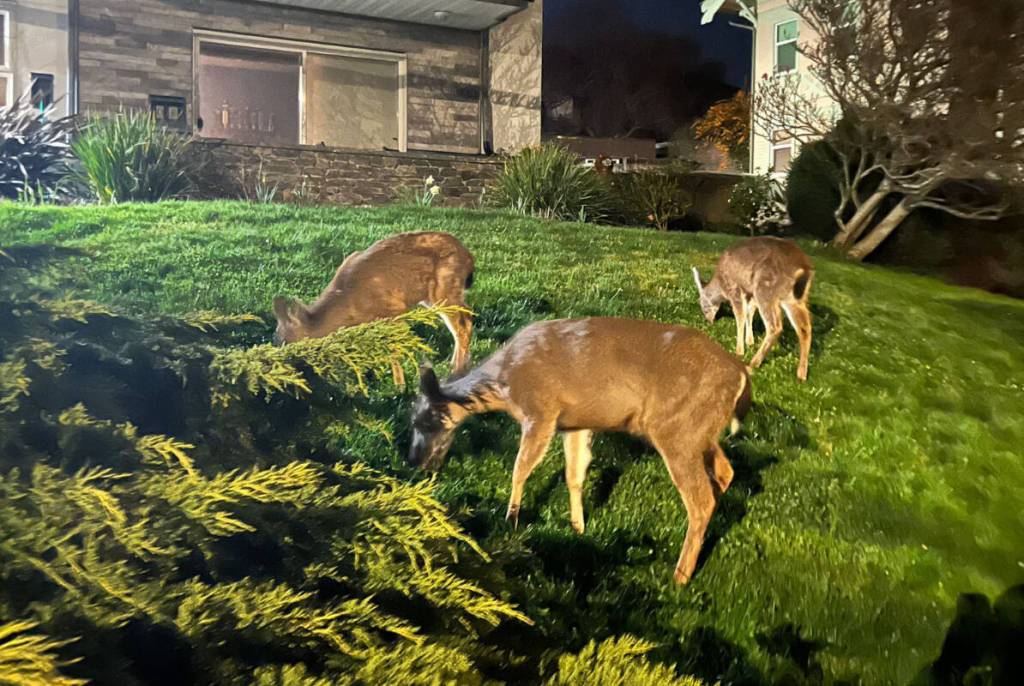
It’s that time of year when mother deer and their newborn fawns become more active in Greater Victoria.
Wildlife experts are urging residents to slow down, remove hazardous garden netting and give deer more space as collisions and entanglements increase. Recently, there have been several instances where deer have been run over by speeding vehicles, and cases of entanglements have increased in many parts of the region.
As fawns who were born in spring grow stronger through the summer, they begin following their mothers while foraging for food, making them especially vulnerable on busy roads.
“Often you’ll see a deer cross the road, but drivers may not realize there are fawns or other deer following behind,” Dr. Andrea Wallace, manager of wild animal welfare at the BC SPCA, told Victoria News.
Wallace said drivers should be extra vigilant, adding that the advice applies to many species raising their offspring during the summer months.
Wild Wise Society president Mollie Cameron also urged motorists not to honk at fawns crossing the road.
“Honking your horn at a baby deer can actually cause them just to drop and stay in the road,” Cameron said. “It’s best to stop and be patient.”
Wildlife advocates say road safety is only part of the issue. As more residents spend time gardening during the summer, deer are increasingly becoming tangled in garden netting and fencing.
Cameron encouraged homeowners to inspect their properties for hazards and consider wildlife-friendly fencing.
“Deer have just as much right to be here as we do. We need to take action to ensure that we’re being responsible when living among those wild animals.”
According to her, deer can carry tangled netting for a long period of time before getting noticed, and it can be dangerous for residents to try to free them. Sometimes, the stress of capture can lead them to a potentially fatal health condition called capture myopathy.
“The biggest thing that we can do is make sure that we’re taking a look around our properties to make sure there’s nothing that they can get entangled in,” Cameron said.
Experts urge people to contact the provincial Conservation Officer Service when they come across an injured or distressed deer, rather than trying to rescue them.
Wallace added that deer entanglements can happen at any time of the year, and they mostly spread awareness during festival seasons, when people put up decorations.
Wallace also warned that residents should not meddle with wildlife to help them remove netting, especially adult males with antlers, as it could be dangerous for both residents and animals.
Urban Wildlife Stewardship Society (UWSS) has also been helping remove netting from several deer in recent weeks, with the help of an authorized veterinarian to tranquillize the deer.
“What you’re supposed to do is call conservation, which is run by the Province of British Columbia. But I would suggest you call conservation [Conservation Officer Service] and then also get in touch with us, because conservation has very, very few officers,” president David Budd says.
Experts collectively agreed that the best way to reduce conflicts is for people to change their mindset with concepts of coexistence.
“We can’t reverse what’s already been done, but we can take action to ensure that we’re being responsible to live among those wild animals,” Cameron said.
Wallace echoed that message, encouraging residents to reduce wildlife attractants, secure garden materials and make their properties safer for animals.
“It’s not all about us, but it’s also not all about them,” she said.
“We need to be able to live in the environment and in our communities and co-exist.”
Budd said giving deer space, especially mothers with fawns, is one of the simplest ways people can help.
“We just need to learn how to coexist with them as opposed to seeing them as a nuisance. Slowing our cars down, giving them space and keeping things out that can entangle them are the best things we can do.”
The Urban Wildlife Stewardship Society also offers Expect Deer signs that residents can purchase for neighbourhoods where deer frequently cross roads, helping alert drivers to slow down. They can order a sign by emailing UWSS at info@uwss.ca.
Vancouver Island Conservation Officer Service can be contacted regarding wildlife in distress at 1-877-952-7277, B.C. Wild Animal Rehabilitation Centre at 1-855-622-7722.
More information about deer-resistant gardening is available at the UWSS website at uwss.ca/deer-resistant-gardening/.