
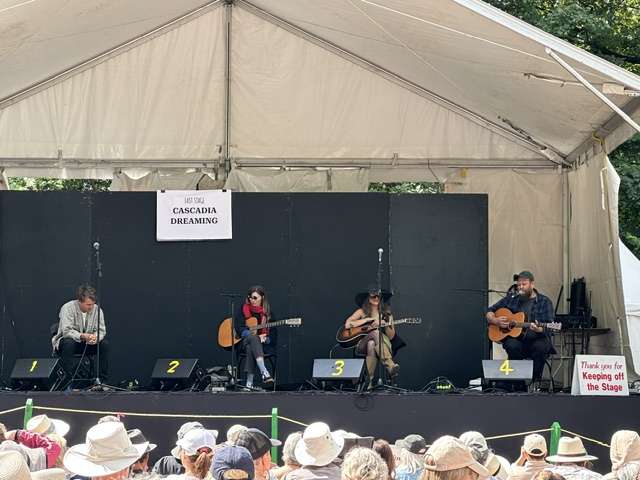
 The Cascadia Dreaming workshop. Photo by Anthony Stonechild.
I am trying to take my own advice. I’m sitting down and listening to entire sets. I’m failing. My ADHD is fighting my higher self.
The weather looked better this morning, so out came the Birkenstocks. Still wearing jeans in case it cools down. The shirt is short sleeved and linen. I’m counting on the rain holding off. And somehow all these decisions meant I left the home late again.
Which means I missed the intro from Luke Wallace, who was hosting the Cascadia Dreaming workshop. Workshops are one of the things I love about the Folk Music Festival. You get pulled in by an artist you know and appreciate, and you discover the artists that inspire and compliment them. So I got to meet Anna Tivel, Lindi Ortega and Jeffery Martin.
Anna has one of those tea and sympathy voices that you want to listen to in your contemplative moments. Smooth and healing.
Lindi is downright hilarious, singing songs about her badly behaved cat, creating a crow army (because (becaws?) apparently Crows hold grudges), and wanting to be a cougar woman (much to the disapproval of her appropriately aged fiancé!)
Jeffery had a quieter presence. A ballast to keep us grounded after Lindi’s hilarity.
But I was really there to see the host of the hour, and I got a chance to sit down and chat with Luke Wallace after the set.
Luke studied Environmental Geography specializing in climate and weather here at UBC. He wasn’t really pursuing it as a career, but more as a placeholder in his life as he developed his musical career. When not studying he was using his down time to go touring through spring breaks and other holidays. His studies did inform his music though through his focus on environmental awareness and social justice. He finished his degree about a decade ago, and has since then been pushing forward his music career to the point that now it’s become his major source of income.
He told me he grew up in Coast Salish territory, so I asked if he had any Native ancestry. “No, “ he said he just thought it was respectful to assign the land to its rightful inhabitants. A lot of his growth in environmental thought came from his participation in front line occupations led by Indigenous folks all over the West coast; stuff that happened on the pipelines in Terrace, Smithers , Haisla territory, here with Kinder Morgan and what the Tsleil-Waututh did and continues to do. A lot of that happened when he was between the ages of 17 and 25, which I observed was a very formative point in his life.
“I think there was a lot of good collaboration, and I hope that we can nurture another wave of that in society,” he said. “It was a big part of my life and it informed a lot of my writing at the time. Music is such a powerful tool for both expressing myself and having a shared story. We all come from different places and think in different ways. But there’s a lot of overlap here and the right song – if people can agree on a song to sing together while they’re marching… It says something about how we do see the world similarly and we can find common ground. It’s one of the great gifts of music “
I asked him if he was influenced by the protest movement in the 60s and he said not really.
“I think a lot of people , rightfully put me in that protest folk music category, and it’s really true, but sometimes people think I’ve listened to, front to back, all of Bob Dylan. And I haven’t,” he said.
“I’ve listened to a lot of it. I love Peter Seegar, Phil Oakes, Woody Guthrie, but I also grew up in the 90s, so a lot of my musical influences were contemporary and popular. You hear that in the sounds that I make. But the lyricism comes from that more activist era.
“I think that when you [assume the intelligence of the audience] 99 per cent of the time it’s affirmed,” he said.
“When you write songs that speak to something, it’s rare that I come to a festival and people don’t come up to me afterwards and say ‘Hey, we’re even further than you think we are. Give us more edge, deeper criticism. I’ve had emails from people critiquing my set yesterday, and I want to write back to them, ‘First of all, how did you get my email address?’ And I’ve gotten praise for parts of my set that were sweet and approachable. I’ve been in this long enough that i’m going to keep trusting my vision. I believe that I’m on the right path. I try to speak to the issues in a way that doesn’t leave people feeling hopeless. Most people are quite in tune with what’s happening in the world. They don’t need to be reminded. I think what these people need is a way to say we can talk about this and we can hold this conversation together and still come out the other side feeling like we can do something. There’s so much potential, not only for what could be…
“We all woke up this morning, and the vast majority of people are remarkably kind and have been functioning in a selfless way from the second they woke up. On any given day there’s about 2 billion people giving care to someone else. We can get so consumed by the bad news and injustices of the world. But those injustices deserve our attention in the context of people being peaceful, generous and kind.
“The more people I talk to, the more I realize they are into doing right in the world”
My conversation with Luke was certainly a refreshment to my soul. Now off to listen to something fun.
And something fun was playing on the west stage: Cousin Harley is a local trio serving us smooth 60s-style swag. They made me think of both The Shadows and of another local fun time band The Hang Ten Hangmen (someone seriously needs to get those guys on one of these stages.) Cousin Harley consists of Paul Pigat, Jessie Cahill, and Jeremy Holmes. Their sound is tight energetic and fun. They had kids of all ages up and dancing in the summer sunshine.
They were followed on the West stage by Bia Ferreira. Her music was so much fun I almost zoned out and missed some of her snappy commentary. “War is not normal. If you support war, here is not your place!” “Nobody can tell your story better than you.” This she stated with conviction, then launched into rapid fire Portuguese. She followed that up with the statement that “Your silence is part of the violence!”
I guess Luke was right. We are mostly all on the same page here.
Okay, I’m melting. The cuffs of my jeans are hiked up over my calves, moisture is seeping through my T and making me consider laundry options for my linen shirt. And I am not moving. I am listening to the fantastic Kazdoura. They just played a song from Algeria and have now launched into an original composition they are debuting for Vancouver. This is pure Arabic fusion. If I were younger I would bring a recording to the local DJ’s and watch their surprise as dance floors flooded. Kazdoura is comprised of a Syrian singer, Leen Hamo and a Lebanese musician, John Abou Chacra. Their sound is deeply west Asian and immediately accessible. They are jazz we have no right to hear here in Vancouver, but here we are. And I am not moving until they stop playing. Sweat and laundry be damned. Man can this guy kill a sax solo.
After that, a bite to eat, then I need to chill out. Time to move to the South stage, Stories from Across the Pond. Hosted by John Smith, this workshop featured Amistat, Tina Dico, and Teddy Thompson. Finding a spot to sit was a challenge. I was farther than I wanted to be for these popular performers.
Teddy guided us through a sing-a-long. We all lamented ’Same old Song’ and ‘Feels so Wrong.’ Apparently, there are so many of us who have lived through heartache. Then Tina Dico told us what to do when we mess up a proposal: ‘Ask Again’. Amistat followed with smooth harmonies.
John Smith declared himself a six-foot ginger vampire. I think the sunshine was getting to him too.
I was sorry I couldn’t stick around for the evening show on the main stage, but I have a standing date with my partner at home every Saturday night.
I will have to catch up with you all again on Sunday.
Related