
The offseason is all about opportunity, but every trade and free-agent signing also creates a few fantasy losers. While some players on this list have seen their fantasy value take another hit after already dealing with declining roles, others are younger players whose path to fantasy relevance became more difficult because of new additions around them. Whether it’s increased competition for power-play time, a reduced role or a more crowded depth chart, these players are heading into the season with a tougher fantasy outlook than they’ve had over the past couple of years.
Any hope of Verhaeghe returning to the 30-goal, 70-point producer we saw a few seasons ago took yet another hit the moment Florida acquired Brady Tkachuk. While the Panthers dealt with injuries throughout much of last season, creating opportunities for players to take on larger roles, this season projects much differently with the expectation that the roster will be healthy from the start. At even strength, there is still plenty to like. Verhaeghe is projected to skate alongside Sam Bennett and Matthew Tkachuk, which should give him a strong opportunity to remain productive. There are also reasons to believe he can improve on last season’s 55-point finish. His shooting percentage was not the issue, as his 13.4% rate was right in line with his career average. The bigger concern was his declining shot volume. After averaging 246 and 278 shots in the previous two seasons, that number dropped to just 187 last year. If he can push back above 220 shots, another 30-goal season may be a possibility.
The bigger fantasy concern is his power-play role. If Brady Tkachuk takes a spot on the top unit alongside Barkov, Reinhart and Matthew Tkachuk, Verhaeghe could be pushed to the second power-play unit. The second unit isn’t anything to scoff at but its not the first unit. Regardless, that would affect his fantasy value. Losing that premium deployment does not mean Verhaeghe is a worse player, but it does lower his ceiling. Instead of being viewed as a legitimate 70-point threat he was a couple of years back, he looks much more like a 55 to 60-point winger unless injuries or lineup changes open the door for him to regain a top power-play role, which is never out of the question in Florida.
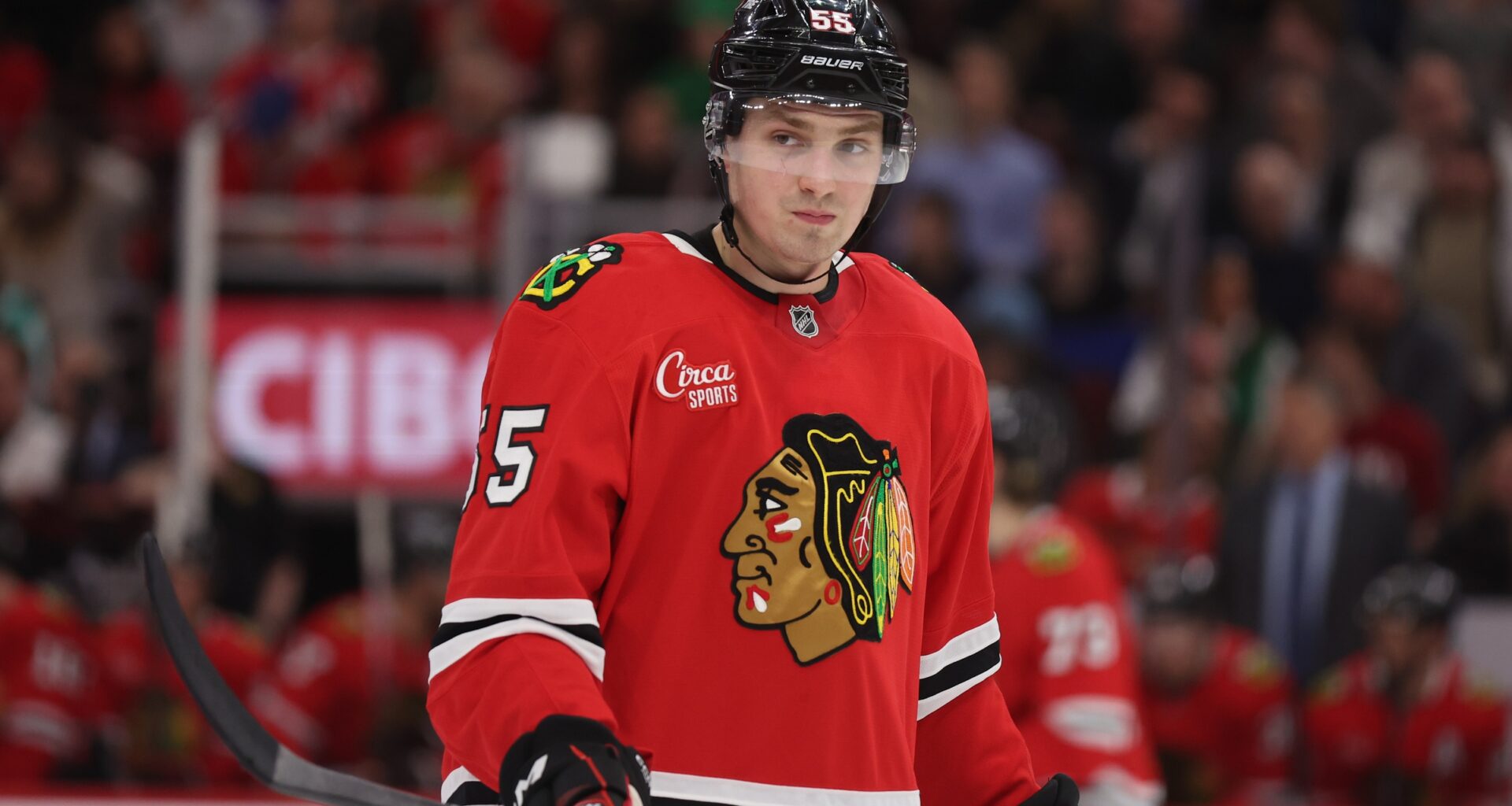
Chicago’s blue line was still searching for a true No. 1 defenseman last season, which forced Artyom Levshunov and Sam Rinzel into bigger roles earlier than expected. The two rookies finished with 24 and 14 points, respectively, and while Levshunov appeared to have a slight edge in terms of future offensive deployment after seeing a bit more power-play time, neither player was ready to fully take over as the team’s top option. In fact, Alex Vlasic ended up leading all Chicago defensemen in average ice time, showing just how unsettled the hierarchy was. The addition of Bowen Byram changes that immediately. Chicago finally gets the top-pairing defenseman it has been looking for. Byram averaged over 22 minutes per game last season, more than any current Blackhawks defenseman, and brings exactly what this group needed. He’s a strong puck mover, can push the pace offensively, join the rush and create offense from the back end while also handling heavy minutes against top competition.
Chicago is still likely to mix and match its pairings throughout the season, but Byram should enter the year with the inside track on the top power-play unit and the biggest workload among their defensemen. That makes it much harder for Levshunov or Rinzel to immediately carve out a high-end fantasy role. Long term, I still believe both Levshunov and Rinzel have the talent to eventually become Chicago’s offensive leaders from the blue line. The question is simply when that happens. Defensemen typically take longer to develop than forwards, and with Byram now in place, Chicago has the luxury of allowing both prospects to develop properly rather than forcing them into roles before they are ready.
I briefly touched on this in my article projecting each team’s power-play quarterback. At the time, I had Victor Hedman penciled in for the role before Tampa Bay went out and signed John Carlson. That addition changes the outlook considerably. Hedman appeared in just 33 games last season and later revealed he stepped away from the team to focus on his mental health. It is difficult to project Hedman ahead of Carlson for the Lightning’s top offensive opportunities. Carlson proved last season that he can still perform at an elite level, averaging 23:10 of ice time and 2:44 on the power play while recording 60 points in 71 games split between Washington and Anaheim. He remains an excellent puck mover, distributes the puck well and has shown he can still quarterback a productive power play.
We’ve seen a similar situation before in Tampa Bay. When Mikhail Sergachev earned a larger offensive role, Hedman’s fantasy value took a noticeable hit as the workload became more evenly distributed. Once Sergachev was traded, Hedman reclaimed the lion’s share of the power-play opportunities and responded with back-to-back 76 and 66-point seasons before last year’s injury-shortened campaign. With Carlson now in the fold, it feels like Tampa Bay is heading back toward that earlier deployment. Hedman should still play significant minutes at even strength and remain an important part of the blue line, but Carlson has to be considered the favorite to run the top power-play unit. If that happens, Hedman’s fantasy ceiling likely takes another step back compared to what we’ve seen over the past two season prior to this.
I know Morgan Rielly‘s value wasn’t that high to begin with but the signing of Darren Raddysh was likely all fantasy managers needed to see when it came to Rielly’s projected role moving forward. His path to premium deployment in Toronto has become even more difficult, and it obviously does not bode well for his fantasy value. Rielly has bounced in and out of the Maple Leafs’ top power-play unit over the past few seasons, but with Raddysh now entering the picture, it is becoming harder to see him even getting those minutes back. In 2023-24, when Rielly was receiving nearly 58% of Toronto’s power-play opportunities, he finished with 58 points. Over the last two seasons, that usage has dropped to 43% and 55%, and his production has followed, with Rielly recording just 41 and 36 points. Heading into this season, there is a legitimate chance he loses that top-unit role altogether, which makes it difficult to see where the offensive upside comes from. The arrival of Jim Hiller as head coach adds another layer of uncertainty to Rielly’s deployment. However, the one positive is that Hiller previously worked as an assistant coach in Toronto, and during that time, Rielly continued to produce offensively while playing under him. Whether that familiarity leads to a larger role remains to be seen. Rielly is still a reliable NHL defenseman who can handle big minutes and contribute in multiple areas of the game. From a fantasy perspective, though, the trend is moving in the wrong direction. Unless Toronto’s blue line situation changes or Raddysh fails to establish himself on the power play, Rielly looks like a player to fade in most fantasy drafts rather than a defenseman with legitimate top-end upside.
Thanks for reading! See you next week! For more fantasy hockey content and analysis, follow me on X @Punters_hockey. If you have any questions about your team or a trade? My DMs are always open, happy to help!