
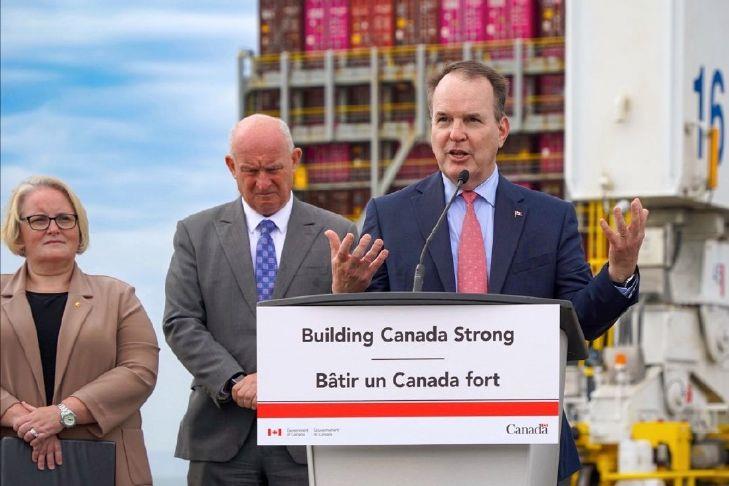
The federal government is looking to streamline expansion of Delta’s container port as part of an overall strategy to double exports to non-U.S. markets by 2035.
On Thursday morning (July 16), federal Transport Minister Steven MacKinnon was joined by his provincial counterpart, Mike Farnworth, Delta MP Jill McKnight, Tsawwassen First Nation Chief Laura Cassidy, and Vancouver Fraser Port Authority president and CEO Peter Xotta, to announce the Roberts Bank Terminal 2 (RBT2) project is being referred to the Major Projects Office for potential fast-tracking as a project of national interest under the Building Canada Act.
“Canada needs modern transportation infrastructure that helps our businesses compete, gets Canadian goods to new markets, and creates good jobs across the country,” MacKinnon said. “By investing in our ports and transportation network, we are growing our economy, strengthening our supply chains, while protecting the environment.”
The project is being submitted as part of the Port of Vancouver’s Gateway Strategy, an “integrated pathway” to grow capacity at the port while addressing existing constraints to improve the operation’s overall efficiency.
“This will include expanding container-handling capacity, identifying and developing land for the construction of modern terminals and other export-focused infrastructure, upgrading rail infrastructure to support the movement of goods, and following Canada’s environmental protections for coastal habitat and at-risk whales,” according to a federal press release.
“As Canada’s largest port, we know we’re going to play an outsized role in delivering on Prime Minister Carney’s commitment to double exports to markets outside of North America. Today’s announcement will help the Port of Vancouver and our partners get game-changing projects like Roberts Bank Terminal 2 built and move more of what Canadians make, mine, harvest and grow to more customers around the world,” Xotta said,
Thursday’s announcement comes two weeks after Prime Minister Mark Carney and Premier David Eby signed a multi-billion dollar agreement that includes $10 billion towards upgrades at the Roberts Bank terminal.
The Gateway Strategy will focus on four key pillars to support capacity growth at the port: RBT2, land use and infrastructure for bulk terminals, rail infrastructure optimization and expansion, and environmental protections.
RBT2 will transform more than 1.7 square kilometres of subtidal and tidal waters into a three-berth facility capable of handling 260 ships and more than 2.4 million containers a year, increasing the port’s capacity by 50 per cent.
The project also involves widening the existing causeway to accommodate additional rail infrastructure, adding road connections and utilities, and expanding the existing tug-boat basin.
A government press release states RBT2 will enable $100 billion of new container trade capacity annually, contribute over $3 billion to Canada’s GDP per year, and support the creation of 17,000 ongoing jobs across the supply chain during operations.
RBT2 received federal and provincial approval in 2023 following the conclusion of each governments’ respective environmental assessment processes.
In 2024, the port authority submitted a Species at Risk Act-compliant Fisheries Act Authorization application to Fisheries and Oceans Canada, with a joint commitment from government and regulators that a decision will come no later than October of 2026.
A port authority press release notes that 27 First Nations have provided consent for RBT2 and will participate in ongoing project development and consultation
On July 13, the Vancouver Fraser Port Authority announced it had selected TerraMarine as its construction partner to build the RBT2 landmass and wharf, subject to finalization of contraction negotiations, following a robust competitive procurement process.
A port authority press release notes the TerraMarine team “has extensive experience in collaboratively delivering major marine infrastructure projects and demonstrated expertise in health and safety, regulatory compliance, project management, environmental protection, and community engagement.”
The bid team is comprised of FlatironDragados Canada Inc., Van Oord Canada Ltd., Aecon Constructors (a division of Aecon Construction Group Inc.) and Carlson Construction Group Inc., supported by design firm Arcadis Professional Services Canada Inc. and sub-consultants Stantec Consulting Ltd., TYPSA Inc. and Tetra Tech Canada Inc.
The construction contract involves the delivery of a marine landmass, wharf structure and berth pocket, widened causeway, expanded tug basin, and select environmental mitigation and offsetting projects.
Construction mobilization and early works are expected to occur in 2027, with major land reclamation works expected to begin in 2028.
With respect to the future construction and operation of the terminal, the port authority and Deltaport operator Global Container Terminals have entered into a memorandum of understanding to explore partnership to advance RBT2 with the goal of achieving a joint operating and development agreement. As part of that agreement, signed in April, GCT withdrew its application to the MPO for its competing Deltaport Berth 4 expansion project.
Operations at Roberts Bank Terminal 2 are expected to begin in the mid-2030s.
Following Thursday morning’s announcement, Tsawwassen First Nation issued a statement, partially attributed to Chief Laura Cassidy, noting TFN consented to RBT2 under strict, legally binding conditions, adding “that consent does not constitute support for the project.”
Cassidy said projects designated as being in the national interest must not come at the expense of treaty rights or existing environmental protections.
“While the benefits of projects like RBT2 may be shared nationally, the impacts are borne most directly by Tsawwassen First Nation in our territory and on the exercise of our treaty-protected harvesting rights. We expect meaningful consultation, respect for our treaty rights, and full implementation of the commitments that have already been made to our nation.”
TFN’s statement said it has worked on this project for decades to ensure the nation’s treaty rights, environment and harvesting activities are protected through environmental assessment, regulatory review and negotiations.
“While RBT2 may provide national economic and trade benefits, its impacts will be felt most directly by Tsawwassen First Nation. Roberts Bank is immediately adjacent to Tsawwassen First Nation’s community area and within the Tsawwassen Fishing Area. The environmental, cultural and harvesting impacts of the project fall disproportionately on Tsawwassen people, including impacts to our constitutionally-protected treaty rights to harvest within our territory. TFN expects Canada to fully uphold all existing approvals, conditions and consultation obligations associated with the project.”
TFN said it will carefully review the implications of Thursday’s announcement and participate in consultation to ensure the nation’s rights, interests and economic development priorities are fully considered.
In order to double non-U.S. trade by 2035, the federal press release states, the port needs new land and must build modern terminals and other export-focused infrastructure to support bulk exports like grain, potash, petroleum products and canola oil — dry and liquid bulk account for approximately 70 per cent of the total tonnage moving through the Port of Vancouver’s 29 marine terminals.
On July 20, the port authority will launch a process to select an operator for its 40-acre Fraser Wharves terminal site in Richmond – the first major terminal opportunity at the Port of Vancouver in a decade.
Thursday’s announcement notes the MPO may support the port authority “to ensure the project is efficiently advanced while respecting Indigenous rights and safeguarding the environment.”
Under the Gateway Strategy, the MPO and the port authority will co-operate to identify similar opportunities for export terminal expansion.
As the majority of cargo moving through the port is transported by rail, the strategy calls for investment in that system, including targeted expansion of the port’s rail infrastructure to avoid the transportation network becoming congested, increasing shipping costs and reducing the competitiveness of Canadian businesses.
In partnership with the railways, the MPO and Transport Canada are developing a rail infrastructure strategy to increase capacity and enhance supply chain efficiency, reliability and resilience.
Under the environmental protections pillar, the strategy highlights three federal initiatives to support coastal protection and address key threats to at-risk whales.
As part of its spring economic update, the government committed more than $258 million over five years to renew and enhance funding for the protection of whales and their habitats.
This includes $95 million over the next five years and $16.5 million on an annual basis to protect southern resident killer whales and their habitat along B.C.’s coast through dedicated protection measures delivered by Transport Canada and Fisheries and Oceans Canada — including additional measures to reduce underwater noise, vessel management measures, monitoring, and long-term habitat protection.
This funding complements the federal government’s announcement in April of $412.9 million over five years to renew the Pacific Salmon Strategy Initiative, enabling continued protection and recovery of wild Pacific salmon stocks.
As well, through the Oceans Protection Plan launched in 2016,, the government has invested $3.5 billion and partnered with Indigenous and coastal communities to “develop a world-leading marine safety system that meets the unique needs of Canada and B.C.,” the release states.