
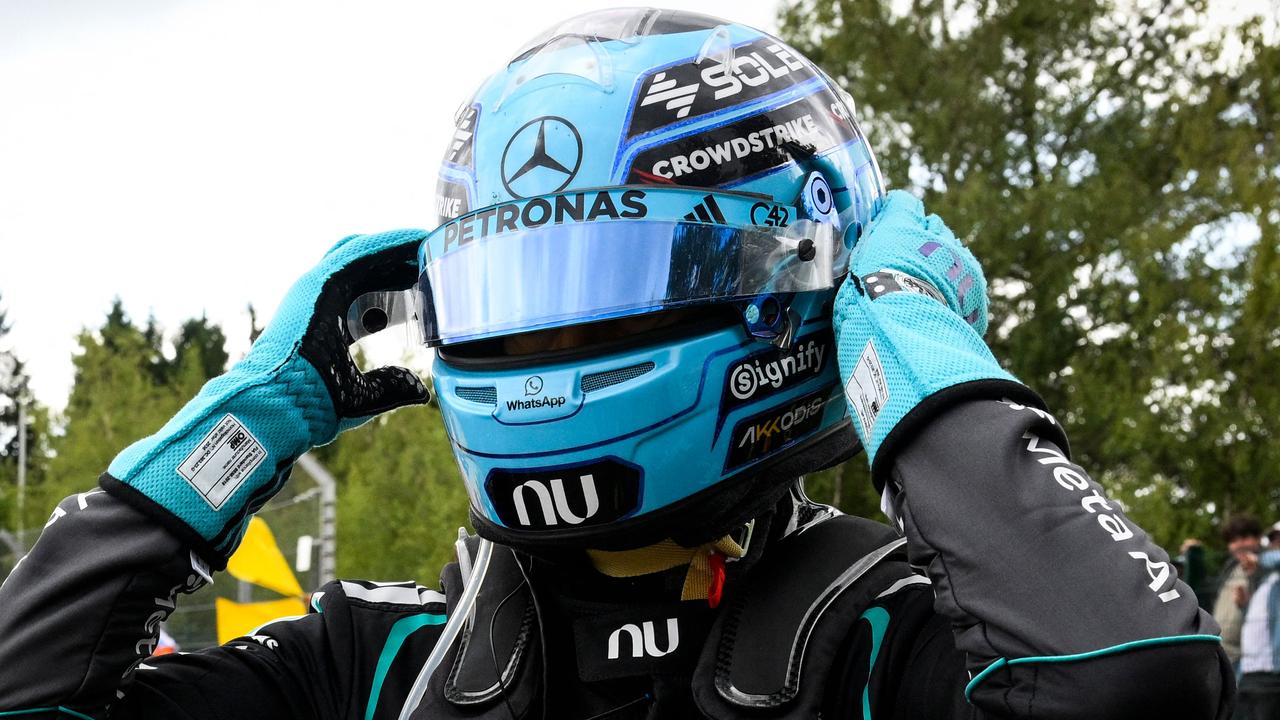
Formula 1 left one of its greatest cathedrals feeling godless on Sunday night.
The annual pilgrimage to the Ardennes to bear witness to grand prix racing around the Circuit de Spa-Francorchamps delivered a race and a winner, with Andrea Kimi Antonelli taking an ultimately comfortable sixth victory for the season.
But the benchmark circuit revealed some deep-seated ills in the 2026 formula that have badly rankled the congregants.

Fox Sports, available on Kayo Sports, is the only place to watch every practice, qualifying session and race in the 2026 FIA Formula One World Championship™ LIVE in 4K. New to Kayo? Join now and get your first month for just $1.
This was the heavily hybridised F1 engines at their very worst, incapable of rising to the challenge of the ferocious layout.
Worse than that, though, is the way the configuration of long straights and fast corners revealed the seemingly unknowable but simultaneously all-powerful dark arts of the engine algorithm, whose shadowy hand is having a material impact on the championship.
For the first time, the public got a glimpse of the depths of discomfort the drivers have been experiencing all season.
“Welcome to F1 2026,” Max Verstappen quipped. “Sometimes it can be a jungle.”
Hamilton smashes the wall in P3! | 01:08
LET’S GO OVER THE BASICS
Circuit de Spa-Francorchamps was always going to be one of the worst layouts for these engines.
The long straights are part of the equation, with the cars flat-out for more than 75 per cent of the lap’s 7.004-kilometre distance.
A fully charged battery lasts only around 11 seconds in 2026. They’re completely exhausted less than halfway between La Source and Les Combes and again between Paul Frère and Bus Stop. At the weekend the batteries were expiring just after cresting Raidillon and well before reaching Blanchimont.
Without battery power, a Formula 1 car produces just 400 kilowatts, solely from its turbocharged V6 internal combustion engine.
That’s less than the 456 kilowatts produced by the V6 turbo in a Formula 2 car.
That lack of power has a compounding effect on the battery state of charge. Spa-Francorchamps has few big braking zones to replenish the battery, and with the cars travelling slower even through the high-speed corners, there is less opportunity again to charge the battery.
For example, last year’s pole lap included Lando Norris lifting into Pouhon, the fearsome downhill double-left. This year it was easily flat not because of car performance but because pole-getter Antonelli entered the corner 30 kilometres per hour slower than Norris did last season. What might have been an opportunity to recharge is now just another battery-depleting straight.
By the time Antonelli approached Les Fagnes, he was 40 kilometres per hour down relative to Norris a year earlier.
The gaps were smaller at other corners, but every one of them was tackled unsatisfactorily slower in 2026.
“You can imagine, of course, that that is not very exciting to drive,” Verstappen said. “But honestly, I don’t want to sit here and complain again, because probably someone will shoot me outside the door.
“I’m mentally just adjusting to it, and I’m trying to make the best out of it, even though it’s not what I like or what I love to do in Formula 1.”
The problem, though, is the goalposts keep changing.
Gasly suffers wild crash in Belgium | 00:27
BUT THERE’S A DEEPER PROBLEM
In some sense, the less the 2026 engine is talked about, the better. That’s not backhander; there are myriad extremely complex elements of performance in every Formula 1 car that are unknown or not understood to outside observers, but that’s never negatively affected the enjoyment of the spectacle in the past.
We could apply the same logic to the engine — that, at the end of the day, the cars still reach remarkable speeds when the driver presses the accelerator. The quirks of the engine rules aren’t always obvious to the casual observer, and they don’t need to be.
But the extreme Spa-Francorchamps layout revealed the uncomfortable truth that the above assumption isn’t correct. The connection between the driver’s right foot and the engine isn’t as direct as you might’ve thought.
There’s now a black box sitting between them deciding how the engine should behave.
It’s been true sine the first hybrid motors of 2014, but it was to a much lesser extent in 2014–25, when the hybrid element was much less powerful and therefore much less decisive to overall performance.
This year the computer has beefed-up authority, and it’s what George Russell says is preventing him from contending for the championship.
Since Silverstone he’s been complaining that his Mercedes engine isn’t generating the same sort of performance as Antonelli’s motor, and given both Silverstone and Spa-Francorchamps are power-sensitive circuits, that deficit was preventing him from contending for pole and victory.
“We thought we found the problem,” Russell said, per The Race, after qualifying half a second slower than Antonelli in Belgium.
“We thought it was something with the brakes; it wasn’t the brakes.
“Then we thought it was my driving style with the throttle … now we’re very confident it’s not the driving style.
“There’s a serious issue at play here. The team are working so hard to resolve it, but every lap I do, when I see I’m down anywhere from 0.2 seconds to 0.6 seconds in the straights, it’s pretty infuriating.”
This isn’t about power output per se; it’s not down every straight. In Belgium the deficit appeared only between Paul Frère and Bus Stop near the end of the lap.
The problem is the battery running out of charge early.
It took until this weekend for Mercedes to accept that there is a problem, though team boss Toto Wolff maintained on Sunday that around half Russell’s gap to Antonelli was down to driving.
The rest?
“We are unable to explain,” he said.
Piastri responds to rumours | 01:14
THE DARK ARTS OF THE ENGNIE ALGORITHM
In a way, it all comes down to driving style but in a sense somewhat alien to how we’re used to talking about it.
Charging the battery is dependent on the inputs of the driver — when they hit the brakes or lift off the throttle. How a driver brakes, steers and lifts and presses the throttle are extremely important.
It’s been clear that Russell is less confident than Antonelli with this year’s car. Going slower through the corners means charging less and deploying more, which means there’s less power available for the straights.
McLaren boss Andrea Stella also posited to Sky Sport Germany this weekend that Russell’s smooth driving style — much like Piastri’s silky approach — is not how the new generation of car wants to be driven.
What frustrated Russell, however, was that he felt he was driving broadly identically to Antonelli this weekend in qualifying — and the telemetry more or less backs this up — but was still finding big discrepancies.
He’s not the only one.
Stella noted there were uncanny similarities between Russell’s lap time relative to Antonelli and Piastri’s lap time relative to Norris.
Both sets of drivers were almost exactly equal at Paul Frère but then had their deficits balloon down the ensuring full-throttle section of track.
“When we try to analyse this, it gets immediately quite complicated,” Stella said, per Racer.
“To operate these power units, you don’t operate them in an open-loop way, whereby I would be able to have an offline simulation [at the factory] and say, ‘Oh, that’s how the electrical power will be deployed [at this track] and it will always be [the same].
“There’s a large component of the controller that operates the power unit that happens with live calculations, and the power unit kind of forward-thinks, forward-calculates what it has to do based on some… I don’t want to get into too much technical description or technical IP, but there’s a lot that happens as the car goes [around].
“This is why it’s not so easy to understand what kind of calculations have been made as the car was going around. There’s always kind of a reason — I’m sure we will understand the reason — but at the same time you need to be able to anticipate and make sure that the operation of the power unit unfolds as expected.”
In other words, the black box between the throttle and the engine is constantly evaluating where and how the car should deploy its electrical energy and where and how it should recharge.
The team gives it its basic parameters for what it should do when, but the computer must have some freedom to make its own decisions based on variables that can’t be controlled — variables like drive behaviour or unexpected grip conditions.
It’s constantly learning and adapting to the driver as they drive — but that means a driver struggling to understand what the car is doing, like Russell, is aiming at goalposts that are constantly moving.
“This is not only for the influence it has in the power-limited sections — in the straights — but also because it affects the braking points,” Stella continued.
“If you have an additional amount of harvest with the super-clip before braking, then you are approaching the braking point 10 kilometres per hour slower, and your braking point changes.
“This is quite difficult to master for the drivers and is one of the reasons I’m sure the drivers talk about the difficulties from a driving point of view to exploit the power unit. It’s not only to get the most out of the power unit, but also because the variations of the power unit affect the references as you approach the corner.
“It definitely kind of learns, but the variations that are significant and relevant are so small that they may happen from one lap to another, even if you have learned from the previous laps.”
Cam Waters aiming for the Championship? | 01:03
‘IT SUCKS’
Stella’s explanation was the most detailed an eloquent yet of the way the 2026 engine rules work.
Piastri, though, might have followed up with the season’s bluntest and most straightforward assessment.
“It sucks,” he said, per Planet F1. “I can’t really say it any other way than that.
“When you’ve got qualifying grids decided by computers behaving or misbehaving, it’s a pretty crap way of going racing.
“When you come in from a qualifying session, you look at all the corners and go, ‘I’m on par with my teammate [here] and I’m 0.2 seconds behind at the end of it’, it’s not a very nice feeling.
“The engines are so complicated. They are sensitive to everything, and even things you do on an out-lap can dictate what happens.
“It’s a very tricky way of going racing.”
That trickiness was on full display on the first lap at the weekend’s race, where Russell — but also all the Mercedes-powered drivers — found himself unexpectedly lacking battery charge exiting La Source.
Finding himself without power after Raidillon triggered him to riskily put himself around the outside of Lewis Hamilton at Les Combes, where his race ended in minor but devastating contact.
“Quite frankly, it was dangerous,” Russell said of his depleted battery, which effectively turned his Mercedes into a Formula 2 car attempting to fend off a pack of Formula 1 cars.
Antonelli, having experienced the same thing but to a lesser magnitude, sympathised with his teammate.
“Being honest, with George this weekend there was a slight loss, and sometimes you just don’t understand,” he said. “I had the same in Australia, for example.
“It can be a little bit down to driving, but sometimes the system just does something a little bit different. It’s very complicated.
“Sometimes, especially on tracks like this that are very energy-demanding, if you start driving differently, then for the system it’s a bit crazy, so it is tricky.”
Charles Leclerc agreed, having earlier this season complained about small lifts of the throttle — for example, when controlling a snap of oversteer — would result in the engine refusing to offer full electrical power down the following straight.
“These power units are so complex that there are some days when you scratch your head trying to understand why you are losing so much on the straights,” he said.
“It’s just very difficult but also very frustrating sometimes for a driver because, even when you are doing your best, there are things in the background that change constantly, and that’s not so nice.”
Not every circuit is going to be like Spa-Francorchamps, which stands alone among F1 tracks even without the complexity of these engines.
This weekend’s Hungarian Grand Prix, for example, is expected to look much more like a normal weekend given the batteries should have no trouble keeping their charge around the slow and twisty layout. Even the average track — Barcelona-Catalunya is usually touted as such — doesn’t look quite as bad.
But there will be more tracks that bring out more of these black-box problems.
Worse is that this fundamental aspect of the engine formula is unlikely to be expunged even with the rule tweaks due in 2027 and 2028.
“[The changes] are not going to fix those specific issues,” Piastri said. “It’s to do with how the engine’s calibrated, how the engine learns. It’s kind of ingrained into these engines.”
In the words of Grand Prix Drivers Association director Carlos Sainz: “Whoever saw these simulations in 2022, 2023 and didn’t look at it and say, ‘How can we even accept that?’ needs to review what happened there, because it should have never happened.”
Teams will get better and programming their engines and at understanding where these anomalies occur. Drivers will develop a better understanding of what their engines want.
After that, the FIA is determined to fast-track a new engine formula by 2030, work on which is slowly beginning.
Until then, the drivers are condemned to the jungle.