

As plans for the West Coast oil pipeline, proposed to carry up to one million barrels of crude per day from Alberta to British Columbia moves ahead, some First Nations say more meaningful engagement and consultation should have started before major deals were signed.
The pipeline, intended to deliver crude oil to Asian markets, is described as a project of national interest.
However, it could impact dozens of First Nations in B.C. and Alberta, including the Lyackson First Nation, whose traditional territory is located on an island across the Strait of Georgia from the proposed pipeline’s end point.
Hereditary Chief Huy’wu’qw Shana Thomas (Laxele’wuts’aat) said there was not a single conversation with the Lyackson First Nation before the pipeline was announced.
“We’re tired of hearing about it after the fact … the prime minister and premier announcing something substantive, that has great impact, with zero consultation,” Thomas said.
The proposed delivery terminal in Delta would span 260 hectares on Tsawwassen First Nation treaty lands, including tank storage and two berths for massive supertankers capable of carrying two million barrels per ship.
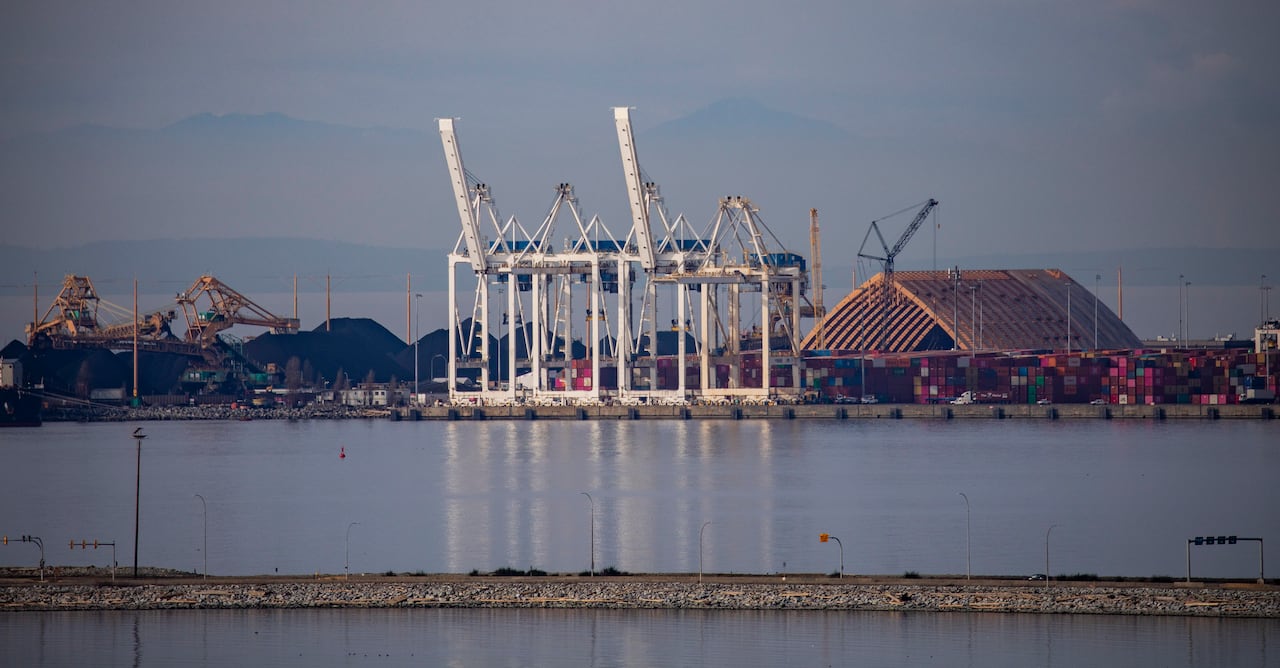 Roberts Bank Terminal is pictured from Delta, B.C, on Wednesday, Jan. 22, 2025. (Ben Nelms/CBC)
Shipping and marine activity directly impact Lyackson and other Quw’utsun member communities, says Thomas, who worries about the impact additional marine traffic could have on her community’s medicinal, cultural and spiritual practices.
The Lyackson First Nation sees the marine ecosystem as interconnected — what impacts the waters impacts the whales and impacts her people’s daily lives and well-being.
LISTEN | Thomas expresses concerns around duty to consult:
On The Island10:09Lyackson calls on governments to engage on prosperity agreement
Huy’wu’qw Laxele’wuts’aat (Hereditary Chief) of Lyackson First Nation Shana Thomas voices concerns with the lack of engagment and consulations with First Nations on the multi-billion dollar Canada-British Columbia Cooperative Prosperity Agreement and how the project stands to impact their traditional territory.Alberta’s project
Governments have a duty to consult First Nations on major projects that would have an impact on their communities. The legally reaffirmed duty to consult and, where appropriate, accommodate First Nations, stems from Section 35 of the Constitution Act, 1982.
The Supreme Court’s 2004 Haida Nation ruling recognized those constitutional rights, clarifying that the Crown has a duty to consult Indigenous peoples whenever it intends to act in a way that may adversely affect potential or established Aboriginal or treaty rights.
Canadian courts have expressed and refined this duty across hundreds of decisions, including 2004’s Taku River Tlingit First Nation appeal, a 2010 judgment in the case of Rio Tinto Alcan Inc. vs. Carrier Sekani Tribal Council and the Tsilhqot’in Nation appeal in 2014.
“For [governments and private businesses] to act as though there’s no duty or obligation and not take it seriously at the early stages, which is the best way to mitigate against challenges later … it’s just surprising,” Thomas said.
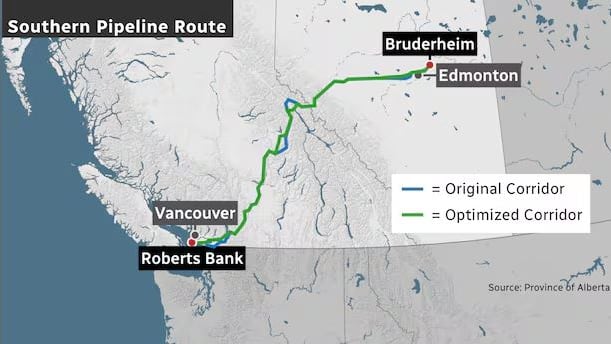 Alberta’s pipeline proposal project currently includes two main routing options, referred to as the original corridor and the optimized corridor. (Government of Alberta)
In an email to CBC News, B.C.’s Ministry of Energy and Climate Solutions said British Columbia “is not seeking a pipeline, this is Alberta’s project,” therefore, it’s not up to B.C. to consult.
“It is for [Alberta] and for the federal government to engage with First Nations on it – just as B.C. engages with First Nations on B.C. projects,” the ministry said.
“While it is not our project and there is no guarantee that a pipeline will move forward, B.C. advocated to Ottawa and secured a commitment in the agreement with Ottawa that Canada commits to engaging in consultations with First Nations if it were to impose a pipeline on B.C.”
A multibillion-dollar economic, infrastructure and environmental deal known as the Canada-British Columbia Cooperative Prosperity Agreement commits to “engaging in early, consistent and meaningful consultation with First Nations in a manner that upholds Aboriginal and Treaty rights under Section 35 of the Constitution Act 1982, while advancing economic opportunities through options for First Nations’ ownership and partnerships.”
The Alberta government said it engaged with over 100 Indigenous communities across Alberta and northern British Columbia between October 2025 and June 2026. Those early talks focused on a northern route that was ultimately abandoned to comply with the federal government’s North Coast oil tanker ban.
Following the pivot to a southern coastal path, Prime Minister Mark Carney said formal, renewed consultations would begin immediately, led by the federal Major Projects Office and its Indigenous Advisory Committee.
WATCH | Carney speaks about pipeline project: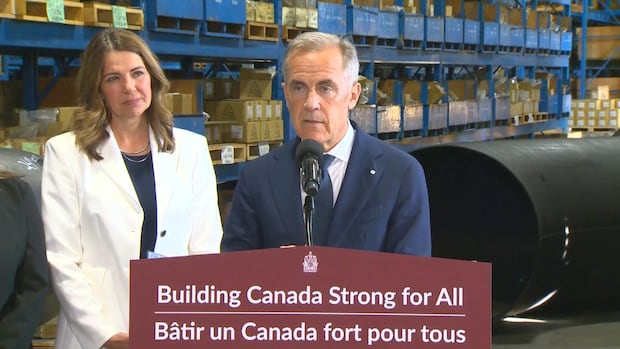
PM Carney says ‘best route for a new pipeline is one that already exists’
At an announcement with Alberta Premier Danielle Smith, Prime Minister Mark Carney said the best route for a new oil pipeline is south through the Trans Mountain corridor to the Pacific coast, “the gateway to the world’s fastest growing markets.”Meaningful consultation
Lawyer Louise Mandell, partner emeritus at Mandel Pinder law firm and lead litigator on the 2004 Haida case, says Alberta’s tally doesn’t quite meet the bar for meaningful consultation.
“This isn’t a majority rule situation,” Mandell said. “They have to engage with every nation whose interests are affected.”
She said the provincial and federal governments cannot divide the obligation to consult between them. When more than one level of government is involved, she added, both jurisdictions hold the duty until it is discharged — that is, neither can point to the other and call it done, as far as the Supreme Court of Canada is concerned.
The cost of shortcuts, she said, isn’t theoretical.
Mandell estimates courts have found the Crown fell short of its legal duty in “upwards of 200 cases” since the 2004 Haida decision, and “for the most part, Indigenous people have won those cases.”
When governments lose, approvals are invalidated, multimillion-dollar projects are halted, and they are sent back to the table to engage and negotiate in a meaningful way, she said.
As Mandell puts it, when a nation learns after the fact that decisions are moving forward without them, “you build up an adversarial process, whereas it should be collaborative” — the kind of relationship building reconciliation is supposed to represent, not undercut.
“If the Crown was going to behave properly, they’d establish the architecture for getting people’s consent, making sure everyone’s involved, and doing it in a systematic way,” she said. “If they can achieve that, they’ve got the ability and the sovereignty to go ahead and do what they need to do. But if they don’t get it … it can be challenged in court and that’s a very expensive way to delay a very expensive project.”