

 Researchers discovered that elephants avoid the sound of honeybees. This led to the development of beehive fences to protect farmlands. These fences successfully deter elephants from raiding crops at night. Image Credits: Wikimedia Commons For many years, farmers in rural areas that share land with elephants have faced repeated problems each harvest season. Huge elephants eat large amounts of crops at night. Traditional deterrents such as banging metal objects and using lights become less effective over time because elephants grow accustomed to them.According to a study published in the journal Current Biology in 2007 by researchers from the University of Oxford and Save the Elephants, wild African elephants flee when exposed to the recorded sound of disturbed honeybees. The study showed that despite their large size and thick skin, elephants react quickly to avoid the threat of bee stings.The research team conducted controlled audio experiments in Kenya to test how wild elephant herds reacted to bee sounds. Hidden loudspeakers were placed in trees where wild elephant families rested during the heat of the day.The experiment in Current Biology yielded instant results. As soon as the bee recording was played, half of the elephant herds began moving away within ten seconds. In eighty seconds, ninety-four per cent of the elephant herds had already vacated the shade of their resting trees. By contrast, most of the elephants exposed to the white-noise control remained still beneath the trees.Why do elephants avoid bee sounds?Elephants try to avoid bees because their stings can be painful. Although most of an elephant’s body is covered by thick skin, sensitive areas include the eyes, behind the ears and inside the trunk.Elephants may remember painful encounters with bees for years, and family groups learn to avoid potential threats together. During the audio experiments, researchers noted that elephants did not just run away. They also shook their heads, dusted themselves with soil, and emitted low-frequency alarm calls to warn neighbouring herds of potential danger.However, scientists concluded that relying on loudspeakers was not a practical, long-term solution for farmers. Loudspeakers require electrical power, which is rare in remote agricultural villages. Furthermore, if recordings were played repeatedly without real bees present, smart elephants would eventually learn that there was no actual danger. To apply the findings in the field, researchers introduced the idea of a live beehive fence.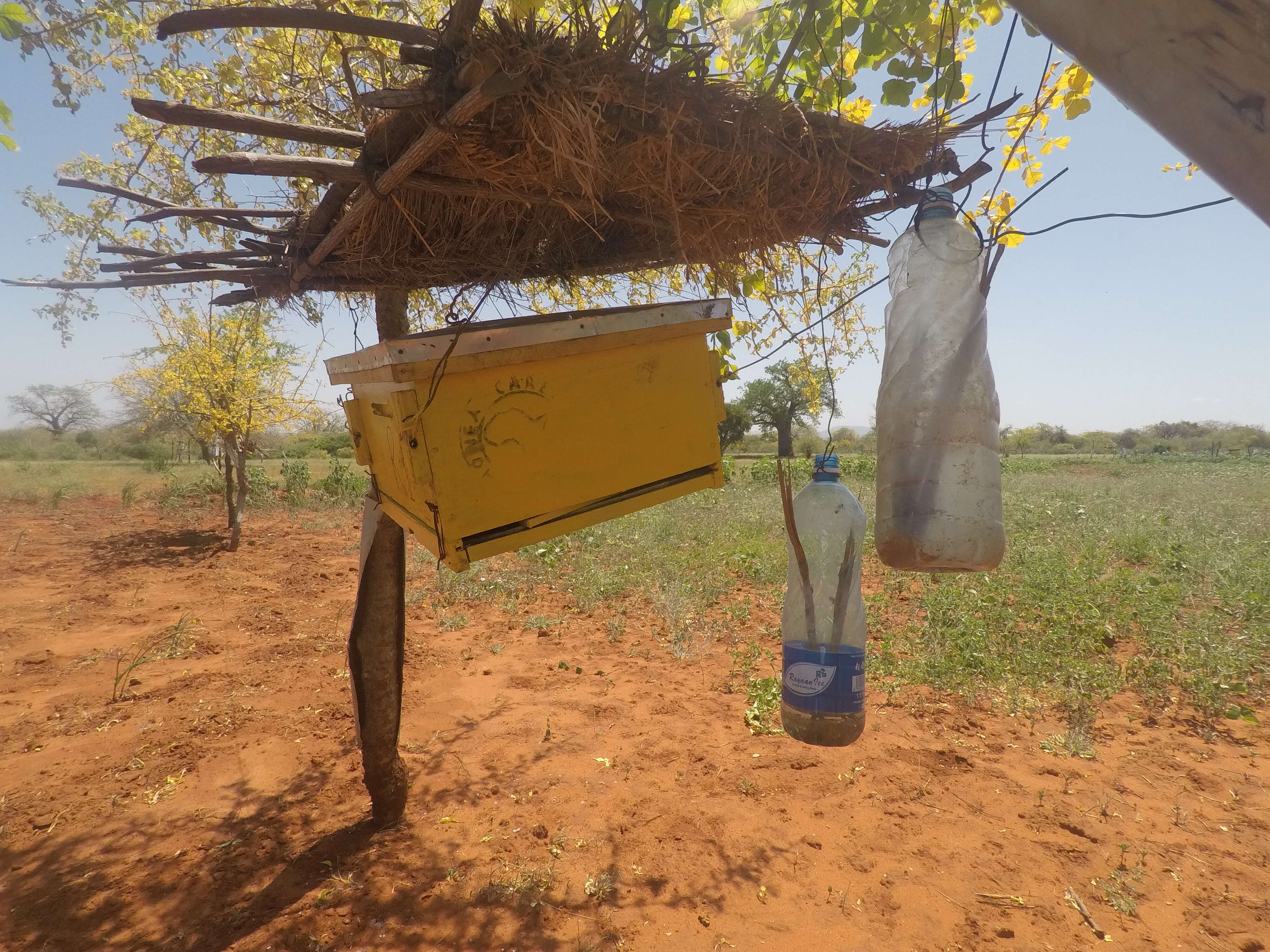
Beehive fences also offer farmers additional income from honey production. This innovative method reduces human-elephant conflict across Africa and Asia. Image Credits: Wikipedia
From laboratory audio to live beehive fences in farmlandsThe beehive fence is a simple fence system. Wooden beehives are attached to wires spaced ten meters apart along the farmland. If elephants raid the farmland at night, their bodies come into contact with the connecting wire.The movement makes the hives on either side swing back and forth, disturbing the honeybees inside. The bees emerge from their hives in response, buzzing loudly to defend their colony. The approaching herd hears the buzzing and turns away before it is stung.Beehive fences also offer other benefits to farming communities. Live beehives can help pollinate nearby crops and flowers, which may increase agricultural production. Farmers can also earn income from honey harvested from the hives.Following early audio experiments, field trials in Kenya led by Save the Elephants and researchers from the University of Oxford found that beehive fences reduced crop-raiding by elephants at the study sites, suggesting they could be a useful tool for mitigating human-elephant conflict. Today, beehive fence systems inspired by the 2007 Current Biology research are utilised in countries across Africa and Asia, supported by conservation programs from Save the Elephants. From small farms in Kenya, Tanzania, and Uganda to agricultural communities in Sri Lanka and Thailand, live bees help reduce human-elephant conflict.By working with natural animal behaviour rather than lethal methods, communities have found a way to reduce conflict with wild elephants. A simple sound from honeybees helps protect agricultural livelihoods and wild elephant herds in their natural environment.